

204
P.L. Tyack and c.w. Clark
100 Eastern Pacific (IUSS)
, , , , '
~ ,!
, ,
50
-. ..... " ,
. ,.lo,:."r. . . . ;;.:;.:
..:,'.'
-
):'
' -.::
•... "\ .'-'.. ;"'\
.' ~.:>. :.,,:' "'j 4~:: ~",~:, " ....
.- .. -
N
I
-
o
200
400
600
800
~
c: Q)
;:,
I 100 Western Atlantic (IUSS)
50
.. -,.1:
' '. I.,;",.I·~
' ,.'-i.: ;
~L··~_·,'.. ~.!"
. ,
o
200
400
Time (sec)
600
800
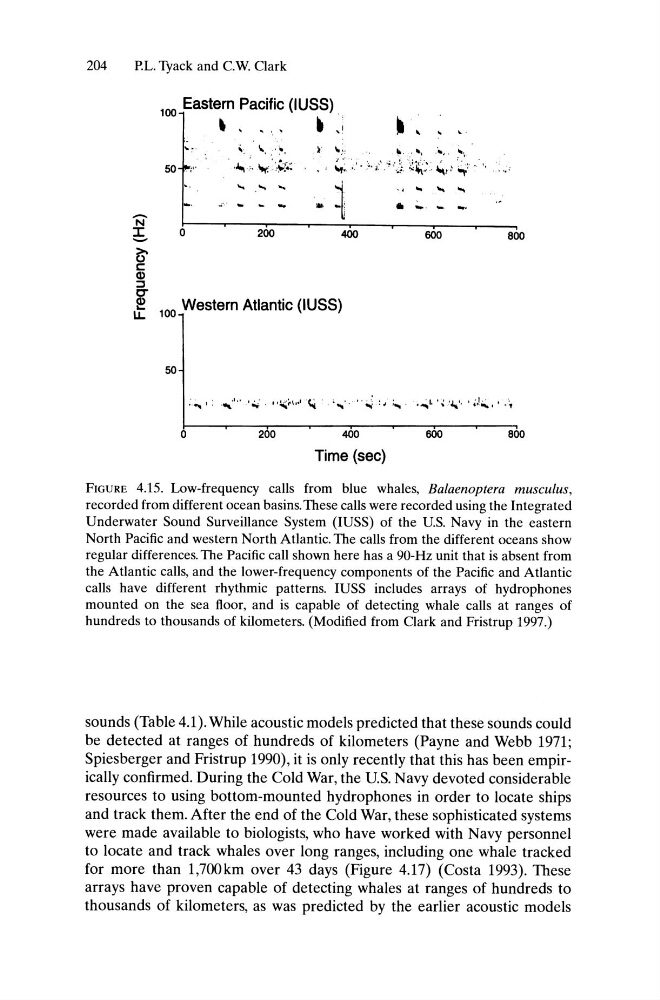
FIGURE 4.15. Low-frequency calls from blue whales, Balaenoptera musculus,
recorded from different ocean basins. These calls were recorded using the Integrated
Underwater Sound Surveillance System (IUSS) of the U.S. Navy in the eastern
North Pacific and western North Atlantic. The calls from the different oceans show
regular differences. The Pacific call shown here has a 90-Hz unit that is absent from
the Atlantic calls, and the lower-frequency components of the Pacific and Atlantic
calls have different rhythmic patterns. IUSS includes arrays of hydrophones
mounted on the sea floor, and is capable of detecting whale calls at ranges of
hundreds to thousands of kilometers. (Modified from Clark and Fristrup 1997.)
sounds (Table 4.1). While acoustic models predicted that these sounds could
be detected at ranges of hundreds of kilometers (Payne and Webb 1971;
Spiesberger and Fristrup 1990), it is only recently that this has been empirically confirmed. During the Cold War, the U.S. Navy devoted considerable
resources to using bottom-mounted hydrophones in order to locate ships
and track them. After the end of the Cold War, these sophisticated systems
were made available to biologists, who have worked with Navy personnel
to locate and track whales over long ranges, including one whale tracked
for more than 1,700km over 43 days (Figure 4.17) (Costa 1993). These
arrays have proven capable of detecting whales at ranges of hundreds to
thousands of kilometers, as was predicted by the earlier acoustic models
P.L. Tyack and c.w. Clark
100 Eastern Pacific (IUSS)
, , , , '
~ ,!
, ,
50
-. ..... " ,
. ,.lo,:."r. . . . ;;.:;.:
..:,'.'
-
):'
' -.::
•... "\ .'-'.. ;"'\
.' ~.:>. :.,,:' "'j 4~:: ~",~:, " ....
.- .. -
N
I
-
o
200
400
600
800
~
c: Q)
;:,
I 100 Western Atlantic (IUSS)
50
.. -,.1:
' '. I.,;",.I·~
' ,.'-i.: ;
~L··~_·,'.. ~.!"
. ,
o
200
400
Time (sec)
600
800
FIGURE 4.15. Low-frequency calls from blue whales, Balaenoptera musculus,
recorded from different ocean basins. These calls were recorded using the Integrated
Underwater Sound Surveillance System (IUSS) of the U.S. Navy in the eastern
North Pacific and western North Atlantic. The calls from the different oceans show
regular differences. The Pacific call shown here has a 90-Hz unit that is absent from
the Atlantic calls, and the lower-frequency components of the Pacific and Atlantic
calls have different rhythmic patterns. IUSS includes arrays of hydrophones
mounted on the sea floor, and is capable of detecting whale calls at ranges of
hundreds to thousands of kilometers. (Modified from Clark and Fristrup 1997.)
sounds (Table 4.1). While acoustic models predicted that these sounds could
be detected at ranges of hundreds of kilometers (Payne and Webb 1971;
Spiesberger and Fristrup 1990), it is only recently that this has been empirically confirmed. During the Cold War, the U.S. Navy devoted considerable
resources to using bottom-mounted hydrophones in order to locate ships
and track them. After the end of the Cold War, these sophisticated systems
were made available to biologists, who have worked with Navy personnel
to locate and track whales over long ranges, including one whale tracked
for more than 1,700km over 43 days (Figure 4.17) (Costa 1993). These
arrays have proven capable of detecting whales at ranges of hundreds to
thousands of kilometers, as was predicted by the earlier acoustic models