

6
W.W.L.Au
140 r----~--.---.--.-- ......._,....,r__--~--.---.--.-- ......._,....,r__-___,
120
"Ii
\
Q. 100
\
::1.
....
e
III
:2- 80
0
oJ
0
.
:I:
"
l/)
...
w 60
0:
:I:
' . .
...
" . .
40
Turs/ops t.
De/ph/nap.
/n/a
Phocoena
Turs/opsg.
Pseudorca
Orc/nus
Sotalla
Gntmpus
Llpotes
100
10
FREQUENCY (KHZ)
20 L -_ _-"-_-'--~~_'_..._.._<__JL_ _ __'___ _'__~._..._'_..............L_l_ ____l
1
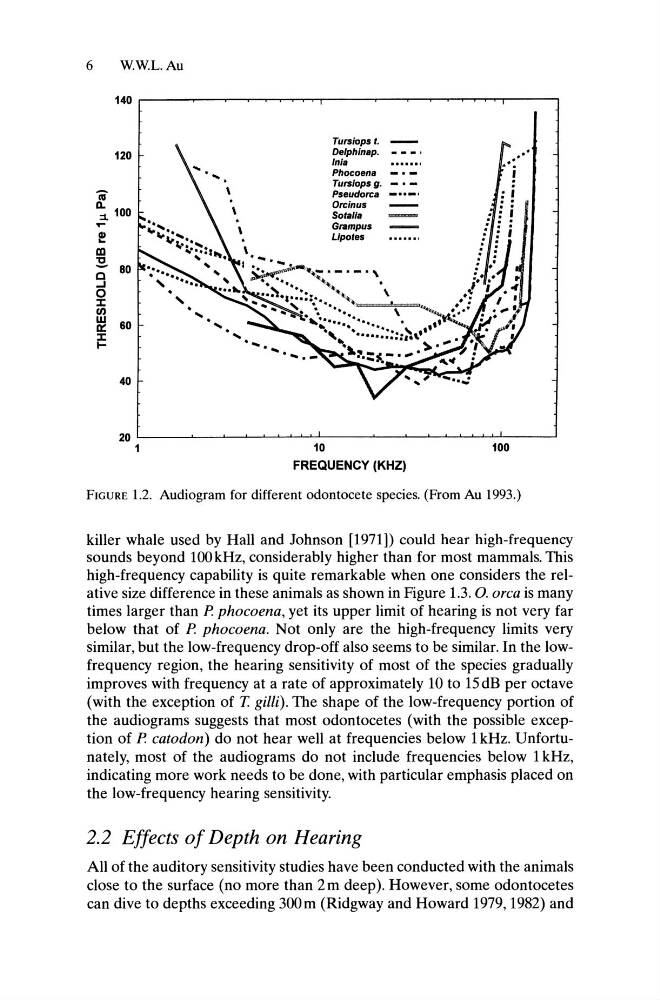
FIGURE 1.2. Audiogram for different odontocete species. (From Au 1993.)
killer whale used by Hall and Johnson [1971]) could hear high-frequency
sounds beyond 100 kHz, considerably higher than for most mammals. This
high-frequency capability is quite remarkable when one considers the relative size difference in these animals as shown in Figure 1.3. 0. orca is many
times larger than P phocoena, yet its upper limit of hearing is not very far
below that of P phocoena. Not only are the high-frequency limits very
similar, but the low-frequency drop-off also seems to be similar. In the lowfrequency region, the hearing sensitivity of most of the species gradually
improves with frequency at a rate of approximately 10 to 15 dB per octave
(with the exception of T. gilli). The shape of the low-frequency portion of
the audiograms suggests that most odontocetes (with the possible exception of P catodon) do not hear well at frequencies below 1kHz. Unfortunately, most of the audiograms do not include frequencies below 1kHz,
indicating more work needs to be done, with particular emphasis placed on
the low-frequency hearing sensitivity.
2.2 Effects of Depth on Hearing
All of the auditory sensitivity studies have been conducted with the animals
close to the surface (no more than 2m deep). However, some odontocetes
can dive to depths exceeding 300m (Ridgway and Howard 1979,1982) and
W.W.L.Au
140 r----~--.---.--.-- ......._,....,r__--~--.---.--.-- ......._,....,r__-___,
120
"Ii
\
Q. 100
\
::1.
....
e
III
:2- 80
0
oJ
0
.
:I:
"
l/)
...
w 60
0:
:I:
' . .
...
" . .
40
Turs/ops t.
De/ph/nap.
/n/a
Phocoena
Turs/opsg.
Pseudorca
Orc/nus
Sotalla
Gntmpus
Llpotes
100
10
FREQUENCY (KHZ)
20 L -_ _-"-_-'--~~_'_..._.._<__JL_ _ __'___ _'__~._..._'_..............L_l_ ____l
1
FIGURE 1.2. Audiogram for different odontocete species. (From Au 1993.)
killer whale used by Hall and Johnson [1971]) could hear high-frequency
sounds beyond 100 kHz, considerably higher than for most mammals. This
high-frequency capability is quite remarkable when one considers the relative size difference in these animals as shown in Figure 1.3. 0. orca is many
times larger than P phocoena, yet its upper limit of hearing is not very far
below that of P phocoena. Not only are the high-frequency limits very
similar, but the low-frequency drop-off also seems to be similar. In the lowfrequency region, the hearing sensitivity of most of the species gradually
improves with frequency at a rate of approximately 10 to 15 dB per octave
(with the exception of T. gilli). The shape of the low-frequency portion of
the audiograms suggests that most odontocetes (with the possible exception of P catodon) do not hear well at frequencies below 1kHz. Unfortunately, most of the audiograms do not include frequencies below 1kHz,
indicating more work needs to be done, with particular emphasis placed on
the low-frequency hearing sensitivity.
2.2 Effects of Depth on Hearing
All of the auditory sensitivity studies have been conducted with the animals
close to the surface (no more than 2m deep). However, some odontocetes
can dive to depths exceeding 300m (Ridgway and Howard 1979,1982) and