

4. Acoustic Communication in Whales and Dolphins
187
II
1/
' I
I I
~, I
I
I
I
I
II
I II
2000 j I:,Ii II ,I :I I I I r I
II : 1 i
~__. __ -,-. _ _ ----'
--'-- _ _ -L _ _ - ' - - -
4000·
8000
CI:l
.....
00
:> -1
10000
~
I
~ 6000·
0.2
0.4
0.6
0.8
Seconds
1.2
1.4
1.6
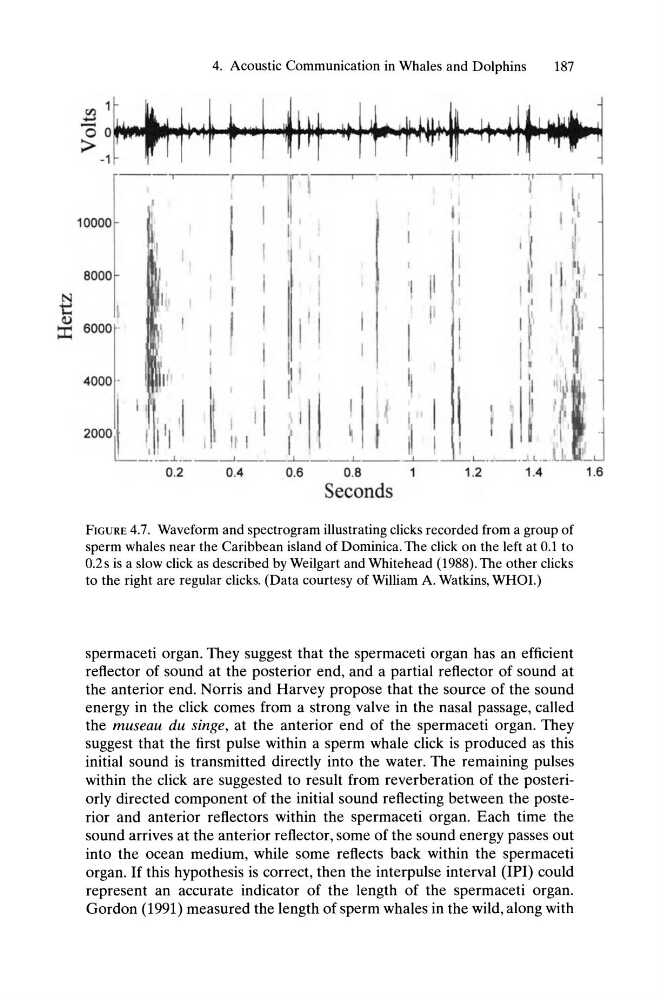
FIGURE 4.7. Waveform and spectrogram illustrating clicks recorded from a group of
sperm whales near the Caribbean island of Dominica. The click on the left at 0.1 to
0.2s is a slow click as described by Weilgart and Whitehead (1988). The other clicks
to the right are regular clicks. (Data courtesy of William A. Watkins, WHOI.)
spermaceti organ. They suggest that the spermaceti organ has an efficient
reflector of sound at the posterior end, and a partial reflector of sound at
the anterior end. Norris and Harvey propose that the source of the sound
energy in the click comes from a strong valve in the nasal passage, called
the museau du singe, at the anterior end of the spermaceti organ. They
suggest that the first pulse within a sperm whale click is produced as this
initial sound is transmitted directly into the water. The remaining pulses
within the click are suggested to result from reverberation of the posteriorly directed component of the initial sound reflecting between the posterior and anterior reflectors within the spermaceti organ. Each time the
sound arrives at the anterior reflector, some of the sound energy passes out
into the ocean medium, while some reflects back within the spermaceti
organ. If this hypothesis is correct, then the interpulse interval (IPI) could
represent an accurate indicator of the length of the spermaceti organ.
Gordon (1991) measured the length of sperm whales in the wild, along with
187
II
1/
' I
I I
~, I
I
I
I
I
II
I II
2000 j I:,Ii II ,I :I I I I r I
II : 1 i
~__. __ -,-. _ _ ----'
--'-- _ _ -L _ _ - ' - - -
4000·
8000
CI:l
.....
00
:> -1
10000
~
I
~ 6000·
0.2
0.4
0.6
0.8
Seconds
1.2
1.4
1.6
FIGURE 4.7. Waveform and spectrogram illustrating clicks recorded from a group of
sperm whales near the Caribbean island of Dominica. The click on the left at 0.1 to
0.2s is a slow click as described by Weilgart and Whitehead (1988). The other clicks
to the right are regular clicks. (Data courtesy of William A. Watkins, WHOI.)
spermaceti organ. They suggest that the spermaceti organ has an efficient
reflector of sound at the posterior end, and a partial reflector of sound at
the anterior end. Norris and Harvey propose that the source of the sound
energy in the click comes from a strong valve in the nasal passage, called
the museau du singe, at the anterior end of the spermaceti organ. They
suggest that the first pulse within a sperm whale click is produced as this
initial sound is transmitted directly into the water. The remaining pulses
within the click are suggested to result from reverberation of the posteriorly directed component of the initial sound reflecting between the posterior and anterior reflectors within the spermaceti organ. Each time the
sound arrives at the anterior reflector, some of the sound energy passes out
into the ocean medium, while some reflects back within the spermaceti
organ. If this hypothesis is correct, then the interpulse interval (IPI) could
represent an accurate indicator of the length of the spermaceti organ.
Gordon (1991) measured the length of sperm whales in the wild, along with