

4. Acoustic Communication in Whales and Dolphins
185
o
)00 JtSCC
1.9
~ 9.9
C/)
c:
Q)
9.6
U
~
1:>
9 ...
8C/)
9.2
9.B
80
160
240
320
400
frequency (kHz)
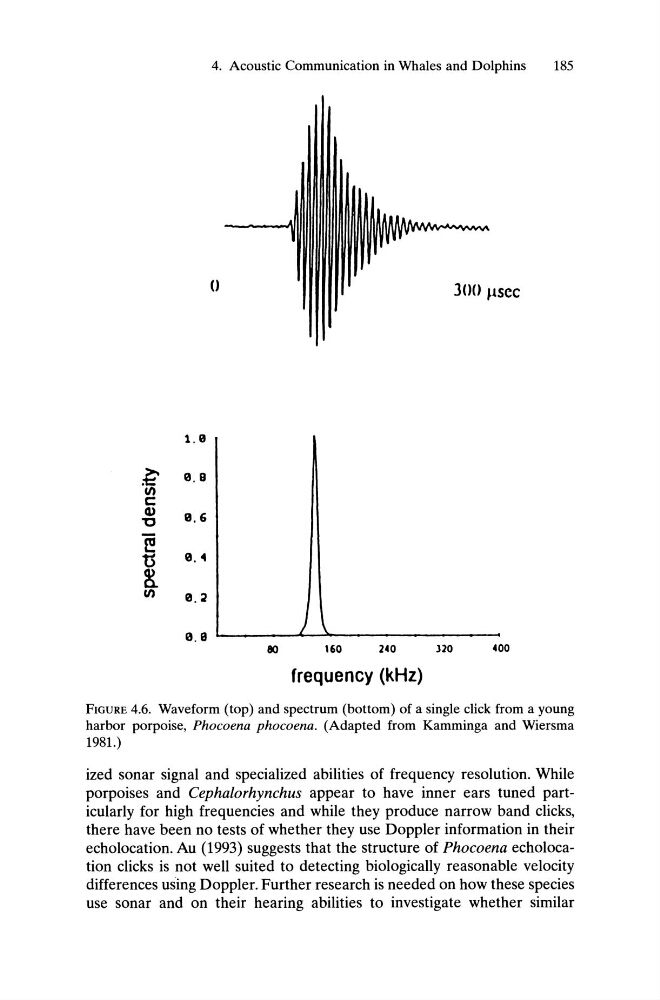
FiGURE 4.6. Waveform (top) and spectrum (bottom) of a single click from a young
harbor porpoise, Phocoena phocoena. (Adapted from Kamminga and Wiersma
1981.)
ized sonar signal and specialized abilities of frequency resolution. While
porpoises and Cephalorhynchus appear to have inner ears tuned particularly for high frequencies and while they produce narrow band clicks,
there have been no tests of whether they use Doppler information in their
echolocation. Au (1993) suggests that the structure of Phocoena echolocation clicks is not well suited to detecting biologically reasonable velocity
differences using Doppler. Further research is needed on how these species
use sonar and on their hearing abilities to investigate whether similar
185
o
)00 JtSCC
1.9
~ 9.9
C/)
c:
Q)
9.6
U
~
1:>
9 ...
8C/)
9.2
9.B
80
160
240
320
400
frequency (kHz)
FiGURE 4.6. Waveform (top) and spectrum (bottom) of a single click from a young
harbor porpoise, Phocoena phocoena. (Adapted from Kamminga and Wiersma
1981.)
ized sonar signal and specialized abilities of frequency resolution. While
porpoises and Cephalorhynchus appear to have inner ears tuned particularly for high frequencies and while they produce narrow band clicks,
there have been no tests of whether they use Doppler information in their
echolocation. Au (1993) suggests that the structure of Phocoena echolocation clicks is not well suited to detecting biologically reasonable velocity
differences using Doppler. Further research is needed on how these species
use sonar and on their hearing abilities to investigate whether similar