

178
PL. Tyack and c.w. Clark
SPl • nBS dB
150l1SCC
'0.117.2 ktlr
BW· 31.1kH'
100
frequency (kHz)
o ~C::;::~.......~r---r~'---'~-T""-"-=t'-.,
o
5
1.0
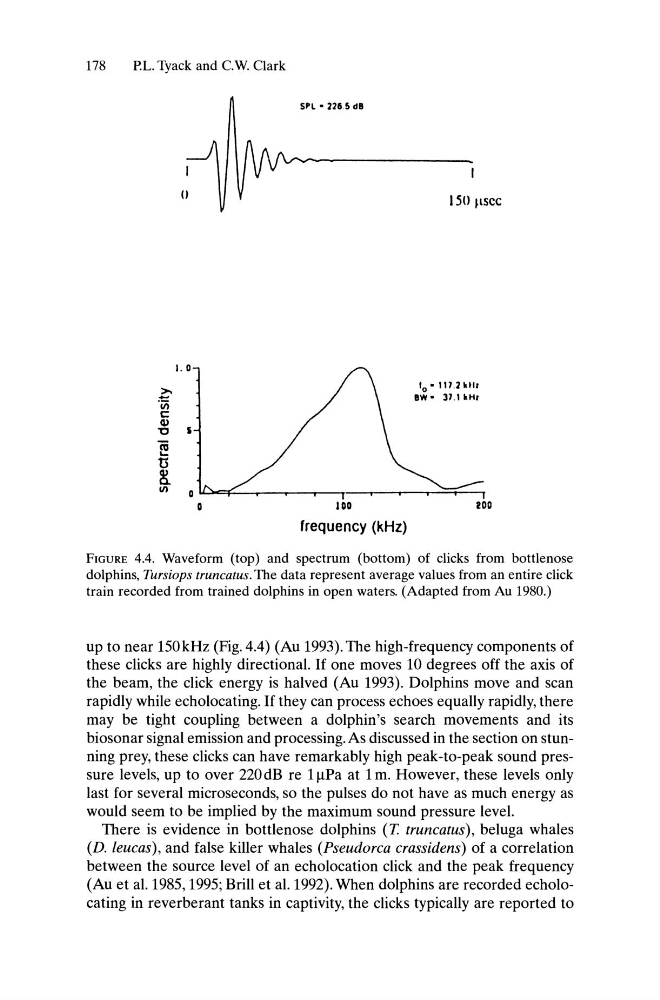
FIGURE 4.4. Waveform (top) and spectrum (bottom) of clicks from bottlenose
dolphins, Tursiops truncatus. The data represent average values from an entire click
train recorded from trained dolphins in open waters. (Adapted from Au 1980.)
up to near 150kHz (Fig. 4.4) (Au 1993). The high-frequency components of
these clicks are highly directional. If one moves 10 degrees off the axis of
the beam, the click energy is halved (Au 1993). Dolphins move and scan
rapidly while echolocating. If they can process echoes equally rapidly, there
may be tight coupling between a dolphin's search movements and its
biosonar signal emission and processing. As discussed in the section on stunning prey, these clicks can have remarkably high peak-to-peak sound pressure levels, up to over 220dB re 1flPa at 1 m. However, these levels only
last for several microseconds, so the pulses do not have as much energy as
would seem to be implied by the maximum sound pressure level.
There is evidence in bottlenose dolphins (T. truncatus), beluga whales
(D. leucas), and false killer whales (Pseudorca crassidens) of a correlation
between the source level of an echolocation click and the peak frequency
(Au et al. 1985, 1995; Brill et al. 1992). When dolphins are recorded echoloeating in reverberant tanks in captivity, the clicks typically are reported to
PL. Tyack and c.w. Clark
SPl • nBS dB
150l1SCC
'0.117.2 ktlr
BW· 31.1kH'
100
frequency (kHz)
o ~C::;::~.......~r---r~'---'~-T""-"-=t'-.,
o
5
1.0
FIGURE 4.4. Waveform (top) and spectrum (bottom) of clicks from bottlenose
dolphins, Tursiops truncatus. The data represent average values from an entire click
train recorded from trained dolphins in open waters. (Adapted from Au 1980.)
up to near 150kHz (Fig. 4.4) (Au 1993). The high-frequency components of
these clicks are highly directional. If one moves 10 degrees off the axis of
the beam, the click energy is halved (Au 1993). Dolphins move and scan
rapidly while echolocating. If they can process echoes equally rapidly, there
may be tight coupling between a dolphin's search movements and its
biosonar signal emission and processing. As discussed in the section on stunning prey, these clicks can have remarkably high peak-to-peak sound pressure levels, up to over 220dB re 1flPa at 1 m. However, these levels only
last for several microseconds, so the pulses do not have as much energy as
would seem to be implied by the maximum sound pressure level.
There is evidence in bottlenose dolphins (T. truncatus), beluga whales
(D. leucas), and false killer whales (Pseudorca crassidens) of a correlation
between the source level of an echolocation click and the peak frequency
(Au et al. 1985, 1995; Brill et al. 1992). When dolphins are recorded echoloeating in reverberant tanks in captivity, the clicks typically are reported to