

168
P.L. Tyack and c.w. Clark
100
Firsl resonance
10
::Gas filled sphere
..
l<
}
1
- ~ .ll 0.28209
'4
-
-
-
0.1
Higher order resonances
Rigid sphere
10
0.1
lea
0.01
0.01
......._
0.001
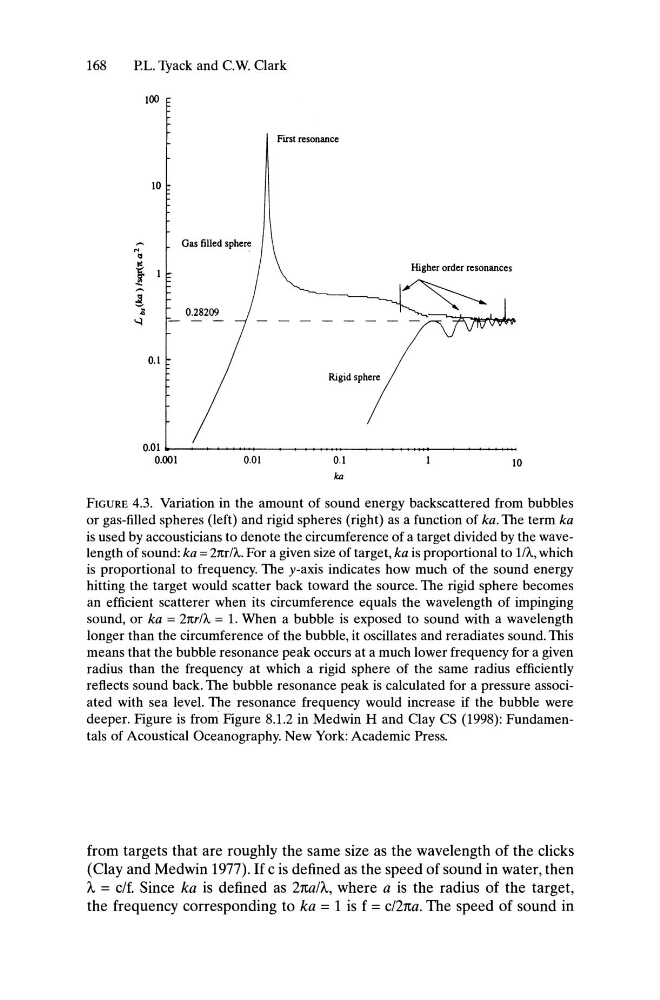
FIGURE 4.3. Variation in the amount of sound energy backscattered from bubbles
or gas-filled spheres (left) and rigid spheres (right) as a function of ka. The term ka
is used by accousticians to denote the circumference of a target divided by the wavelength of sound: ka = 2m/A. For a given size of target, ka is proportional to l/A, which
is proportional to frequency. The y-axis indicates how much of the sound energy
hitting the target would scatter back toward the source. The rigid sphere becomes
an efficient scatterer when its circumference equals the wavelength of impinging
sound, or ka = 2rr.r/A = 1. When a bubble is exposed to sound with a wavelength
longer than the circumference of the bubble, it oscillates and reradiates sound. This
means that the bubble resonance peak occurs at a much lower frequency for a given
radius than the frequency at which a rigid sphere of the same radius efficiently
reflects sound back. The bubble resonance peak is calculated for a pressure associated with sea level. The resonance frequency would increase if the bubble were
deeper. Figure is from Figure 8.1.2 in Medwin H and Clay CS (1998): Fundamentals of Acoustical Oceanography. New York: Academic Press.
from targets that are roughly the same size as the wavelength of the clicks
(Clay and Medwin 1977). If c is defined as the speed of sound in water, then
A = c/f. Since ka is defined as 2na/A, where a is the radius of the target,
the frequency corresponding to ka = 1 is f = c/2na. The speed of sound in
P.L. Tyack and c.w. Clark
100
Firsl resonance
10
::Gas filled sphere
..
l<
}
1
- ~ .ll 0.28209
'4
-
-
-
0.1
Higher order resonances
Rigid sphere
10
0.1
lea
0.01
0.01
......._
0.001
FIGURE 4.3. Variation in the amount of sound energy backscattered from bubbles
or gas-filled spheres (left) and rigid spheres (right) as a function of ka. The term ka
is used by accousticians to denote the circumference of a target divided by the wavelength of sound: ka = 2m/A. For a given size of target, ka is proportional to l/A, which
is proportional to frequency. The y-axis indicates how much of the sound energy
hitting the target would scatter back toward the source. The rigid sphere becomes
an efficient scatterer when its circumference equals the wavelength of impinging
sound, or ka = 2rr.r/A = 1. When a bubble is exposed to sound with a wavelength
longer than the circumference of the bubble, it oscillates and reradiates sound. This
means that the bubble resonance peak occurs at a much lower frequency for a given
radius than the frequency at which a rigid sphere of the same radius efficiently
reflects sound back. The bubble resonance peak is calculated for a pressure associated with sea level. The resonance frequency would increase if the bubble were
deeper. Figure is from Figure 8.1.2 in Medwin H and Clay CS (1998): Fundamentals of Acoustical Oceanography. New York: Academic Press.
from targets that are roughly the same size as the wavelength of the clicks
(Clay and Medwin 1977). If c is defined as the speed of sound in water, then
A = c/f. Since ka is defined as 2na/A, where a is the radius of the target,
the frequency corresponding to ka = 1 is f = c/2na. The speed of sound in