

4. Acoustic Communication in Whales and Dolphins
161
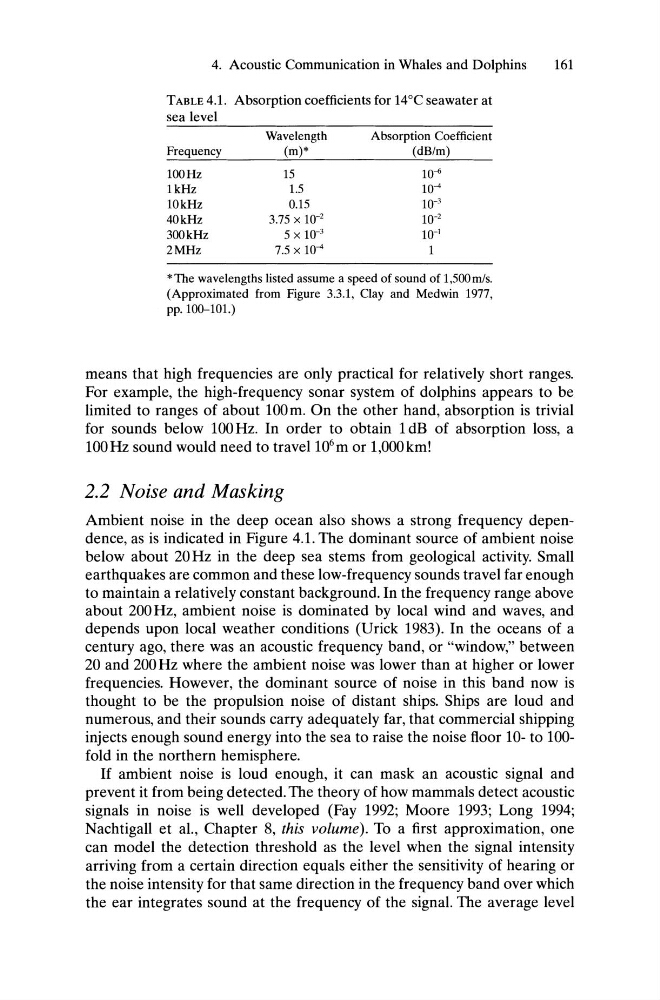
TABLE 4.1. Absorption coefficients for 14°C seawater at
sea level
Frequency
100Hz
1kHz
10kHz
40kHz
300kHz
2MHz
Wavelength
(m)*
15
1.5
0.15
3.75 x 10²
5 X 10- 3
7.5 X 10⁻⁴
Absorption Coefficient
(dB/m)
10-6
10-4
10- 3
10- 2
10- 1
1
*The wavelengths listed assume a speed of sound of 1,5OOm/s.
(Approximated from Figure 3.3.1, Clay and Medwin 1977,
pp.IOO-I01.)
means that high frequencies are only practical for relatively short ranges.
For example, the high-frequency sonar system of dolphins appears to be
limited to ranges of about 100m. On the other hand, absorption is trivial
for sounds below 100 Hz. In order to obtain 1dB of absorption loss, a
100Hz sound would need to travel 10
6
m or 1,000km!
2.2 Noise and Masking
Ambient noise in the deep ocean also shows a strong frequency dependence, as is indicated in Figure 4.1. The dominant source of ambient noise
below about 20 Hz in the deep sea stems from geological activity. Small
earthquakes are common and these low-frequency sounds travel far enough
to maintain a relatively constant background. In the frequency range above
about 200 Hz, ambient noise is dominated by local wind and waves, and
depends upon local weather conditions (Urick 1983). In the oceans of a
century ago, there was an acoustic frequency band, or "window," between
20 and 200 Hz where the ambient noise was lower than at higher or lower
frequencies. However, the dominant source of noise in this band now is
thought to be the propulsion noise of distant ships. Ships are loud and
numerous, and their sounds carry adequately far, that commercial shipping
injects enough sound energy into the sea to raise the noise floor 10- to 100fold in the northern hemisphere.
If ambient noise is loud enough, it can mask an acoustic signal and
prevent it from being detected. The theory of how mammals detect acoustic
signals in noise is well developed (Fay 1992; Moore 1993; Long 1994;
Nachtigall et aI., Chapter 8, this volume). To a first approximation, one
can model the detection threshold as the level when the signal intensity
arriving from a certain direction equals either the sensitivity of hearing or
the noise intensity for that same direction in the frequency band over which
the ear integrates sound at the frequency of the signal. The average level
161
TABLE 4.1. Absorption coefficients for 14°C seawater at
sea level
Frequency
100Hz
1kHz
10kHz
40kHz
300kHz
2MHz
Wavelength
(m)*
15
1.5
0.15
3.75 x 10²
5 X 10- 3
7.5 X 10⁻⁴
Absorption Coefficient
(dB/m)
10-6
10-4
10- 3
10- 2
10- 1
1
*The wavelengths listed assume a speed of sound of 1,5OOm/s.
(Approximated from Figure 3.3.1, Clay and Medwin 1977,
pp.IOO-I01.)
means that high frequencies are only practical for relatively short ranges.
For example, the high-frequency sonar system of dolphins appears to be
limited to ranges of about 100m. On the other hand, absorption is trivial
for sounds below 100 Hz. In order to obtain 1dB of absorption loss, a
100Hz sound would need to travel 10
6
m or 1,000km!
2.2 Noise and Masking
Ambient noise in the deep ocean also shows a strong frequency dependence, as is indicated in Figure 4.1. The dominant source of ambient noise
below about 20 Hz in the deep sea stems from geological activity. Small
earthquakes are common and these low-frequency sounds travel far enough
to maintain a relatively constant background. In the frequency range above
about 200 Hz, ambient noise is dominated by local wind and waves, and
depends upon local weather conditions (Urick 1983). In the oceans of a
century ago, there was an acoustic frequency band, or "window," between
20 and 200 Hz where the ambient noise was lower than at higher or lower
frequencies. However, the dominant source of noise in this band now is
thought to be the propulsion noise of distant ships. Ships are loud and
numerous, and their sounds carry adequately far, that commercial shipping
injects enough sound energy into the sea to raise the noise floor 10- to 100fold in the northern hemisphere.
If ambient noise is loud enough, it can mask an acoustic signal and
prevent it from being detected. The theory of how mammals detect acoustic
signals in noise is well developed (Fay 1992; Moore 1993; Long 1994;
Nachtigall et aI., Chapter 8, this volume). To a first approximation, one
can model the detection threshold as the level when the signal intensity
arriving from a certain direction equals either the sensitivity of hearing or
the noise intensity for that same direction in the frequency band over which
the ear integrates sound at the frequency of the signal. The average level