

3. Impulse Sound Sources
127
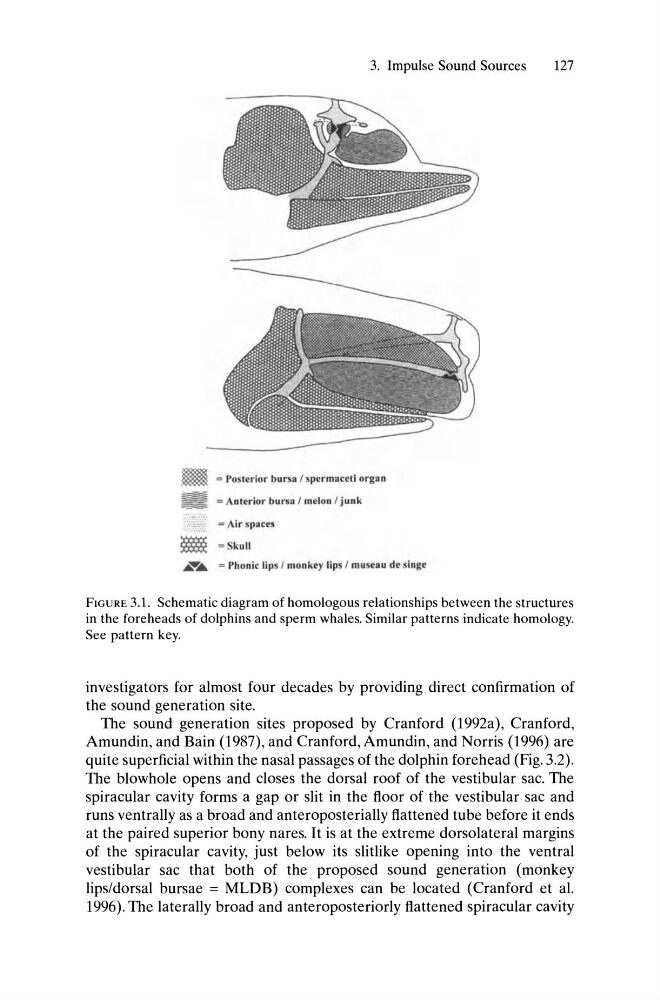
~ = Posterior bursa I spermaceti organ
~ ---..= = Anterior bursa I melon I junk
- -
= Air spaces
~ =Skull
......... = Phonic lips I monkey lips I museau de singe
FIGURE 3.1. Schematic diagram of homologous relationships between the structures
in the foreheads of dolphins and sperm whales. Similar patterns indicate homology.
See pattern key.
investigators for almost four decades by providing direct confirmation of
the sound generation site.
The sound generation sites proposed by Cranford (1992a), Cranford,
Amundin, and Bain (1987), and Cranford, Amundin, and Norris (1996) are
quite superficial within the nasal passages of the dolphin forehead (Fig. 3.2).
The blowhole opens and closes the dorsal roof of the vestibular sac. The
spiracular cavity forms a gap or slit in the floor of the vestibular sac and
runs ventrally as a broad and anteroposterially flattened tube before it ends
at the paired superior bony nares. It is at the extreme dorsolateral margins
of the spiracular cavity, just below its slitlike opening into the ventral
vestibular sac that both of the proposed sound generation (monkey
lips/dorsal bursae = MLDB) complexes can be located (Cranford et al.
1996). The laterally broad and anteroposteriorly flattened spiracular cavity
127
~ = Posterior bursa I spermaceti organ
~ ---..= = Anterior bursa I melon I junk
- -
= Air spaces
~ =Skull
......... = Phonic lips I monkey lips I museau de singe
FIGURE 3.1. Schematic diagram of homologous relationships between the structures
in the foreheads of dolphins and sperm whales. Similar patterns indicate homology.
See pattern key.
investigators for almost four decades by providing direct confirmation of
the sound generation site.
The sound generation sites proposed by Cranford (1992a), Cranford,
Amundin, and Bain (1987), and Cranford, Amundin, and Norris (1996) are
quite superficial within the nasal passages of the dolphin forehead (Fig. 3.2).
The blowhole opens and closes the dorsal roof of the vestibular sac. The
spiracular cavity forms a gap or slit in the floor of the vestibular sac and
runs ventrally as a broad and anteroposterially flattened tube before it ends
at the paired superior bony nares. It is at the extreme dorsolateral margins
of the spiracular cavity, just below its slitlike opening into the ventral
vestibular sac that both of the proposed sound generation (monkey
lips/dorsal bursae = MLDB) complexes can be located (Cranford et al.
1996). The laterally broad and anteroposteriorly flattened spiracular cavity