

86
b
a
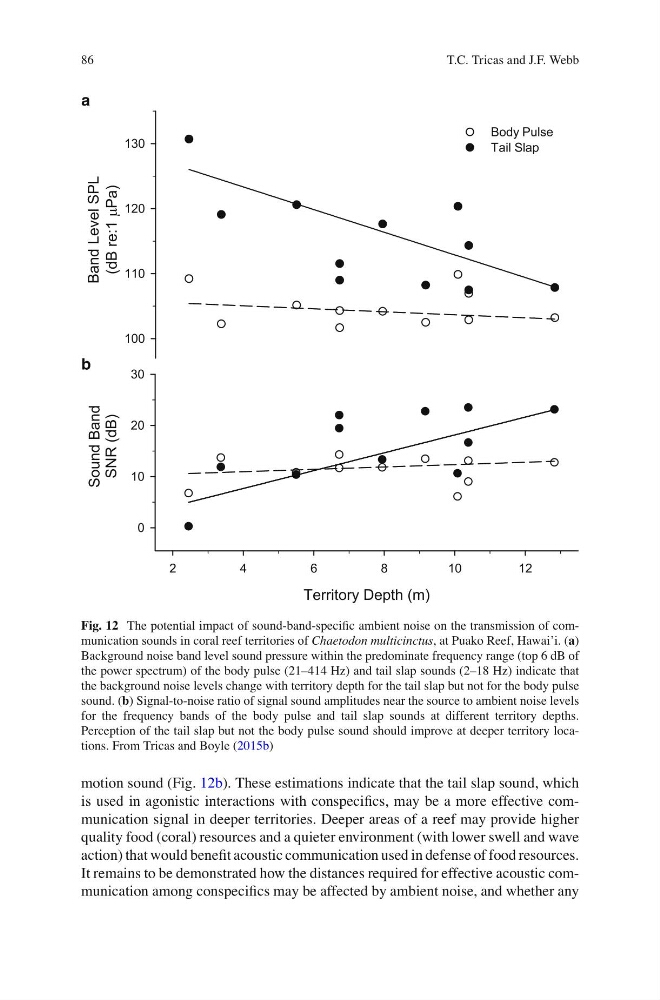
Fig. 12 The potential impact of sound-band-specifi c ambient noise on the transmission of communication sounds in coral reef territories of Chaetodon multicinctus , at Puako Reef, Hawai’i. ( a )
Background noise band level sound pressure within the predominate frequency range (top 6 dB of
the power spectrum) of the body pulse (21–414 Hz) and tail slap sounds (2–18 Hz) indicate that
the background noise levels change with territory depth for the tail slap but not for the body pulse
sound. ( b ) Signal-to-noise ratio of signal sound amplitudes near the source to ambient noise levels
for the frequency bands of the body pulse and tail slap sounds at different territory depths.
Perception of the tail slap but not the body pulse sound should improve at deeper territory locations. From Tricas and Boyle ( 2015b )
motion sound (Fig. 12b ). These estimations indicate that the tail slap sound, which
is used in agonistic interactions with conspecifi cs, may be a more effective communication signal in deeper territories. Deeper areas of a reef may provide higher
quality food (coral) resources and a quieter environment (with lower swell and wave
action) that would benefi t acoustic communication used in defense of food resources.
It remains to be demonstrated how the distances required for effective acoustic communication among conspecifi cs may be affected by ambient noise, and whether any
T.C. Tricas and J.F. Webb
b
a
Fig. 12 The potential impact of sound-band-specifi c ambient noise on the transmission of communication sounds in coral reef territories of Chaetodon multicinctus , at Puako Reef, Hawai’i. ( a )
Background noise band level sound pressure within the predominate frequency range (top 6 dB of
the power spectrum) of the body pulse (21–414 Hz) and tail slap sounds (2–18 Hz) indicate that
the background noise levels change with territory depth for the tail slap but not for the body pulse
sound. ( b ) Signal-to-noise ratio of signal sound amplitudes near the source to ambient noise levels
for the frequency bands of the body pulse and tail slap sounds at different territory depths.
Perception of the tail slap but not the body pulse sound should improve at deeper territory locations. From Tricas and Boyle ( 2015b )
motion sound (Fig. 12b ). These estimations indicate that the tail slap sound, which
is used in agonistic interactions with conspecifi cs, may be a more effective communication signal in deeper territories. Deeper areas of a reef may provide higher
quality food (coral) resources and a quieter environment (with lower swell and wave
action) that would benefi t acoustic communication used in defense of food resources.
It remains to be demonstrated how the distances required for effective acoustic communication among conspecifi cs may be affected by ambient noise, and whether any
T.C. Tricas and J.F. Webb