

72
15 ms
> 100 Hz
< 30 Hz
C. multicinctus
C. ornatissimus
Tail slap
Body motion
Body shake
Body motion pulse train
Body motion
100 ms
100 ms
200 ms
Tail slap
500 ms
500 ms
10 100 1000
1
0
1.0
.5
10 100 1000
1
0
1.0
.5
Frequency (Hz)
Rel. Amp.
Rel. Amp.
10
100 1000
1
0
1.0
.5
Rel. Amp.
10
100 1000
1
0
1.0
.5
Rel. Amp.
Frequency (Hz)
10
100 1000
1
0
1.0
.5
Rel. Amp.
10
100 1000
1
0
1.0
.5
Rel. Amp.
Frequency (Hz)
a
b
c
d
e
100 ms
Forcipiger flavissimus
Anal fin retract
Head bob
20 ms
10 100 1000
1
0
1.0
.5
Rel. Amp.
Frequency (Hz)
10 100 1000
1
0
1.0
.5
Rel. Amp.
Frequency (Hz)
C. auriga
Head bob - Jaw protrusion
100 ms
10
100 1000
1
0
1.0
.5
Rel. Amp.
Frequency (Hz)
f
C. unimaculatus
C. kleinii
Jaw protrusion
Tail slap
Head bob - Jaw protrusion
200 ms
300 ms
5 ms
10 100 1000
1
0
1.0
.5
Frequency (Hz)
Rel. Amp.
10 100 1000
1
0
1.0
.5
Rel. Amp.
Frequency (Hz)
10 100 1000
1
0
1.0
.5
Rel. Amp.
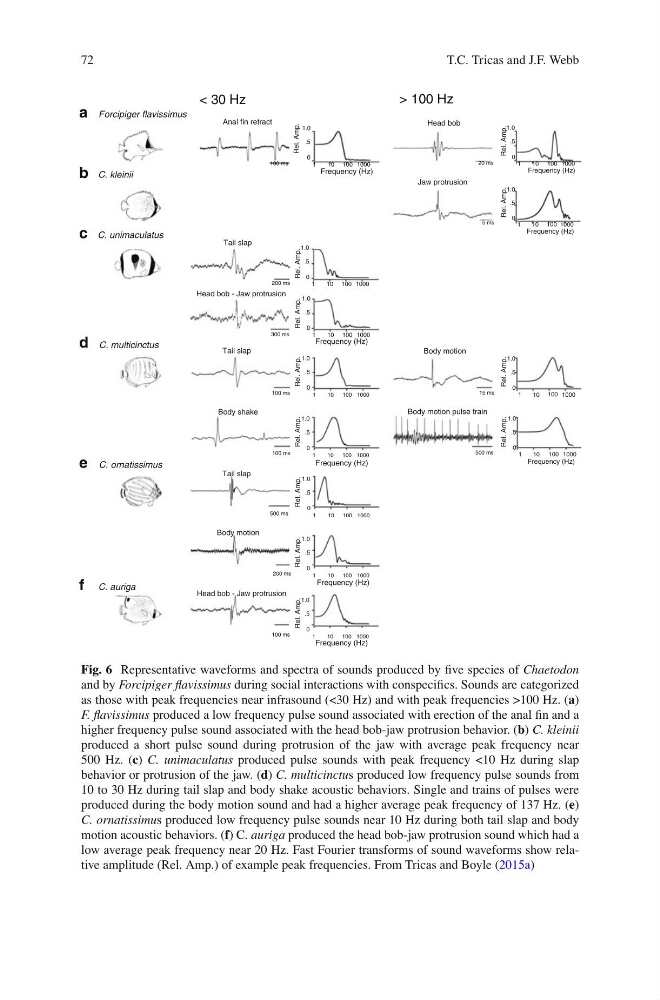
Fig. 6 Representative waveforms and spectra of sounds produced by fi ve species of Chaetodon
and by Forcipiger fl avissimus during social interactions with conspecifi cs. Sounds are categorized
as those with peak frequencies near infrasound (<30 Hz) and with peak frequencies >100 Hz. ( a )
F. fl avissimus produced a low frequency pulse sound associated with erection of the anal fi n and a
higher frequency pulse sound associated with the head bob-jaw protrusion behavior. ( b ) C. kleinii
produced a short pulse sound during protrusion of the jaw with average peak frequency near
500 Hz. ( c ) C. unimaculatus produced pulse sounds with peak frequency <10 Hz during slap
behavior or protrusion of the jaw. ( d ) C. multicinctu s produced low frequency pulse sounds from
10 to 30 Hz during tail slap and body shake acoustic behaviors. Single and trains of pulses were
produced during the body motion sound and had a higher average peak frequency of 137 Hz. ( e )
C. ornatissimu s produced low frequency pulse sounds near 10 Hz during both tail slap and body
motion acoustic behaviors. ( f ) C. auriga produced the head bob-jaw protrusion sound which had a
low average peak frequency near 20 Hz. Fast Fourier transforms of sound waveforms show relative amplitude (Rel. Amp.) of example peak frequencies. From Tricas and Boyle ( 2015a )
T.C. Tricas and J.F. Webb
15 ms
> 100 Hz
< 30 Hz
C. multicinctus
C. ornatissimus
Tail slap
Body motion
Body shake
Body motion pulse train
Body motion
100 ms
100 ms
200 ms
Tail slap
500 ms
500 ms
10 100 1000
1
0
1.0
.5
10 100 1000
1
0
1.0
.5
Frequency (Hz)
Rel. Amp.
Rel. Amp.
10
100 1000
1
0
1.0
.5
Rel. Amp.
10
100 1000
1
0
1.0
.5
Rel. Amp.
Frequency (Hz)
10
100 1000
1
0
1.0
.5
Rel. Amp.
10
100 1000
1
0
1.0
.5
Rel. Amp.
Frequency (Hz)
a
b
c
d
e
100 ms
Forcipiger flavissimus
Anal fin retract
Head bob
20 ms
10 100 1000
1
0
1.0
.5
Rel. Amp.
Frequency (Hz)
10 100 1000
1
0
1.0
.5
Rel. Amp.
Frequency (Hz)
C. auriga
Head bob - Jaw protrusion
100 ms
10
100 1000
1
0
1.0
.5
Rel. Amp.
Frequency (Hz)
f
C. unimaculatus
C. kleinii
Jaw protrusion
Tail slap
Head bob - Jaw protrusion
200 ms
300 ms
5 ms
10 100 1000
1
0
1.0
.5
Frequency (Hz)
Rel. Amp.
10 100 1000
1
0
1.0
.5
Rel. Amp.
Frequency (Hz)
10 100 1000
1
0
1.0
.5
Rel. Amp.
Fig. 6 Representative waveforms and spectra of sounds produced by fi ve species of Chaetodon
and by Forcipiger fl avissimus during social interactions with conspecifi cs. Sounds are categorized
as those with peak frequencies near infrasound (<30 Hz) and with peak frequencies >100 Hz. ( a )
F. fl avissimus produced a low frequency pulse sound associated with erection of the anal fi n and a
higher frequency pulse sound associated with the head bob-jaw protrusion behavior. ( b ) C. kleinii
produced a short pulse sound during protrusion of the jaw with average peak frequency near
500 Hz. ( c ) C. unimaculatus produced pulse sounds with peak frequency <10 Hz during slap
behavior or protrusion of the jaw. ( d ) C. multicinctu s produced low frequency pulse sounds from
10 to 30 Hz during tail slap and body shake acoustic behaviors. Single and trains of pulses were
produced during the body motion sound and had a higher average peak frequency of 137 Hz. ( e )
C. ornatissimu s produced low frequency pulse sounds near 10 Hz during both tail slap and body
motion acoustic behaviors. ( f ) C. auriga produced the head bob-jaw protrusion sound which had a
low average peak frequency near 20 Hz. Fast Fourier transforms of sound waveforms show relative amplitude (Rel. Amp.) of example peak frequencies. From Tricas and Boyle ( 2015a )
T.C. Tricas and J.F. Webb