

67
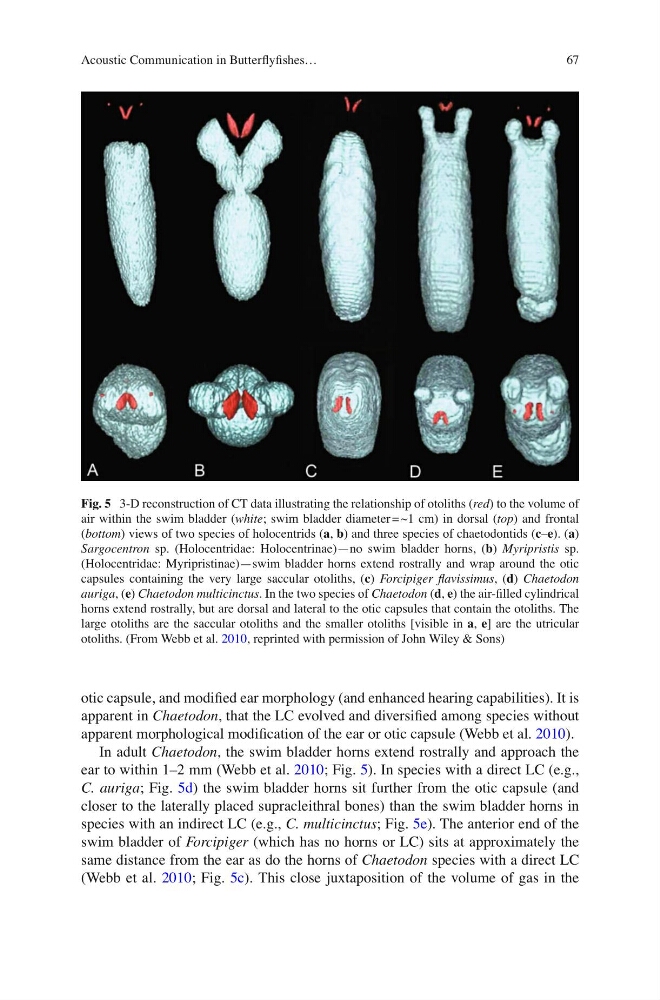
Fig. 5 3-D reconstruction of CT data illustrating the relationship of otoliths ( red ) to the volume of
air within the swim bladder ( white ; swim bladder diameter = ~1 cm) in dorsal ( top ) and frontal
( bottom ) views of two species of holocentrids ( a , b ) and three species of chaetodontids ( c – e ). ( a )
Sargocentron sp. (Holocentridae: Holocentrinae)—no swim bladder horns, ( b ) Myripristis sp.
(Holocentridae: Myripristinae)—swim bladder horns extend rostrally and wrap around the otic
capsules containing the very large saccular otoliths, ( c ) Forcipiger fl avissimus , ( d ) Chaetodon
auriga , ( e ) Chaetodon multicinctus . In the two species of Chaetodon ( d , e ) the air-fi lled cylindrical
horns extend rostrally, but are dorsal and lateral to the otic capsules that contain the otoliths. The
large otoliths are the saccular otoliths and the smaller otoliths [visible in a , e ] are the utricular
otoliths. (From Webb et al. 2010 , reprinted with permission of John Wiley & Sons)
otic capsule, and modifi ed ear morphology (and enhanced hearing capabilities). It is
apparent in Chaetodon , that the LC evolved and diversifi ed among species without
apparent morphological modifi cation of the ear or otic capsule (Webb et al. 2010 ).
In adult Chaetodon, the swim bladder horns extend rostrally and approach the
ear to within 1–2 mm (Webb et al. 2010 ; Fig. 5 ). In species with a direct LC (e.g.,
C. auriga ; Fig. 5d ) the swim bladder horns sit further from the otic capsule (and
closer to the laterally placed supracleithral bones) than the swim bladder horns in
species with an indirect LC (e.g., C. multicinctus ; Fig. 5e ). The anterior end of the
swim bladder of Forcipiger (which has no horns or LC) sits at approximately the
same distance from the ear as do the horns of Chaetodon species with a direct LC
(Webb et al. 2010 ; Fig. 5c ). This close juxtaposition of the volume of gas in the
Acoustic Communication in Butterfl yfi shes…
Fig. 5 3-D reconstruction of CT data illustrating the relationship of otoliths ( red ) to the volume of
air within the swim bladder ( white ; swim bladder diameter = ~1 cm) in dorsal ( top ) and frontal
( bottom ) views of two species of holocentrids ( a , b ) and three species of chaetodontids ( c – e ). ( a )
Sargocentron sp. (Holocentridae: Holocentrinae)—no swim bladder horns, ( b ) Myripristis sp.
(Holocentridae: Myripristinae)—swim bladder horns extend rostrally and wrap around the otic
capsules containing the very large saccular otoliths, ( c ) Forcipiger fl avissimus , ( d ) Chaetodon
auriga , ( e ) Chaetodon multicinctus . In the two species of Chaetodon ( d , e ) the air-fi lled cylindrical
horns extend rostrally, but are dorsal and lateral to the otic capsules that contain the otoliths. The
large otoliths are the saccular otoliths and the smaller otoliths [visible in a , e ] are the utricular
otoliths. (From Webb et al. 2010 , reprinted with permission of John Wiley & Sons)
otic capsule, and modifi ed ear morphology (and enhanced hearing capabilities). It is
apparent in Chaetodon , that the LC evolved and diversifi ed among species without
apparent morphological modifi cation of the ear or otic capsule (Webb et al. 2010 ).
In adult Chaetodon, the swim bladder horns extend rostrally and approach the
ear to within 1–2 mm (Webb et al. 2010 ; Fig. 5 ). In species with a direct LC (e.g.,
C. auriga ; Fig. 5d ) the swim bladder horns sit further from the otic capsule (and
closer to the laterally placed supracleithral bones) than the swim bladder horns in
species with an indirect LC (e.g., C. multicinctus ; Fig. 5e ). The anterior end of the
swim bladder of Forcipiger (which has no horns or LC) sits at approximately the
same distance from the ear as do the horns of Chaetodon species with a direct LC
(Webb et al. 2010 ; Fig. 5c ). This close juxtaposition of the volume of gas in the
Acoustic Communication in Butterfl yfi shes…