

59
overlap the frequency range for both hearing and sound production and may
present a challenge for the extraction of biologically relevant acoustic information.
In this chapter we review the comparative anatomy of the laterophysic connection
(in Chaetodon species), ear, and swim bladder, which may all be involved in the
reception of acoustic fi eld stimuli (Sect. 2 ). We review the current (but still limited)
knowledge of the diversity of butterfl yfi sh sounds and sound production mechanisms, and examine the evolution of their acoustic behaviors (Sect. 3 ). We describe
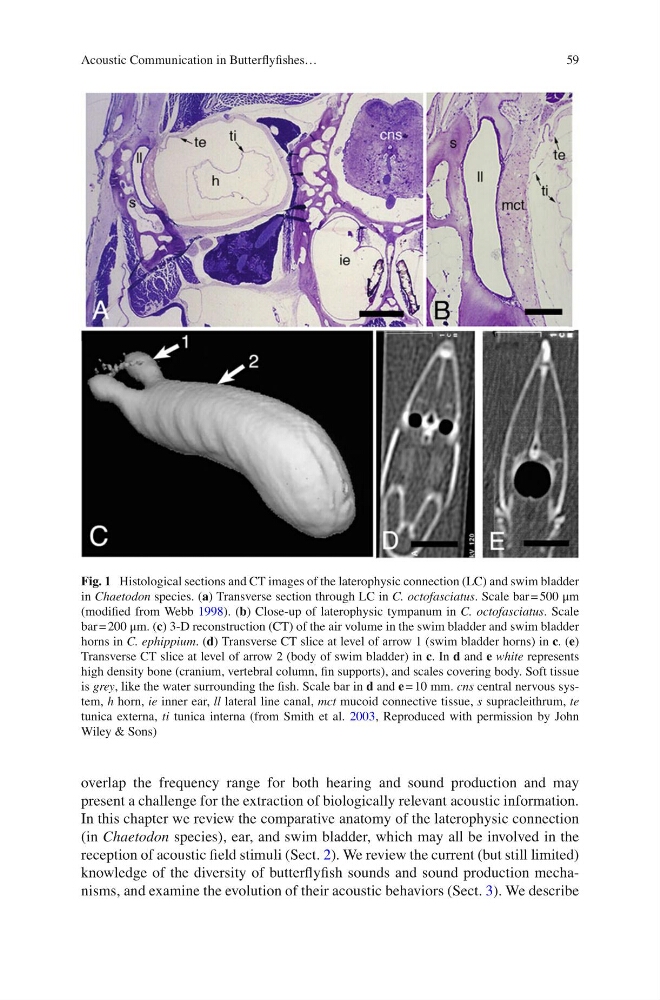
Fig. 1 Histological sections and CT images of the laterophysic connection (LC) and swim bladder
in Chaetodon species. ( a ) Transverse section through LC in C. octofasciatus . Scale bar = 500 μm
(modifi ed from Webb 1998 ). ( b ) Close-up of laterophysic tympanum in C. octofasciatus . Scale
bar = 200 μm. ( c ) 3-D reconstruction (CT) of the air volume in the swim bladder and swim bladder
horns in C. ephippium . ( d ) Transverse CT slice at level of arrow 1 (swim bladder horns) in c . ( e )
Transverse CT slice at level of arrow 2 (body of swim bladder) in c . In d and e white represents
high density bone (cranium, vertebral column, fi n supports), and scales covering body. Soft tissue
is grey , like the water surrounding the fi sh. Scale bar in d and e = 10 mm. cns central nervous system, h horn, ie inner ear, ll lateral line canal, mct mucoid connective tissue, s supracleithrum, te
tunica externa, ti tunica interna (from Smith et al. 2003 , Reproduced with permission by John
Wiley & Sons)
Acoustic Communication in Butterfl yfi shes…
overlap the frequency range for both hearing and sound production and may
present a challenge for the extraction of biologically relevant acoustic information.
In this chapter we review the comparative anatomy of the laterophysic connection
(in Chaetodon species), ear, and swim bladder, which may all be involved in the
reception of acoustic fi eld stimuli (Sect. 2 ). We review the current (but still limited)
knowledge of the diversity of butterfl yfi sh sounds and sound production mechanisms, and examine the evolution of their acoustic behaviors (Sect. 3 ). We describe
Fig. 1 Histological sections and CT images of the laterophysic connection (LC) and swim bladder
in Chaetodon species. ( a ) Transverse section through LC in C. octofasciatus . Scale bar = 500 μm
(modifi ed from Webb 1998 ). ( b ) Close-up of laterophysic tympanum in C. octofasciatus . Scale
bar = 200 μm. ( c ) 3-D reconstruction (CT) of the air volume in the swim bladder and swim bladder
horns in C. ephippium . ( d ) Transverse CT slice at level of arrow 1 (swim bladder horns) in c . ( e )
Transverse CT slice at level of arrow 2 (body of swim bladder) in c . In d and e white represents
high density bone (cranium, vertebral column, fi n supports), and scales covering body. Soft tissue
is grey , like the water surrounding the fi sh. Scale bar in d and e = 10 mm. cns central nervous system, h horn, ie inner ear, ll lateral line canal, mct mucoid connective tissue, s supracleithrum, te
tunica externa, ti tunica interna (from Smith et al. 2003 , Reproduced with permission by John
Wiley & Sons)
Acoustic Communication in Butterfl yfi shes…