

402
channel catfi sh, but not for the bass or perch. Mid-frequency active (MFA) sonar, at
a cumulative SEL of 220 dB re 1 μPa
2 s, did not cause a hearing threshold shift in
rainbow trout, but channel catfi sh exhibited a 4–6 dB threshold shift at 2300 Hz,
which recovered within 24 h (Halvorsen et al. 2012c ). In summary, the effects of
sonar on fi sh hearing depend upon the sensitivity and bandwidth of the species and
the frequency range of the sonar.
Recently, a number of studies have examined the effects of pile driving sounds on
fi shes (Halvorsen et al. 2011 , 2012a , b ; Casper et al. 2012 , 2013a , b ). Most of these
studies focused on barotrauma and the effects of these impulsive sounds on non-sensory tissues such as swim bladder, liver, and blood vessels, but one study examined
the effect of pile driving signals on the sensory epithelia of fi sh. Casper et al. ( 2013a )
exposed hybrid striped bass ( Morone chrysops X Morone saxatilis ) and Mozambique
tilapia ( Oreochromis mossambicus ) to 960 pile driving strikes at either 216, 213, or
210 dB re 1 μPa
2 s cumulative SEL. Both sound-exposed species exhibited barotraumas. The bass also had signifi cant saccular hair cell damage and loss, but only after
being exposed to the highest sound level, while only one tilapia exhibited damage.
In conclusion, anthropogenic sound sources can produce sensory hair cell and
hearing loss in fi shes. However, most of these studies represent artifi cial scenarios
in which the fi shes are constrained relatively close to the sound source. Fishes in the
wild would likely be frightened away by initial sounds, which would probably
greatly mitigate their continued exposure to the sound source. Thus, there is a great
need for behavioral studies of the responses of fi shes to anthropogenic sound in
their natural environments (see Popper and Hastings 2009 ). In addition, data is
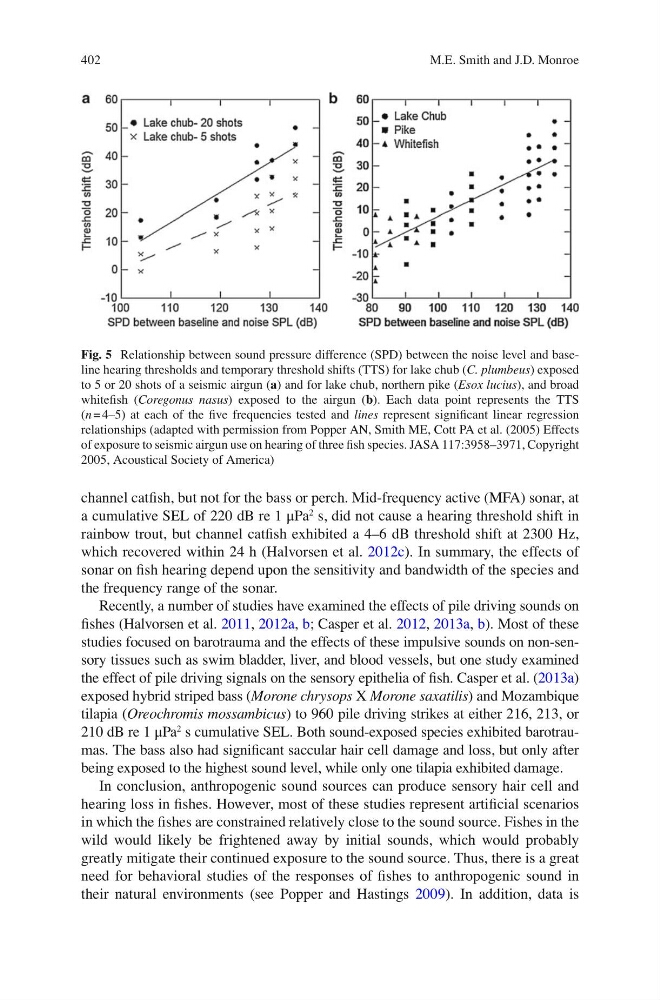
Fig. 5 Relationship between sound pressure difference (SPD) between the noise level and baseline hearing thresholds and temporary threshold shifts (TTS) for lake chub ( C. plumbeus ) exposed
to 5 or 20 shots of a seismic airgun ( a ) and for lake chub, northern pike ( Esox lucius ), and broad
whitefi sh ( Coregonus nasus ) exposed to the airgun ( b ). Each data point represents the TTS
( n = 4–5) at each of the fi ve frequencies tested and lines represent signifi cant linear regression
relationships (adapted with permission from Popper AN, Smith ME, Cott PA et al. (2005) Effects
of exposure to seismic airgun use on hearing of three fi sh species. JASA 117:3958–3971, Copyright
2005, Acoustical Society of America)
M.E. Smith and J.D. Monroe
channel catfi sh, but not for the bass or perch. Mid-frequency active (MFA) sonar, at
a cumulative SEL of 220 dB re 1 μPa
2 s, did not cause a hearing threshold shift in
rainbow trout, but channel catfi sh exhibited a 4–6 dB threshold shift at 2300 Hz,
which recovered within 24 h (Halvorsen et al. 2012c ). In summary, the effects of
sonar on fi sh hearing depend upon the sensitivity and bandwidth of the species and
the frequency range of the sonar.
Recently, a number of studies have examined the effects of pile driving sounds on
fi shes (Halvorsen et al. 2011 , 2012a , b ; Casper et al. 2012 , 2013a , b ). Most of these
studies focused on barotrauma and the effects of these impulsive sounds on non-sensory tissues such as swim bladder, liver, and blood vessels, but one study examined
the effect of pile driving signals on the sensory epithelia of fi sh. Casper et al. ( 2013a )
exposed hybrid striped bass ( Morone chrysops X Morone saxatilis ) and Mozambique
tilapia ( Oreochromis mossambicus ) to 960 pile driving strikes at either 216, 213, or
210 dB re 1 μPa
2 s cumulative SEL. Both sound-exposed species exhibited barotraumas. The bass also had signifi cant saccular hair cell damage and loss, but only after
being exposed to the highest sound level, while only one tilapia exhibited damage.
In conclusion, anthropogenic sound sources can produce sensory hair cell and
hearing loss in fi shes. However, most of these studies represent artifi cial scenarios
in which the fi shes are constrained relatively close to the sound source. Fishes in the
wild would likely be frightened away by initial sounds, which would probably
greatly mitigate their continued exposure to the sound source. Thus, there is a great
need for behavioral studies of the responses of fi shes to anthropogenic sound in
their natural environments (see Popper and Hastings 2009 ). In addition, data is
Fig. 5 Relationship between sound pressure difference (SPD) between the noise level and baseline hearing thresholds and temporary threshold shifts (TTS) for lake chub ( C. plumbeus ) exposed
to 5 or 20 shots of a seismic airgun ( a ) and for lake chub, northern pike ( Esox lucius ), and broad
whitefi sh ( Coregonus nasus ) exposed to the airgun ( b ). Each data point represents the TTS
( n = 4–5) at each of the fi ve frequencies tested and lines represent signifi cant linear regression
relationships (adapted with permission from Popper AN, Smith ME, Cott PA et al. (2005) Effects
of exposure to seismic airgun use on hearing of three fi sh species. JASA 117:3958–3971, Copyright
2005, Acoustical Society of America)
M.E. Smith and J.D. Monroe