

328
Acanthodoras spinosissimus (talking catfi sh), Agamyxis pectinifrons (whitebarred
catfi sh), and Megalodoras uranoscopus varied from 0.174 to 0.201 and that it varied
in a second group including Amblydoras affi nis , Hemidoras morrisi , and Oxydoras
niger (ripsaw catfi sh) between 0.129 and 0.158 (Fig. 7 ).
Besides bladder size, these six species show a large variation in bladder morphology. Acanthodoras spinosissimus and A. affi nis have apple-shaped bladders
without any diverticula (Fig. 7 ). Agamyxis pectinifrons possesses small simpleformed diverticula at the caudal end. Bladders are cordiform (heart-shaped) in M.
uranoscopus , O. niger , and H. morrisi . In M. uranoscopus and H. morrisi they have
many long, branched diverticula cranially, laterally, and caudally. Two species, M.
uranoscopus und O. niger , have a small secondary bladder.
All species detect tone bursts between 70 Hz and 6 kHz. Audiograms were typically U-shaped with best hearing located between 0.5 and 1 kHz except for one
species (Zebedin and Ladich 2013 ) (Fig. 8a ). Averaged hearing sensitivities of the
three species with smaller swim bladders were signifi cantly higher (= thresholds
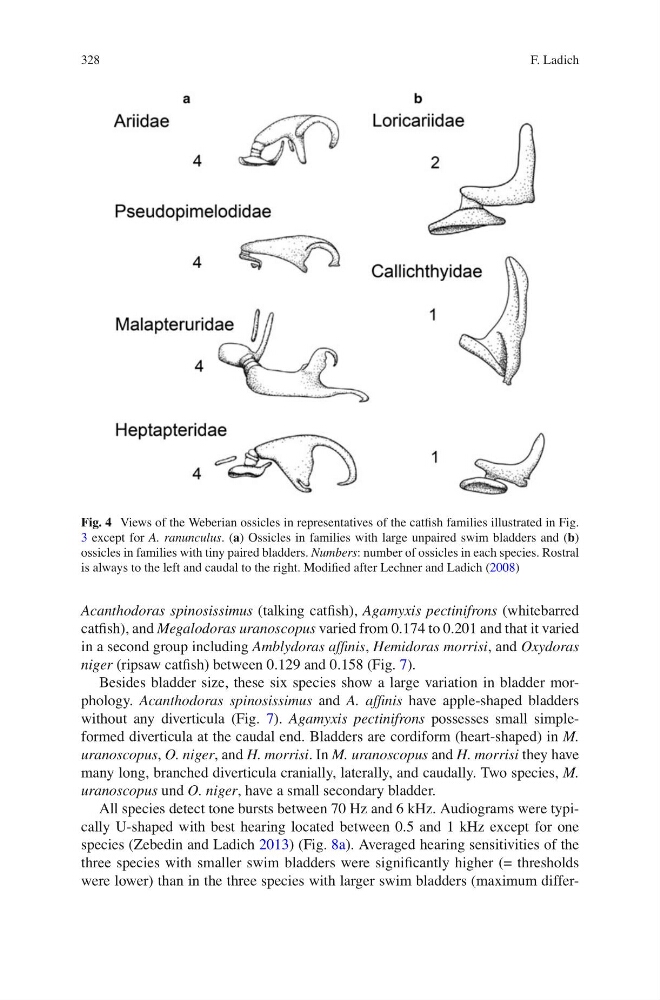
were lower) than in the three species with larger swim bladders (maximum differFig. 4 Views of the Weberian ossicles in representatives of the catfi sh families illustrated in Fig.
3 except for A. ranunculus . ( a ) Ossicles in families with large unpaired swim bladders and ( b )
ossicles in families with tiny paired bladders. Numbers : number of ossicles in each species. Rostral
is always to the left and caudal to the right. Modifi ed after Lechner and Ladich ( 2008 )
F. Ladich
Acanthodoras spinosissimus (talking catfi sh), Agamyxis pectinifrons (whitebarred
catfi sh), and Megalodoras uranoscopus varied from 0.174 to 0.201 and that it varied
in a second group including Amblydoras affi nis , Hemidoras morrisi , and Oxydoras
niger (ripsaw catfi sh) between 0.129 and 0.158 (Fig. 7 ).
Besides bladder size, these six species show a large variation in bladder morphology. Acanthodoras spinosissimus and A. affi nis have apple-shaped bladders
without any diverticula (Fig. 7 ). Agamyxis pectinifrons possesses small simpleformed diverticula at the caudal end. Bladders are cordiform (heart-shaped) in M.
uranoscopus , O. niger , and H. morrisi . In M. uranoscopus and H. morrisi they have
many long, branched diverticula cranially, laterally, and caudally. Two species, M.
uranoscopus und O. niger , have a small secondary bladder.
All species detect tone bursts between 70 Hz and 6 kHz. Audiograms were typically U-shaped with best hearing located between 0.5 and 1 kHz except for one
species (Zebedin and Ladich 2013 ) (Fig. 8a ). Averaged hearing sensitivities of the
three species with smaller swim bladders were signifi cantly higher (= thresholds
were lower) than in the three species with larger swim bladders (maximum differFig. 4 Views of the Weberian ossicles in representatives of the catfi sh families illustrated in Fig.
3 except for A. ranunculus . ( a ) Ossicles in families with large unpaired swim bladders and ( b )
ossicles in families with tiny paired bladders. Numbers : number of ossicles in each species. Rostral
is always to the left and caudal to the right. Modifi ed after Lechner and Ladich ( 2008 )
F. Ladich