

325
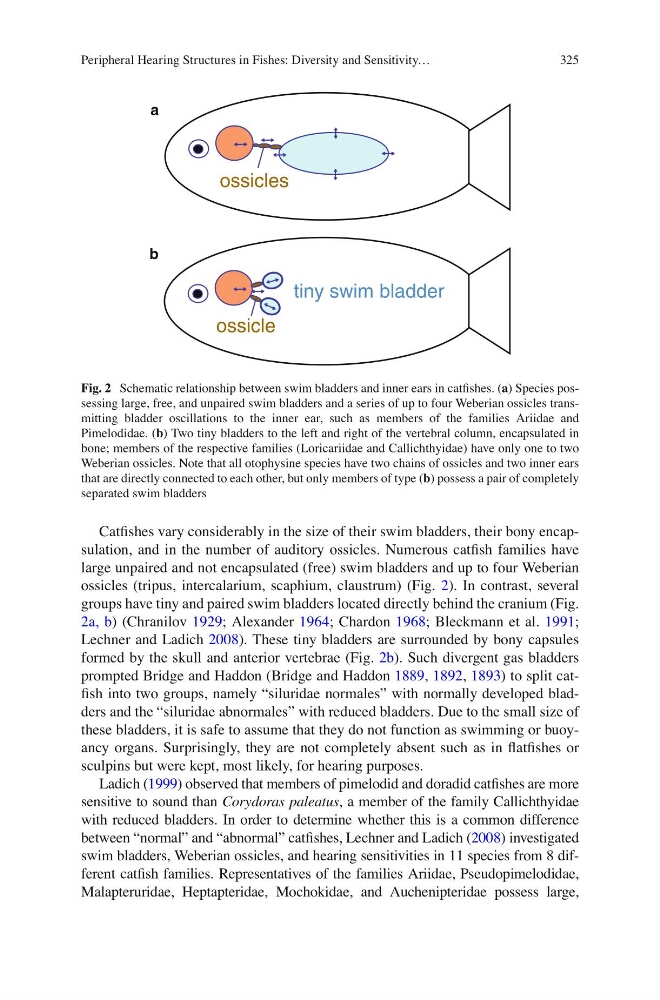
Catfi shes vary considerably in the size of their swim bladders, their bony encapsulation, and in the number of auditory ossicles. Numerous catfi sh families have
large unpaired and not encapsulated (free) swim bladders and up to four Weberian
ossicles (tripus, intercalarium, scaphium, claustrum) (Fig. 2 ). In contrast, several
groups have tiny and paired swim bladders located directly behind the cranium (Fig.
2a, b ) (Chranilov 1929 ; Alexander 1964 ; Chardon 1968 ; Bleckmann et al. 1991 ;
Lechner and Ladich 2008 ). These tiny bladders are surrounded by bony capsules
formed by the skull and anterior vertebrae (Fig. 2b ). Such divergent gas bladders
prompted Bridge and Haddon (Bridge and Haddon 1889 , 1892 , 1893 ) to split catfi sh into two groups, namely “siluridae normales” with normally developed bladders and the “siluridae abnormales” with reduced bladders. Due to the small size of
these bladders, it is safe to assume that they do not function as swimming or buoyancy organs. Surprisingly, they are not completely absent such as in fl atfi shes or
sculpins but were kept, most likely, for hearing purposes.
Ladich ( 1999 ) observed that members of pimelodid and doradid catfi shes are more
sensitive to sound than Corydoras paleatus , a member of the family Callichthyidae
with reduced bladders. In order to determine whether this is a common difference
between “normal” and “abnormal” catfi shes, Lechner and Ladich ( 2008 ) investigated
swim bladders, Weberian ossicles, and hearing sensitivities in 11 species from 8 different catfi sh families. Representatives of the families Ariidae, Pseudopimelodidae,
Malapteruridae, Heptapteridae, Mochokidae, and Auchenipteridae possess large,
ossicles
a
b
ossicle
tiny swim bladder
Fig. 2 Schematic relationship between swim bladders and inner ears in catfi shes. ( a ) Species possessing large, free, and unpaired swim bladders and a series of up to four Weberian ossicles transmitting bladder oscillations to the inner ear, such as members of the families Ariidae and
Pimelodidae. ( b ) Two tiny bladders to the left and right of the vertebral column, encapsulated in
bone; members of the respective families (Loricariidae and Callichthyidae) have only one to two
Weberian ossicles. Note that all otophysine species have two chains of ossicles and two inner ears
that are directly connected to each other, but only members of type ( b ) possess a pair of completely
separated swim bladders
Peripheral Hearing Structures in Fishes: Diversity and Sensitivity…
Catfi shes vary considerably in the size of their swim bladders, their bony encapsulation, and in the number of auditory ossicles. Numerous catfi sh families have
large unpaired and not encapsulated (free) swim bladders and up to four Weberian
ossicles (tripus, intercalarium, scaphium, claustrum) (Fig. 2 ). In contrast, several
groups have tiny and paired swim bladders located directly behind the cranium (Fig.
2a, b ) (Chranilov 1929 ; Alexander 1964 ; Chardon 1968 ; Bleckmann et al. 1991 ;
Lechner and Ladich 2008 ). These tiny bladders are surrounded by bony capsules
formed by the skull and anterior vertebrae (Fig. 2b ). Such divergent gas bladders
prompted Bridge and Haddon (Bridge and Haddon 1889 , 1892 , 1893 ) to split catfi sh into two groups, namely “siluridae normales” with normally developed bladders and the “siluridae abnormales” with reduced bladders. Due to the small size of
these bladders, it is safe to assume that they do not function as swimming or buoyancy organs. Surprisingly, they are not completely absent such as in fl atfi shes or
sculpins but were kept, most likely, for hearing purposes.
Ladich ( 1999 ) observed that members of pimelodid and doradid catfi shes are more
sensitive to sound than Corydoras paleatus , a member of the family Callichthyidae
with reduced bladders. In order to determine whether this is a common difference
between “normal” and “abnormal” catfi shes, Lechner and Ladich ( 2008 ) investigated
swim bladders, Weberian ossicles, and hearing sensitivities in 11 species from 8 different catfi sh families. Representatives of the families Ariidae, Pseudopimelodidae,
Malapteruridae, Heptapteridae, Mochokidae, and Auchenipteridae possess large,
ossicles
a
b
ossicle
tiny swim bladder
Fig. 2 Schematic relationship between swim bladders and inner ears in catfi shes. ( a ) Species possessing large, free, and unpaired swim bladders and a series of up to four Weberian ossicles transmitting bladder oscillations to the inner ear, such as members of the families Ariidae and
Pimelodidae. ( b ) Two tiny bladders to the left and right of the vertebral column, encapsulated in
bone; members of the respective families (Loricariidae and Callichthyidae) have only one to two
Weberian ossicles. Note that all otophysine species have two chains of ossicles and two inner ears
that are directly connected to each other, but only members of type ( b ) possess a pair of completely
separated swim bladders
Peripheral Hearing Structures in Fishes: Diversity and Sensitivity…