

323
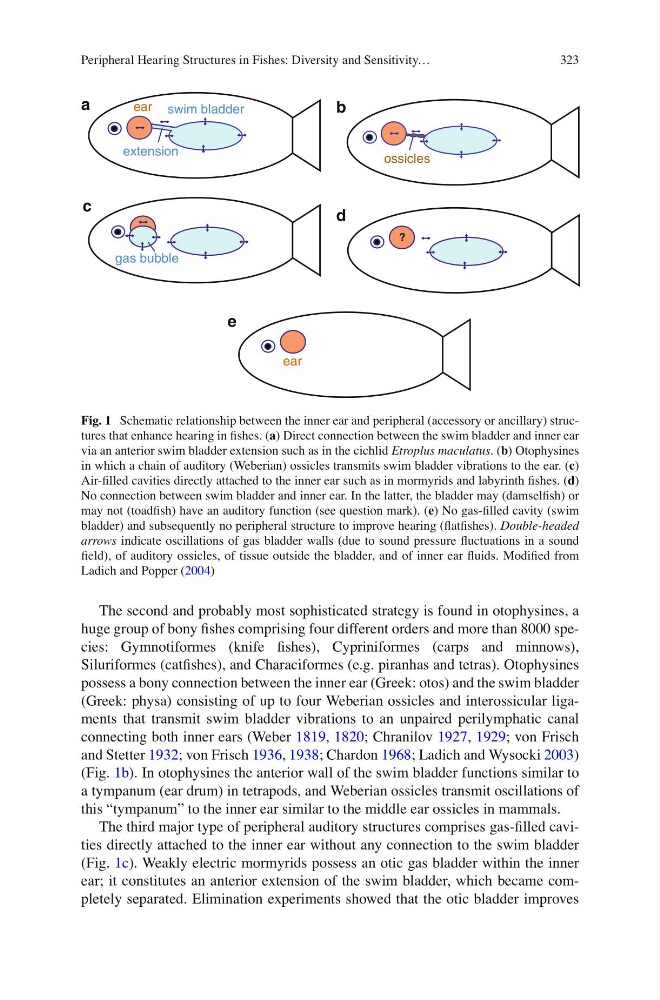
The second and probably most sophisticated strategy is found in otophysines, a
huge group of bony fi shes comprising four different orders and more than 8000 species: Gymnotiformes (knife fi shes), Cypriniformes (carps and minnows),
Siluriformes (catfi shes), and Characiformes (e.g. piranhas and tetras). Otophysines
possess a bony connection between the inner ear (Greek: otos) and the swim bladder
(Greek: physa) consisting of up to four Weberian ossicles and interossicular ligaments that transmit swim bladder vibrations to an unpaired perilymphatic canal
connecting both inner ears (Weber 1819 , 1820 ; Chranilov 1927 , 1929 ; von Frisch
and Stetter 1932 ; von Frisch 1936 , 1938 ; Chardon 1968 ; Ladich and Wysocki 2003 )
(Fig. 1b ). In otophysines the anterior wall of the swim bladder functions similar to
a tympanum (ear drum) in tetrapods, and Weberian ossicles transmit oscillations of
this “tympanum” to the inner ear similar to the middle ear ossicles in mammals.
The third major type of peripheral auditory structures comprises gas-fi lled cavities directly attached to the inner ear without any connection to the swim bladder
(Fig. 1c ). Weakly electric mormyrids possess an otic gas bladder within the inner
ear; it constitutes an anterior extension of the swim bladder, which became completely separated. Elimination experiments showed that the otic bladder improves
?
d
ossicles
b
ear
e
extension
a
swim bladder
ear
gas bubble
c
Fig. 1 Schematic relationship between the inner ear and peripheral (accessory or ancillary) structures that enhance hearing in fi shes. ( a ) Direct connection between the swim bladder and inner ear
via an anterior swim bladder extension such as in the cichlid Etroplus maculatus . ( b ) Otophysines
in which a chain of auditory (Weberian) ossicles transmits swim bladder vibrations to the ear. ( c )
Air-fi lled cavities directly attached to the inner ear such as in mormyrids and labyrinth fi shes. ( d )
No connection between swim bladder and inner ear. In the latter, the bladder may (damselfi sh) or
may not (toadfi sh) have an auditory function (see question mark). ( e ) No gas-fi lled cavity (swim
bladder) and subsequently no peripheral structure to improve hearing (fl atfi shes). Double-headed
arrows indicate oscillations of gas bladder walls (due to sound pressure fl uctuations in a sound
fi eld), of auditory ossicles, of tissue outside the bladder, and of inner ear fl uids. Modifi ed from
Ladich and Popper ( 2004 )
Peripheral Hearing Structures in Fishes: Diversity and Sensitivity…
The second and probably most sophisticated strategy is found in otophysines, a
huge group of bony fi shes comprising four different orders and more than 8000 species: Gymnotiformes (knife fi shes), Cypriniformes (carps and minnows),
Siluriformes (catfi shes), and Characiformes (e.g. piranhas and tetras). Otophysines
possess a bony connection between the inner ear (Greek: otos) and the swim bladder
(Greek: physa) consisting of up to four Weberian ossicles and interossicular ligaments that transmit swim bladder vibrations to an unpaired perilymphatic canal
connecting both inner ears (Weber 1819 , 1820 ; Chranilov 1927 , 1929 ; von Frisch
and Stetter 1932 ; von Frisch 1936 , 1938 ; Chardon 1968 ; Ladich and Wysocki 2003 )
(Fig. 1b ). In otophysines the anterior wall of the swim bladder functions similar to
a tympanum (ear drum) in tetrapods, and Weberian ossicles transmit oscillations of
this “tympanum” to the inner ear similar to the middle ear ossicles in mammals.
The third major type of peripheral auditory structures comprises gas-fi lled cavities directly attached to the inner ear without any connection to the swim bladder
(Fig. 1c ). Weakly electric mormyrids possess an otic gas bladder within the inner
ear; it constitutes an anterior extension of the swim bladder, which became completely separated. Elimination experiments showed that the otic bladder improves
?
d
ossicles
b
ear
e
extension
a
swim bladder
ear
gas bubble
c
Fig. 1 Schematic relationship between the inner ear and peripheral (accessory or ancillary) structures that enhance hearing in fi shes. ( a ) Direct connection between the swim bladder and inner ear
via an anterior swim bladder extension such as in the cichlid Etroplus maculatus . ( b ) Otophysines
in which a chain of auditory (Weberian) ossicles transmits swim bladder vibrations to the ear. ( c )
Air-fi lled cavities directly attached to the inner ear such as in mormyrids and labyrinth fi shes. ( d )
No connection between swim bladder and inner ear. In the latter, the bladder may (damselfi sh) or
may not (toadfi sh) have an auditory function (see question mark). ( e ) No gas-fi lled cavity (swim
bladder) and subsequently no peripheral structure to improve hearing (fl atfi shes). Double-headed
arrows indicate oscillations of gas bladder walls (due to sound pressure fl uctuations in a sound
fi eld), of auditory ossicles, of tissue outside the bladder, and of inner ear fl uids. Modifi ed from
Ladich and Popper ( 2004 )
Peripheral Hearing Structures in Fishes: Diversity and Sensitivity…