

309
Perciformes
Within this highly diverse order, representatives of several families have been investigated. One research question that has received recent interest is whether the biotic
sounds of reef habitats serve as important sound orientation cues for pelagic larvae
and facilitate the localization and recruitment to appropriate settlement habitats.
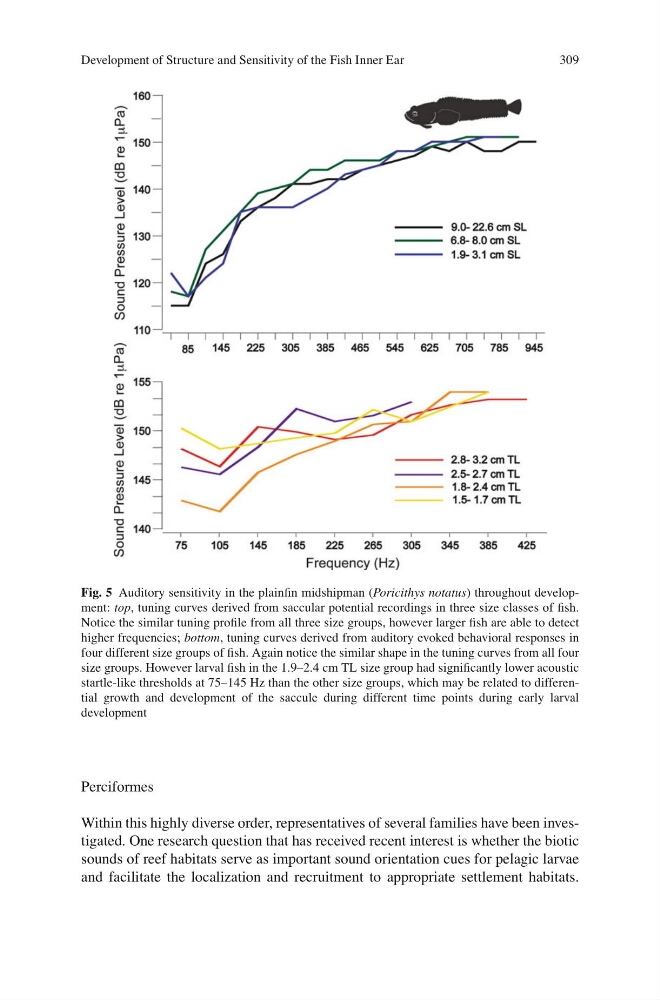
Fig. 5 Auditory sensitivity in the plainfi n midshipman ( Poricithys notatus ) throughout development: top , tuning curves derived from saccular potential recordings in three size classes of fi sh.
Notice the similar tuning profi le from all three size groups, however larger fi sh are able to detect
higher frequencies; bottom , tuning curves derived from auditory evoked behavioral responses in
four different size groups of fi sh. Again notice the similar shape in the tuning curves from all four
size groups. However larval fi sh in the 1.9–2.4 cm TL size group had signifi cantly lower acoustic
startle-like thresholds at 75–145 Hz than the other size groups, which may be related to differential growth and development of the saccule during different time points during early larval
development
Development of Structure and Sensitivity of the Fish Inner Ear
Perciformes
Within this highly diverse order, representatives of several families have been investigated. One research question that has received recent interest is whether the biotic
sounds of reef habitats serve as important sound orientation cues for pelagic larvae
and facilitate the localization and recruitment to appropriate settlement habitats.
Fig. 5 Auditory sensitivity in the plainfi n midshipman ( Poricithys notatus ) throughout development: top , tuning curves derived from saccular potential recordings in three size classes of fi sh.
Notice the similar tuning profi le from all three size groups, however larger fi sh are able to detect
higher frequencies; bottom , tuning curves derived from auditory evoked behavioral responses in
four different size groups of fi sh. Again notice the similar shape in the tuning curves from all four
size groups. However larval fi sh in the 1.9–2.4 cm TL size group had signifi cantly lower acoustic
startle-like thresholds at 75–145 Hz than the other size groups, which may be related to differential growth and development of the saccule during different time points during early larval
development
Development of Structure and Sensitivity of the Fish Inner Ear