

306
DeSmidt 2013 ).The fi rst study to investigate the ontogeny of hearing in zebrafi sh
was conducted by Higgs et al. ( 2001 ) using AEP recordings, and reported an
absence of improvements in auditory sensitivity or bandwidth with growth and
development, despite continuous hair cell production with age/size (body length
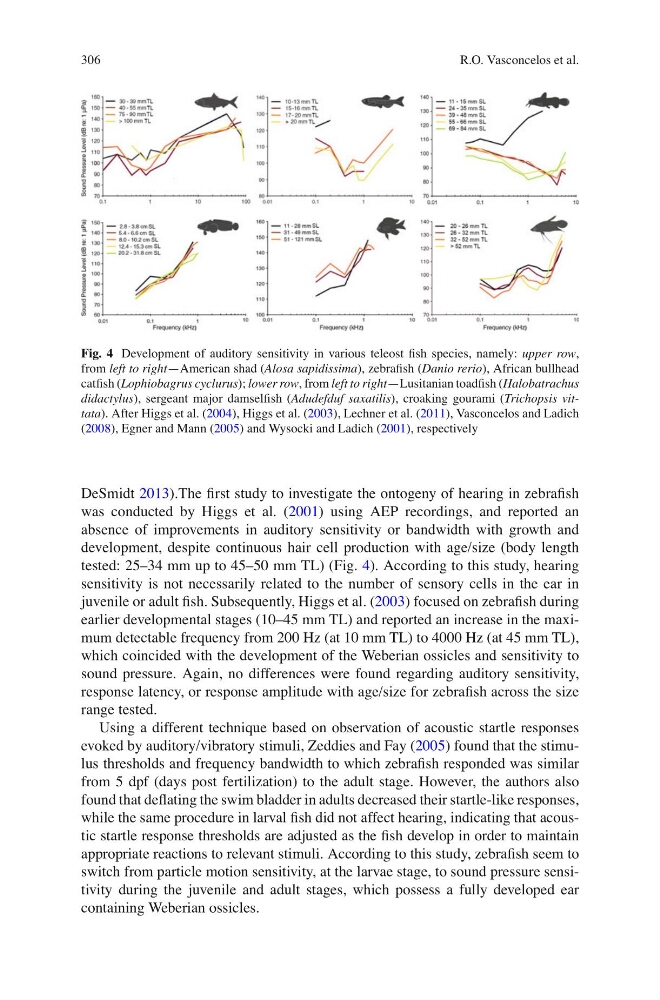
tested: 25–34 mm up to 45–50 mm TL) (Fig. 4 ). According to this study, hearing
sensitivity is not necessarily related to the number of sensory cells in the ear in
juvenile or adult fi sh. Subsequently, Higgs et al. ( 2003 ) focused on zebrafi sh during
earlier developmental stages (10–45 mm TL) and reported an increase in the maximum detectable frequency from 200 Hz (at 10 mm TL) to 4000 Hz (at 45 mm TL),
which coincided with the development of the Weberian ossicles and sensitivity to
sound pressure. Again, no differences were found regarding auditory sensitivity,
response latency, or response amplitude with age/size for zebrafi sh across the size
range tested.
Using a different technique based on observation of acoustic startle responses
evoked by auditory/vibratory stimuli, Zeddies and Fay ( 2005 ) found that the stimulus thresholds and frequency bandwidth to which zebrafi sh responded was similar
from 5 dpf (days post fertilization) to the adult stage. However, the authors also
found that defl ating the swim bladder in adults decreased their startle-like responses,
while the same procedure in larval fi sh did not affect hearing, indicating that acoustic startle response thresholds are adjusted as the fi sh develop in order to maintain
appropriate reactions to relevant stimuli. According to this study, zebrafi sh seem to
switch from particle motion sensitivity, at the larvae stage, to sound pressure sensitivity during the juvenile and adult stages, which possess a fully developed ear
containing Weberian ossicles.
Fig. 4 Development of auditory sensitivity in various teleost fi sh species, namely: upper row ,
from left to right —American shad ( Alosa sapidissima ), zebrafi sh ( Danio rerio ), African bullhead
catfi sh ( Lophiobagrus cyclurus ); lower row , from left to right —Lusitanian toadfi sh ( Halobatrachus
didactylus ), sergeant major damselfi sh ( Adudefduf saxatilis ), croaking gourami ( Trichopsis vittata ). After Higgs et al. ( 2004 ), Higgs et al. ( 2003 ), Lechner et al. ( 2011 ), Vasconcelos and Ladich
( 2008 ), Egner and Mann ( 2005 ) and Wysocki and Ladich ( 2001 ), respectively
R.O. Vasconcelos et al.
DeSmidt 2013 ).The fi rst study to investigate the ontogeny of hearing in zebrafi sh
was conducted by Higgs et al. ( 2001 ) using AEP recordings, and reported an
absence of improvements in auditory sensitivity or bandwidth with growth and
development, despite continuous hair cell production with age/size (body length
tested: 25–34 mm up to 45–50 mm TL) (Fig. 4 ). According to this study, hearing
sensitivity is not necessarily related to the number of sensory cells in the ear in
juvenile or adult fi sh. Subsequently, Higgs et al. ( 2003 ) focused on zebrafi sh during
earlier developmental stages (10–45 mm TL) and reported an increase in the maximum detectable frequency from 200 Hz (at 10 mm TL) to 4000 Hz (at 45 mm TL),
which coincided with the development of the Weberian ossicles and sensitivity to
sound pressure. Again, no differences were found regarding auditory sensitivity,
response latency, or response amplitude with age/size for zebrafi sh across the size
range tested.
Using a different technique based on observation of acoustic startle responses
evoked by auditory/vibratory stimuli, Zeddies and Fay ( 2005 ) found that the stimulus thresholds and frequency bandwidth to which zebrafi sh responded was similar
from 5 dpf (days post fertilization) to the adult stage. However, the authors also
found that defl ating the swim bladder in adults decreased their startle-like responses,
while the same procedure in larval fi sh did not affect hearing, indicating that acoustic startle response thresholds are adjusted as the fi sh develop in order to maintain
appropriate reactions to relevant stimuli. According to this study, zebrafi sh seem to
switch from particle motion sensitivity, at the larvae stage, to sound pressure sensitivity during the juvenile and adult stages, which possess a fully developed ear
containing Weberian ossicles.
Fig. 4 Development of auditory sensitivity in various teleost fi sh species, namely: upper row ,
from left to right —American shad ( Alosa sapidissima ), zebrafi sh ( Danio rerio ), African bullhead
catfi sh ( Lophiobagrus cyclurus ); lower row , from left to right —Lusitanian toadfi sh ( Halobatrachus
didactylus ), sergeant major damselfi sh ( Adudefduf saxatilis ), croaking gourami ( Trichopsis vittata ). After Higgs et al. ( 2004 ), Higgs et al. ( 2003 ), Lechner et al. ( 2011 ), Vasconcelos and Ladich
( 2008 ), Egner and Mann ( 2005 ) and Wysocki and Ladich ( 2001 ), respectively
R.O. Vasconcelos et al.