

294
with inner ear otoliths acting as accelerometers all teleost fi shes are able to detect
the particle motion component of sound as discussed above, however several teleost
groups have independently evolved specialized auditory structures that likely
enhance hearing and/or make it possible for the additional detection of sound pressure (Fay and Popper 1975 , 1980 ; Coombs and Popper 1979 ). For example, several
groups have developed unique mechanisms that involve inner ear placement near a
gas bladder, or by directly coupling the inner ear to a gas bladder that changes in
volume in response to changes in sound pressure (Platt and Popper 1981 ).
Additionally, there is a great deal of diversity in regard to the structure and morphology of teleost peripheral auditory system, such as the position of the inner ear within
the braincase, the size and shape of each otolithic end organ and otoliths, as well as
the size, shape, and ultrastructure of the sensory macula (Fay and Popper 1975 ; Platt
and Popper 1981 ). All of these differences in auditory structure between various fi sh
species likely refl ect their high adaptation to specifi c environments that has been
shaping the function of the auditory system. An ontogenetic perspective provides a
readily testable framework for understanding the structure-function relationships
within the auditory system.
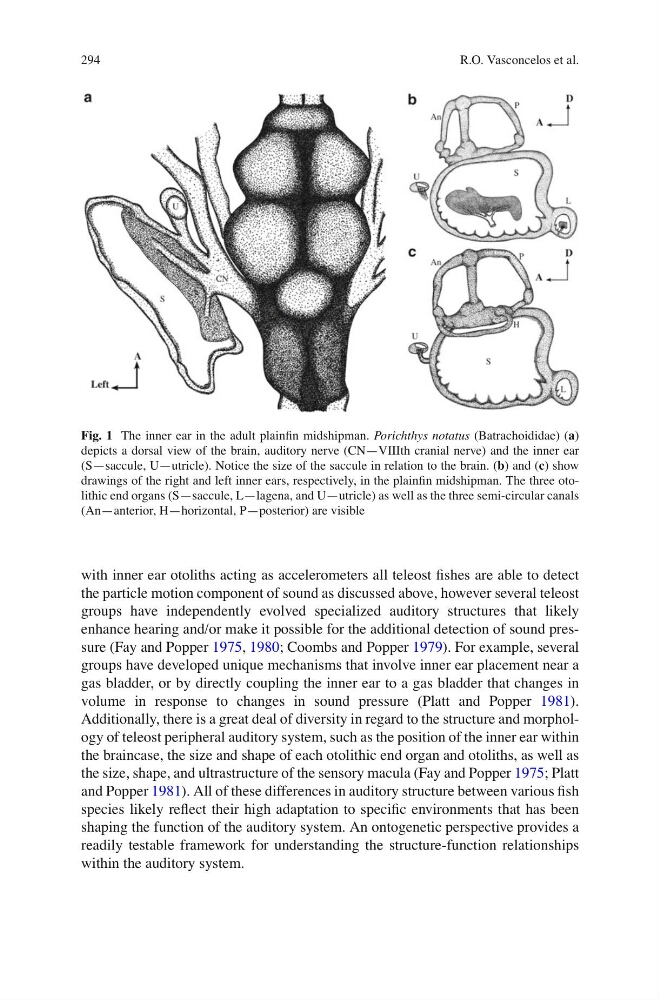
Fig. 1 The inner ear in the adult plainfi n midshipman. Porichthys notatus (Batrachoididae) ( a )
depicts a dorsal view of the brain, auditory nerve (CN—VIIIth cranial nerve) and the inner ear
(S—saccule, U—utricle). Notice the size of the saccule in relation to the brain. ( b ) and ( c ) show
drawings of the right and left inner ears, respectively, in the plainfi n midshipman. The three otolithic end organs (S—saccule, L—lagena, and U—utricle) as well as the three semi-circular canals
(An—anterior, H—horizontal, P—posterior) are visible
R.O. Vasconcelos et al.
with inner ear otoliths acting as accelerometers all teleost fi shes are able to detect
the particle motion component of sound as discussed above, however several teleost
groups have independently evolved specialized auditory structures that likely
enhance hearing and/or make it possible for the additional detection of sound pressure (Fay and Popper 1975 , 1980 ; Coombs and Popper 1979 ). For example, several
groups have developed unique mechanisms that involve inner ear placement near a
gas bladder, or by directly coupling the inner ear to a gas bladder that changes in
volume in response to changes in sound pressure (Platt and Popper 1981 ).
Additionally, there is a great deal of diversity in regard to the structure and morphology of teleost peripheral auditory system, such as the position of the inner ear within
the braincase, the size and shape of each otolithic end organ and otoliths, as well as
the size, shape, and ultrastructure of the sensory macula (Fay and Popper 1975 ; Platt
and Popper 1981 ). All of these differences in auditory structure between various fi sh
species likely refl ect their high adaptation to specifi c environments that has been
shaping the function of the auditory system. An ontogenetic perspective provides a
readily testable framework for understanding the structure-function relationships
within the auditory system.
Fig. 1 The inner ear in the adult plainfi n midshipman. Porichthys notatus (Batrachoididae) ( a )
depicts a dorsal view of the brain, auditory nerve (CN—VIIIth cranial nerve) and the inner ear
(S—saccule, U—utricle). Notice the size of the saccule in relation to the brain. ( b ) and ( c ) show
drawings of the right and left inner ears, respectively, in the plainfi n midshipman. The three otolithic end organs (S—saccule, L—lagena, and U—utricle) as well as the three semi-circular canals
(An—anterior, H—horizontal, P—posterior) are visible
R.O. Vasconcelos et al.