

277
3 Results
3.1 Initial Experiments with the Telemetry Tag
The effectiveness of the telemetry tag was fi rst demonstrated in the toadfi sh mechanosensory lateral line. Since ethical constraints make it diffi cult to justify removing
anesthesia from restrained or paralyzed animals, it has been problematic to assess
the effect of anesthesia on the fi sh nervous system, as it would entail removing the
drug from immobilized animals. The telemetry tag proved effective in assessing the
common fi sh anesthetic MS-222 on neural sensitivity. The electrodes were implanted
under anesthesia, and the fi sh allowed to recover and resume normal activity.
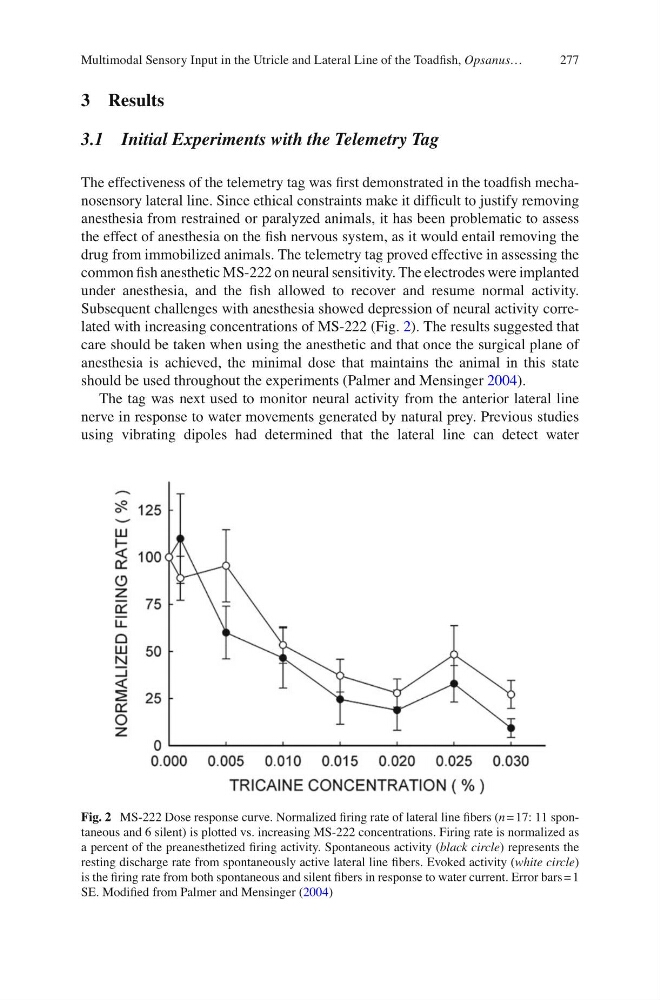
Subsequent challenges with anesthesia showed depression of neural activity correlated with increasing concentrations of MS-222 (Fig. 2 ). The results suggested that
care should be taken when using the anesthetic and that once the surgical plane of
anesthesia is achieved, the minimal dose that maintains the animal in this state
should be used throughout the experiments (Palmer and Mensinger 2004 ).
The tag was next used to monitor neural activity from the anterior lateral line
nerve in response to water movements generated by natural prey. Previous studies
using vibrating dipoles had determined that the lateral line can detect water
Fig. 2 MS-222 Dose response curve. Normalized fi ring rate of lateral line fi bers ( n = 17: 11 spontaneous and 6 silent) is plotted vs. increasing MS-222 concentrations. Firing rate is normalized as
a percent of the preanesthetized fi ring activity. Spontaneous activity ( black circle ) represents the
resting discharge rate from spontaneously active lateral line fi bers. Evoked activity ( white circle )
is the fi ring rate from both spontaneous and silent fi bers in response to water current. Error bars = 1
SE. Modifi ed from Palmer and Mensinger ( 2004 )
Multimodal Sensory Input in the Utricle and Lateral Line of the Toadfi sh, Opsanus…
3 Results
3.1 Initial Experiments with the Telemetry Tag
The effectiveness of the telemetry tag was fi rst demonstrated in the toadfi sh mechanosensory lateral line. Since ethical constraints make it diffi cult to justify removing
anesthesia from restrained or paralyzed animals, it has been problematic to assess
the effect of anesthesia on the fi sh nervous system, as it would entail removing the
drug from immobilized animals. The telemetry tag proved effective in assessing the
common fi sh anesthetic MS-222 on neural sensitivity. The electrodes were implanted
under anesthesia, and the fi sh allowed to recover and resume normal activity.
Subsequent challenges with anesthesia showed depression of neural activity correlated with increasing concentrations of MS-222 (Fig. 2 ). The results suggested that
care should be taken when using the anesthetic and that once the surgical plane of
anesthesia is achieved, the minimal dose that maintains the animal in this state
should be used throughout the experiments (Palmer and Mensinger 2004 ).
The tag was next used to monitor neural activity from the anterior lateral line
nerve in response to water movements generated by natural prey. Previous studies
using vibrating dipoles had determined that the lateral line can detect water
Fig. 2 MS-222 Dose response curve. Normalized fi ring rate of lateral line fi bers ( n = 17: 11 spontaneous and 6 silent) is plotted vs. increasing MS-222 concentrations. Firing rate is normalized as
a percent of the preanesthetized fi ring activity. Spontaneous activity ( black circle ) represents the
resting discharge rate from spontaneously active lateral line fi bers. Evoked activity ( white circle )
is the fi ring rate from both spontaneous and silent fi bers in response to water current. Error bars = 1
SE. Modifi ed from Palmer and Mensinger ( 2004 )
Multimodal Sensory Input in the Utricle and Lateral Line of the Toadfi sh, Opsanus…