

261
While fi sh may use sound as a long-distance attraction in some cases (see below),
for conspecifi c communication—using Myrberg’s ( 1981 ) defi nition of purposeful
transfer of information to benefi t the sender—both the signaller and the receiver are
generally quite close together. In aggressive interactions involving sound cues, fi sh
are typically within centimetres of each other (reviewed in Ladich 2004 ) and frequently produce high energy but low frequency (<600 Hz) sounds as aggressive
displays (e.g. Tavolga 1958 ; Torricelli and Romani 1986 ; Torricelli et al. 1990 ;
Amorim and Vasconcelos 2008; Johnston et al. 2008 ). In such cases, particle motion
would predominate and both auditory and lateral line hair cells would likely be
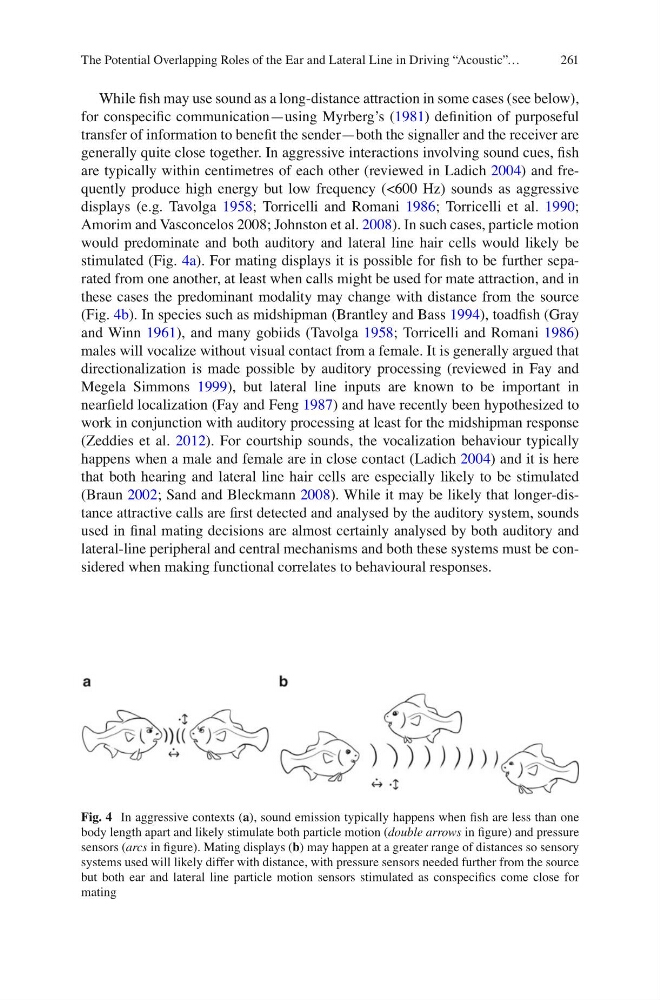
stimulated (Fig. 4a ). For mating displays it is possible for fi sh to be further separated from one another, at least when calls might be used for mate attraction, and in
these cases the predominant modality may change with distance from the source
(Fig. 4b ). In species such as midshipman (Brantley and Bass 1994 ), toadfi sh (Gray
and Winn 1961 ), and many gobiids (Tavolga 1958 ; Torricelli and Romani 1986 )
males will vocalize without visual contact from a female. It is generally argued that
directionalization is made possible by auditory processing (reviewed in Fay and
Megela Simmons 1999 ), but lateral line inputs are known to be important in
nearfi eld localization (Fay and Feng 1987 ) and have recently been hypothesized to
work in conjunction with auditory processing at least for the midshipman response
(Zeddies et al. 2012 ). For courtship sounds, the vocalization behaviour typically
happens when a male and female are in close contact (Ladich 2004 ) and it is here
that both hearing and lateral line hair cells are especially likely to be stimulated
(Braun 2002 ; Sand and Bleckmann 2008 ). While it may be likely that longer-distance attractive calls are fi rst detected and analysed by the auditory system, sounds
used in fi nal mating decisions are almost certainly analysed by both auditory and
lateral-line peripheral and central mechanisms and both these systems must be considered when making functional correlates to behavioural responses.
Fig. 4 In aggressive contexts ( a ), sound emission typically happens when fi sh are less than one
body length apart and likely stimulate both particle motion ( double arrows in fi gure) and pressure
sensors ( arcs in fi gure). Mating displays ( b ) may happen at a greater range of distances so sensory
systems used will likely differ with distance, with pressure sensors needed further from the source
but both ear and lateral line particle motion sensors stimulated as conspecifi cs come close for
mating
The Potential Overlapping Roles of the Ear and Lateral Line in Driving “Acoustic”…
While fi sh may use sound as a long-distance attraction in some cases (see below),
for conspecifi c communication—using Myrberg’s ( 1981 ) defi nition of purposeful
transfer of information to benefi t the sender—both the signaller and the receiver are
generally quite close together. In aggressive interactions involving sound cues, fi sh
are typically within centimetres of each other (reviewed in Ladich 2004 ) and frequently produce high energy but low frequency (<600 Hz) sounds as aggressive
displays (e.g. Tavolga 1958 ; Torricelli and Romani 1986 ; Torricelli et al. 1990 ;
Amorim and Vasconcelos 2008; Johnston et al. 2008 ). In such cases, particle motion
would predominate and both auditory and lateral line hair cells would likely be
stimulated (Fig. 4a ). For mating displays it is possible for fi sh to be further separated from one another, at least when calls might be used for mate attraction, and in
these cases the predominant modality may change with distance from the source
(Fig. 4b ). In species such as midshipman (Brantley and Bass 1994 ), toadfi sh (Gray
and Winn 1961 ), and many gobiids (Tavolga 1958 ; Torricelli and Romani 1986 )
males will vocalize without visual contact from a female. It is generally argued that
directionalization is made possible by auditory processing (reviewed in Fay and
Megela Simmons 1999 ), but lateral line inputs are known to be important in
nearfi eld localization (Fay and Feng 1987 ) and have recently been hypothesized to
work in conjunction with auditory processing at least for the midshipman response
(Zeddies et al. 2012 ). For courtship sounds, the vocalization behaviour typically
happens when a male and female are in close contact (Ladich 2004 ) and it is here
that both hearing and lateral line hair cells are especially likely to be stimulated
(Braun 2002 ; Sand and Bleckmann 2008 ). While it may be likely that longer-distance attractive calls are fi rst detected and analysed by the auditory system, sounds
used in fi nal mating decisions are almost certainly analysed by both auditory and
lateral-line peripheral and central mechanisms and both these systems must be considered when making functional correlates to behavioural responses.
Fig. 4 In aggressive contexts ( a ), sound emission typically happens when fi sh are less than one
body length apart and likely stimulate both particle motion ( double arrows in fi gure) and pressure
sensors ( arcs in fi gure). Mating displays ( b ) may happen at a greater range of distances so sensory
systems used will likely differ with distance, with pressure sensors needed further from the source
but both ear and lateral line particle motion sensors stimulated as conspecifi cs come close for
mating
The Potential Overlapping Roles of the Ear and Lateral Line in Driving “Acoustic”…