

247
extremely useful for studying how salient information from sounds received at the
inner ear is transformed along the auditory pathway and ultimately integrated with
other senses and internal physiology to allow context-appropriate behavioral decisions.
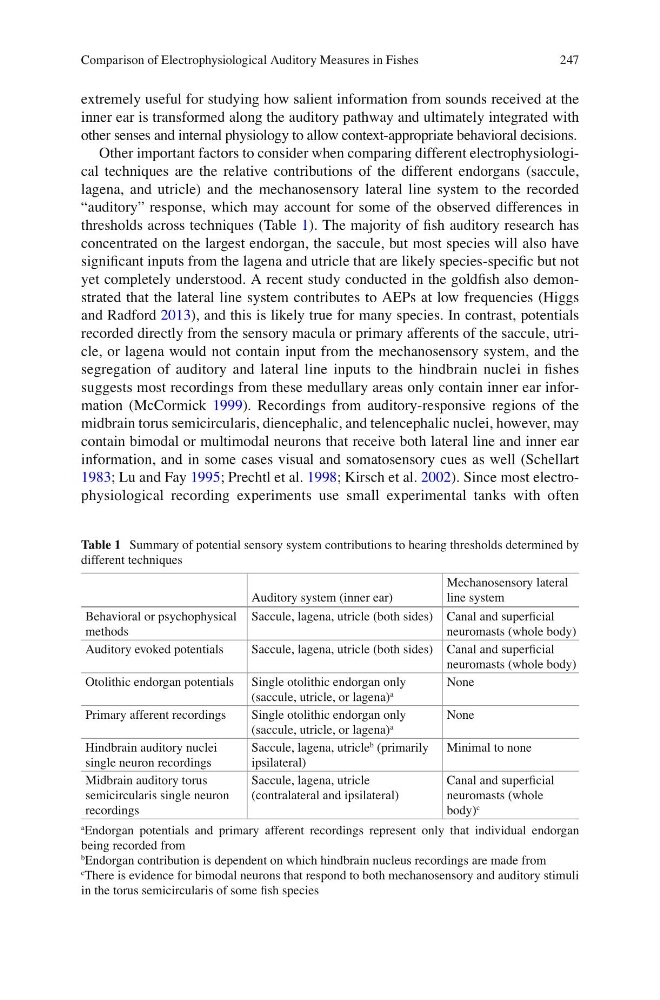
Other important factors to consider when comparing different electrophysiological techniques are the relative contributions of the different endorgans (saccule,
lagena, and utricle) and the mechanosensory lateral line system to the recorded
“auditory” response, which may account for some of the observed differences in
thresholds across techniques (Table 1 ). The majority of fi sh auditory research has
concentrated on the largest endorgan, the saccule, but most species will also have
signifi cant inputs from the lagena and utricle that are likely species-specifi c but not
yet completely understood. A recent study conducted in the goldfi sh also demonstrated that the lateral line system contributes to AEPs at low frequencies (Higgs
and Radford 2013 ), and this is likely true for many species. In contrast, potentials
recorded directly from the sensory macula or primary afferents of the saccule, utricle, or lagena would not contain input from the mechanosensory system, and the
segregation of auditory and lateral line inputs to the hindbrain nuclei in fi shes
suggests most recordings from these medullary areas only contain inner ear information (McCormick 1999 ). Recordings from auditory-responsive regions of the
midbrain torus semicircularis, diencephalic, and telencephalic nuclei, however, may
contain bimodal or multimodal neurons that receive both lateral line and inner ear
information, and in some cases visual and somatosensory cues as well (Schellart
1983 ; Lu and Fay 1995 ; Prechtl et al. 1998 ; Kirsch et al. 2002 ). Since most electrophysiological recording experiments use small experimental tanks with often
Table 1 Summary of potential sensory system contributions to hearing thresholds determined by
different techniques
Auditory system (inner ear)
Mechanosensory lateral
line system
Behavioral or psychophysical
methods
Saccule, lagena, utricle (both sides) Canal and superfi cial
neuromasts (whole body)
Auditory evoked potentials
Saccule, lagena, utricle (both sides) Canal and superfi cial
neuromasts (whole body)
Otolithic endorgan potentials Single otolithic endorgan only
(saccule, utricle, or lagena)
a
None
Primary afferent recordings
Single otolithic endorgan only
(saccule, utricle, or lagena)
a
None
Hindbrain auditory nuclei
single neuron recordings
Saccule, lagena, utricle
b (primarily
ipsilateral)
Minimal to none
Midbrain auditory torus
semicircularis single neuron
recordings
Saccule, lagena, utricle
(contralateral and ipsilateral)
Canal and superfi cial
neuromasts (whole
body)
c
a
Endorgan potentials and primary afferent recordings represent only that individual endorgan
being recorded from
b
Endorgan contribution is dependent on which hindbrain nucleus recordings are made from
c
There is evidence for bimodal neurons that respond to both mechanosensory and auditory stimuli
in the torus semicircularis of some fi sh species
Comparison of Electrophysiological Auditory Measures in Fishes
extremely useful for studying how salient information from sounds received at the
inner ear is transformed along the auditory pathway and ultimately integrated with
other senses and internal physiology to allow context-appropriate behavioral decisions.
Other important factors to consider when comparing different electrophysiological techniques are the relative contributions of the different endorgans (saccule,
lagena, and utricle) and the mechanosensory lateral line system to the recorded
“auditory” response, which may account for some of the observed differences in
thresholds across techniques (Table 1 ). The majority of fi sh auditory research has
concentrated on the largest endorgan, the saccule, but most species will also have
signifi cant inputs from the lagena and utricle that are likely species-specifi c but not
yet completely understood. A recent study conducted in the goldfi sh also demonstrated that the lateral line system contributes to AEPs at low frequencies (Higgs
and Radford 2013 ), and this is likely true for many species. In contrast, potentials
recorded directly from the sensory macula or primary afferents of the saccule, utricle, or lagena would not contain input from the mechanosensory system, and the
segregation of auditory and lateral line inputs to the hindbrain nuclei in fi shes
suggests most recordings from these medullary areas only contain inner ear information (McCormick 1999 ). Recordings from auditory-responsive regions of the
midbrain torus semicircularis, diencephalic, and telencephalic nuclei, however, may
contain bimodal or multimodal neurons that receive both lateral line and inner ear
information, and in some cases visual and somatosensory cues as well (Schellart
1983 ; Lu and Fay 1995 ; Prechtl et al. 1998 ; Kirsch et al. 2002 ). Since most electrophysiological recording experiments use small experimental tanks with often
Table 1 Summary of potential sensory system contributions to hearing thresholds determined by
different techniques
Auditory system (inner ear)
Mechanosensory lateral
line system
Behavioral or psychophysical
methods
Saccule, lagena, utricle (both sides) Canal and superfi cial
neuromasts (whole body)
Auditory evoked potentials
Saccule, lagena, utricle (both sides) Canal and superfi cial
neuromasts (whole body)
Otolithic endorgan potentials Single otolithic endorgan only
(saccule, utricle, or lagena)
a
None
Primary afferent recordings
Single otolithic endorgan only
(saccule, utricle, or lagena)
a
None
Hindbrain auditory nuclei
single neuron recordings
Saccule, lagena, utricle
b (primarily
ipsilateral)
Minimal to none
Midbrain auditory torus
semicircularis single neuron
recordings
Saccule, lagena, utricle
(contralateral and ipsilateral)
Canal and superfi cial
neuromasts (whole
body)
c
a
Endorgan potentials and primary afferent recordings represent only that individual endorgan
being recorded from
b
Endorgan contribution is dependent on which hindbrain nucleus recordings are made from
c
There is evidence for bimodal neurons that respond to both mechanosensory and auditory stimuli
in the torus semicircularis of some fi sh species
Comparison of Electrophysiological Auditory Measures in Fishes