

191
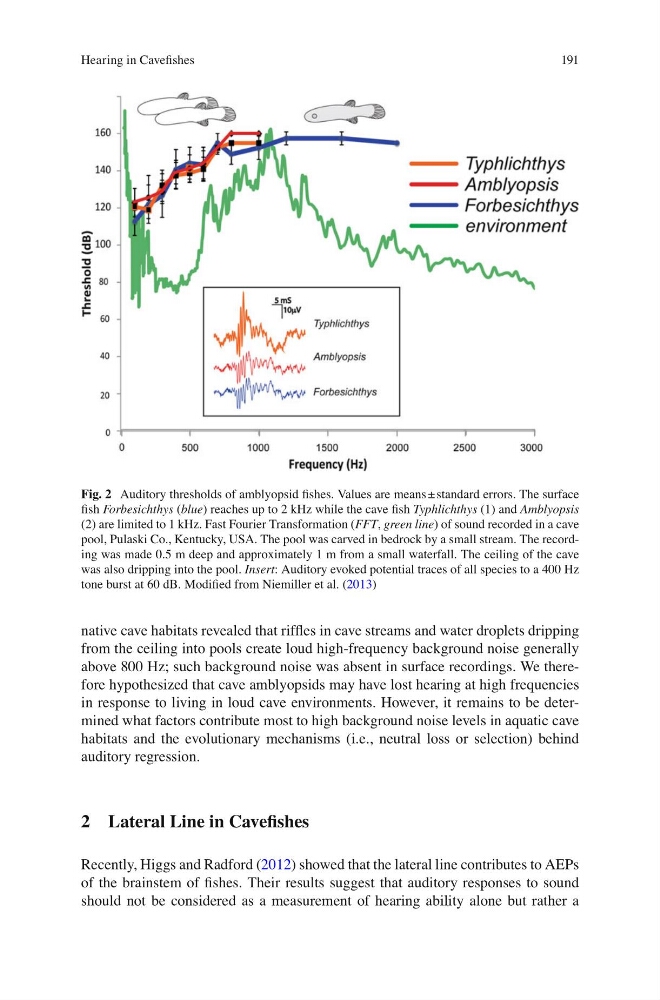
native cave habitats revealed that riffl es in cave streams and water droplets dripping
from the ceiling into pools create loud high-frequency background noise generally
above 800 Hz; such background noise was absent in surface recordings. We therefore hypothesized that cave amblyopsids may have lost hearing at high frequencies
in response to living in loud cave environments. However, it remains to be determined what factors contribute most to high background noise levels in aquatic cave
habitats and the evolutionary mechanisms (i.e., neutral loss or selection) behind
auditory regression.
2 Lateral Line in Cavefi shes
Recently, Higgs and Radford ( 2012 ) showed that the lateral line contributes to AEPs
of the brainstem of fi shes. Their results suggest that auditory responses to sound
should not be considered as a measurement of hearing ability alone but rather a
Fig. 2 Auditory thresholds of amblyopsid fi shes. Values are means ± standard errors. The surface
fi sh Forbesichthys ( blue ) reaches up to 2 kHz while the cave fi sh Typhlichthys (1) and Amblyopsis
(2) are limited to 1 kHz. Fast Fourier Transformation ( FFT , green line ) of sound recorded in a cave
pool, Pulaski Co., Kentucky, USA. The pool was carved in bedrock by a small stream. The recording was made 0.5 m deep and approximately 1 m from a small waterfall. The ceiling of the cave
was also dripping into the pool. Insert : Auditory evoked potential traces of all species to a 400 Hz
tone burst at 60 dB. Modifi ed from Niemiller et al. ( 2013 )
Hearing in Cavefi shes
native cave habitats revealed that riffl es in cave streams and water droplets dripping
from the ceiling into pools create loud high-frequency background noise generally
above 800 Hz; such background noise was absent in surface recordings. We therefore hypothesized that cave amblyopsids may have lost hearing at high frequencies
in response to living in loud cave environments. However, it remains to be determined what factors contribute most to high background noise levels in aquatic cave
habitats and the evolutionary mechanisms (i.e., neutral loss or selection) behind
auditory regression.
2 Lateral Line in Cavefi shes
Recently, Higgs and Radford ( 2012 ) showed that the lateral line contributes to AEPs
of the brainstem of fi shes. Their results suggest that auditory responses to sound
should not be considered as a measurement of hearing ability alone but rather a
Fig. 2 Auditory thresholds of amblyopsid fi shes. Values are means ± standard errors. The surface
fi sh Forbesichthys ( blue ) reaches up to 2 kHz while the cave fi sh Typhlichthys (1) and Amblyopsis
(2) are limited to 1 kHz. Fast Fourier Transformation ( FFT , green line ) of sound recorded in a cave
pool, Pulaski Co., Kentucky, USA. The pool was carved in bedrock by a small stream. The recording was made 0.5 m deep and approximately 1 m from a small waterfall. The ceiling of the cave
was also dripping into the pool. Insert : Auditory evoked potential traces of all species to a 400 Hz
tone burst at 60 dB. Modifi ed from Niemiller et al. ( 2013 )
Hearing in Cavefi shes