

167
“C-start” response, so called because of the conformation of the body to from a “C”
at the apex of the response when all the muscles of that side are contracted (Kimmel
et al. 1974 ). The authors used an experimental paradigm in which they dropped a
metal ball into the tank containing zebrafi sh ( Danio rerio ) from varying heights (a
greater height would correspond to a larger intensity) and recorded the startle behavior of the fi sh using a video camera. Using this, they were able to show that the
startle response is present in both larval and adult zebrafi sh, it could be elicited with
auditory or tactile stimuli, and it could be described using a psychometric function.
The latter fi nding is important because it shows that the M-cells have intensitydependent fi ring probability (Neumeister et al. 2008 ). This property allows for
model fi tting of this response to a psychometric function, and allows for interpolation of threshold from discrete responses.
The ASR has been used most prominently in studies of the development of hearing in larval zebrafi sh (Kimmel et al. 1980 ; Zeddies and Fay 2005 ), but in most
other studies it has served only as a test to determine whether or not the auditory
system is functional. Zeddies and Fay ( 2005 ) were the fi rst to use acoustic startlelike responses to construct audiograms in larval zebrafi sh. In this study, the authors
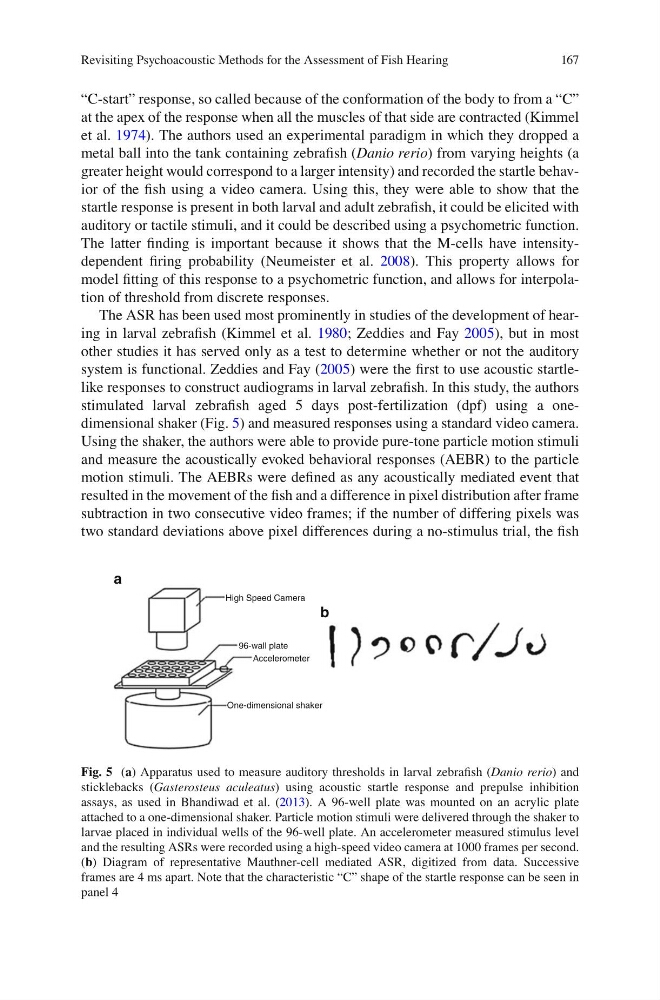
stimulated larval zebrafi sh aged 5 days post-fertilization (dpf) using a onedimensional shaker (Fig. 5 ) and measured responses using a standard video camera.
Using the shaker, the authors were able to provide pure-tone particle motion stimuli
and measure the acoustically evoked behavioral responses (AEBR) to the particle
motion stimuli. The AEBRs were defi ned as any acoustically mediated event that
resulted in the movement of the fi sh and a difference in pixel distribution after frame
subtraction in two consecutive video frames; if the number of differing pixels was
two standard deviations above pixel differences during a no-stimulus trial, the fi sh
High Speed Camera
a
b
96-wall plate
Accelerometer
One-dimensional shaker
Fig. 5 ( a ) Apparatus used to measure auditory thresholds in larval zebrafi sh ( Danio rerio ) and
sticklebacks ( Gasterosteus aculeatus ) using acoustic startle response and prepulse inhibition
assays, as used in Bhandiwad et al. ( 2013 ). A 96-well plate was mounted on an acrylic plate
attached to a one-dimensional shaker. Particle motion stimuli were delivered through the shaker to
larvae placed in individual wells of the 96-well plate. An accelerometer measured stimulus level
and the resulting ASRs were recorded using a high-speed video camera at 1000 frames per second.
( b ) Diagram of representative Mauthner-cell mediated ASR, digitized from data. Successive
frames are 4 ms apart. Note that the characteristic “C” shape of the startle response can be seen in
panel 4
Revisiting Psychoacoustic Methods for the Assessment of Fish Hearing
“C-start” response, so called because of the conformation of the body to from a “C”
at the apex of the response when all the muscles of that side are contracted (Kimmel
et al. 1974 ). The authors used an experimental paradigm in which they dropped a
metal ball into the tank containing zebrafi sh ( Danio rerio ) from varying heights (a
greater height would correspond to a larger intensity) and recorded the startle behavior of the fi sh using a video camera. Using this, they were able to show that the
startle response is present in both larval and adult zebrafi sh, it could be elicited with
auditory or tactile stimuli, and it could be described using a psychometric function.
The latter fi nding is important because it shows that the M-cells have intensitydependent fi ring probability (Neumeister et al. 2008 ). This property allows for
model fi tting of this response to a psychometric function, and allows for interpolation of threshold from discrete responses.
The ASR has been used most prominently in studies of the development of hearing in larval zebrafi sh (Kimmel et al. 1980 ; Zeddies and Fay 2005 ), but in most
other studies it has served only as a test to determine whether or not the auditory
system is functional. Zeddies and Fay ( 2005 ) were the fi rst to use acoustic startlelike responses to construct audiograms in larval zebrafi sh. In this study, the authors
stimulated larval zebrafi sh aged 5 days post-fertilization (dpf) using a onedimensional shaker (Fig. 5 ) and measured responses using a standard video camera.
Using the shaker, the authors were able to provide pure-tone particle motion stimuli
and measure the acoustically evoked behavioral responses (AEBR) to the particle
motion stimuli. The AEBRs were defi ned as any acoustically mediated event that
resulted in the movement of the fi sh and a difference in pixel distribution after frame
subtraction in two consecutive video frames; if the number of differing pixels was
two standard deviations above pixel differences during a no-stimulus trial, the fi sh
High Speed Camera
a
b
96-wall plate
Accelerometer
One-dimensional shaker
Fig. 5 ( a ) Apparatus used to measure auditory thresholds in larval zebrafi sh ( Danio rerio ) and
sticklebacks ( Gasterosteus aculeatus ) using acoustic startle response and prepulse inhibition
assays, as used in Bhandiwad et al. ( 2013 ). A 96-well plate was mounted on an acrylic plate
attached to a one-dimensional shaker. Particle motion stimuli were delivered through the shaker to
larvae placed in individual wells of the 96-well plate. An accelerometer measured stimulus level
and the resulting ASRs were recorded using a high-speed video camera at 1000 frames per second.
( b ) Diagram of representative Mauthner-cell mediated ASR, digitized from data. Successive
frames are 4 ms apart. Note that the characteristic “C” shape of the startle response can be seen in
panel 4
Revisiting Psychoacoustic Methods for the Assessment of Fish Hearing