

165
Perhaps the most powerful use of classical conditioning methods has been in the
study of auditory scene analysis in goldfi sh ( C. auratus ), in particular auditory
stream segregation. Utilizing a ventilation suppression refl ex, Fay ( 1998 ) trained
goldfi sh to suppress ventilation when presented with a complex acoustic stimulus
that was paired with a mild electric shock. During conditioning, the goldfi sh learned
to anticipate the shock paired with the acoustic stimulus by suppressing their ventilatory movements, functionally measured as the rate of mouth openings (Otis et al.
1957 ). The pairing of the conditioned acoustic stimulus and an unconditioned shock
stimulus led to an association of the conditioned stimulus with an unconditioned
response, the involuntary suppression of ventilatory movements of the goldfi sh,
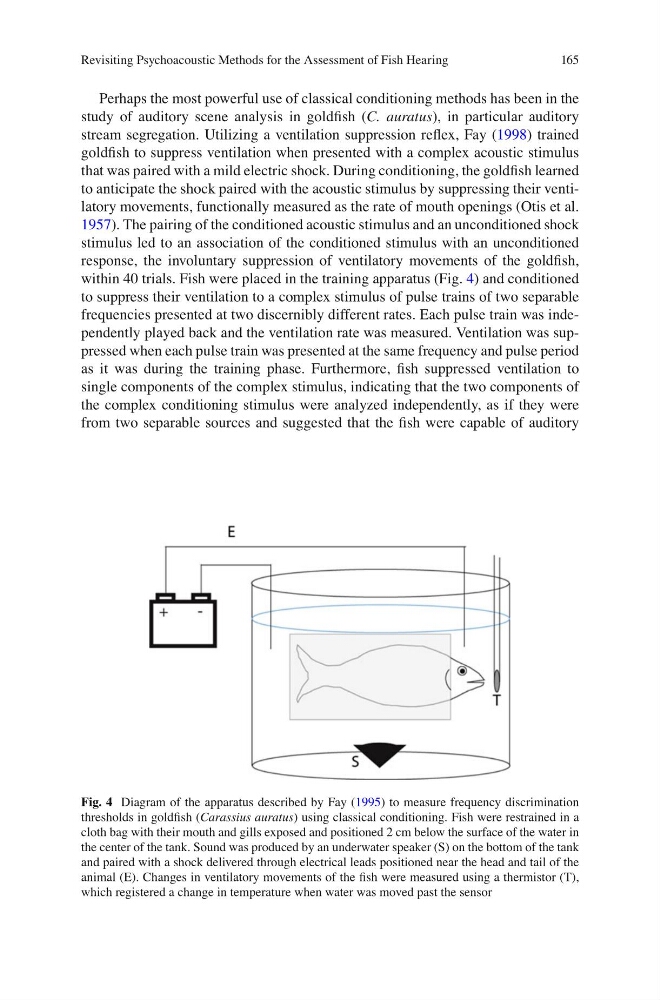
within 40 trials. Fish were placed in the training apparatus (Fig. 4 ) and conditioned
to suppress their ventilation to a complex stimulus of pulse trains of two separable
frequencies presented at two discernibly different rates. Each pulse train was independently played back and the ventilation rate was measured. Ventilation was suppressed when each pulse train was presented at the same frequency and pulse period
as it was during the training phase. Furthermore, fi sh suppressed ventilation to
single components of the complex stimulus, indicating that the two components of
the complex conditioning stimulus were analyzed independently, as if they were
from two separable sources and suggested that the fi sh were capable of auditory
Fig. 4 Diagram of the apparatus described by Fay ( 1995 ) to measure frequency discrimination
thresholds in goldfi sh ( Carassius auratus ) using classical conditioning. Fish were restrained in a
cloth bag with their mouth and gills exposed and positioned 2 cm below the surface of the water in
the center of the tank. Sound was produced by an underwater speaker (S) on the bottom of the tank
and paired with a shock delivered through electrical leads positioned near the head and tail of the
animal (E). Changes in ventilatory movements of the fi sh were measured using a thermistor (T),
which registered a change in temperature when water was moved past the sensor
Revisiting Psychoacoustic Methods for the Assessment of Fish Hearing
Perhaps the most powerful use of classical conditioning methods has been in the
study of auditory scene analysis in goldfi sh ( C. auratus ), in particular auditory
stream segregation. Utilizing a ventilation suppression refl ex, Fay ( 1998 ) trained
goldfi sh to suppress ventilation when presented with a complex acoustic stimulus
that was paired with a mild electric shock. During conditioning, the goldfi sh learned
to anticipate the shock paired with the acoustic stimulus by suppressing their ventilatory movements, functionally measured as the rate of mouth openings (Otis et al.
1957 ). The pairing of the conditioned acoustic stimulus and an unconditioned shock
stimulus led to an association of the conditioned stimulus with an unconditioned
response, the involuntary suppression of ventilatory movements of the goldfi sh,
within 40 trials. Fish were placed in the training apparatus (Fig. 4 ) and conditioned
to suppress their ventilation to a complex stimulus of pulse trains of two separable
frequencies presented at two discernibly different rates. Each pulse train was independently played back and the ventilation rate was measured. Ventilation was suppressed when each pulse train was presented at the same frequency and pulse period
as it was during the training phase. Furthermore, fi sh suppressed ventilation to
single components of the complex stimulus, indicating that the two components of
the complex conditioning stimulus were analyzed independently, as if they were
from two separable sources and suggested that the fi sh were capable of auditory
Fig. 4 Diagram of the apparatus described by Fay ( 1995 ) to measure frequency discrimination
thresholds in goldfi sh ( Carassius auratus ) using classical conditioning. Fish were restrained in a
cloth bag with their mouth and gills exposed and positioned 2 cm below the surface of the water in
the center of the tank. Sound was produced by an underwater speaker (S) on the bottom of the tank
and paired with a shock delivered through electrical leads positioned near the head and tail of the
animal (E). Changes in ventilatory movements of the fi sh were measured using a thermistor (T),
which registered a change in temperature when water was moved past the sensor
Revisiting Psychoacoustic Methods for the Assessment of Fish Hearing