

163
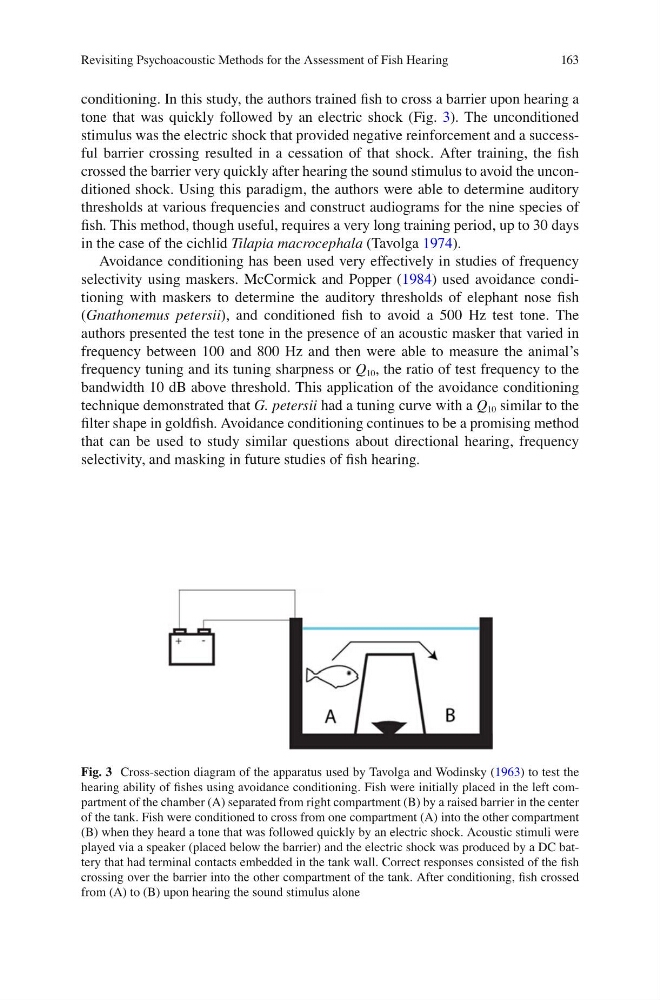
conditioning. In this study, the authors trained fi sh to cross a barrier upon hearing a
tone that was quickly followed by an electric shock (Fig. 3 ). The unconditioned
stimulus was the electric shock that provided negative reinforcement and a successful barrier crossing resulted in a cessation of that shock. After training, the fi sh
crossed the barrier very quickly after hearing the sound stimulus to avoid the unconditioned shock. Using this paradigm, the authors were able to determine auditory
thresholds at various frequencies and construct audiograms for the nine species of
fi sh. This method, though useful, requires a very long training period, up to 30 days
in the case of the cichlid Tilapia macrocephala (Tavolga 1974 ).
Avoidance conditioning has been used very effectively in studies of frequency
selectivity using maskers. McCormick and Popper ( 1984 ) used avoidance conditioning with maskers to determine the auditory thresholds of elephant nose fi sh
( Gnathonemus petersii ), and conditioned fi sh to avoid a 500 Hz test tone. The
authors presented the test tone in the presence of an acoustic masker that varied in
frequency between 100 and 800 Hz and then were able to measure the animal’s
frequency tuning and its tuning sharpness or Q 10 , the ratio of test frequency to the
bandwidth 10 dB above threshold. This application of the avoidance conditioning
technique demonstrated that G. petersii had a tuning curve with a Q 10 similar to the
fi lter shape in goldfi sh. Avoidance conditioning continues to be a promising method
that can be used to study similar questions about directional hearing, frequency
selectivity, and masking in future studies of fi sh hearing.
Fig. 3 Cross-section diagram of the apparatus used by Tavolga and Wodinsky ( 1963 ) to test the
hearing ability of fi shes using avoidance conditioning. Fish were initially placed in the left compartment of the chamber (A) separated from right compartment (B) by a raised barrier in the center
of the tank. Fish were conditioned to cross from one compartment (A) into the other compartment
(B) when they heard a tone that was followed quickly by an electric shock. Acoustic stimuli were
played via a speaker (placed below the barrier) and the electric shock was produced by a DC battery that had terminal contacts embedded in the tank wall. Correct responses consisted of the fi sh
crossing over the barrier into the other compartment of the tank. After conditioning, fi sh crossed
from (A) to (B) upon hearing the sound stimulus alone
Revisiting Psychoacoustic Methods for the Assessment of Fish Hearing
conditioning. In this study, the authors trained fi sh to cross a barrier upon hearing a
tone that was quickly followed by an electric shock (Fig. 3 ). The unconditioned
stimulus was the electric shock that provided negative reinforcement and a successful barrier crossing resulted in a cessation of that shock. After training, the fi sh
crossed the barrier very quickly after hearing the sound stimulus to avoid the unconditioned shock. Using this paradigm, the authors were able to determine auditory
thresholds at various frequencies and construct audiograms for the nine species of
fi sh. This method, though useful, requires a very long training period, up to 30 days
in the case of the cichlid Tilapia macrocephala (Tavolga 1974 ).
Avoidance conditioning has been used very effectively in studies of frequency
selectivity using maskers. McCormick and Popper ( 1984 ) used avoidance conditioning with maskers to determine the auditory thresholds of elephant nose fi sh
( Gnathonemus petersii ), and conditioned fi sh to avoid a 500 Hz test tone. The
authors presented the test tone in the presence of an acoustic masker that varied in
frequency between 100 and 800 Hz and then were able to measure the animal’s
frequency tuning and its tuning sharpness or Q 10 , the ratio of test frequency to the
bandwidth 10 dB above threshold. This application of the avoidance conditioning
technique demonstrated that G. petersii had a tuning curve with a Q 10 similar to the
fi lter shape in goldfi sh. Avoidance conditioning continues to be a promising method
that can be used to study similar questions about directional hearing, frequency
selectivity, and masking in future studies of fi sh hearing.
Fig. 3 Cross-section diagram of the apparatus used by Tavolga and Wodinsky ( 1963 ) to test the
hearing ability of fi shes using avoidance conditioning. Fish were initially placed in the left compartment of the chamber (A) separated from right compartment (B) by a raised barrier in the center
of the tank. Fish were conditioned to cross from one compartment (A) into the other compartment
(B) when they heard a tone that was followed quickly by an electric shock. Acoustic stimuli were
played via a speaker (placed below the barrier) and the electric shock was produced by a DC battery that had terminal contacts embedded in the tank wall. Correct responses consisted of the fi sh
crossing over the barrier into the other compartment of the tank. After conditioning, fi sh crossed
from (A) to (B) upon hearing the sound stimulus alone
Revisiting Psychoacoustic Methods for the Assessment of Fish Hearing