

158
1 Introduction
Interest in teleost audition dates back to Aristotle’s observation that “fi shes undoubtedly hear…For they are observed to run away from any loud noise, such as would
be made by the rowing of a galley, so as to become easy of capture in their holes; for
though a sound be very slight in the open air, it has a loud and alarming resonance
to creatures that hear under water” (for translation of Aristotle’s original text see
Barnes 1984 ). However, the formal study of hearing in fi shes began at the turn of the
twentieth century after Retzius ( 1881 ) published his study of the structure of inner
ears of 48 species of fi shes, which spawned interests in studying the mechanisms
and processes underlying fi sh hearing. Parker ( 1903 ) was the fi rst to quantitatively
show that these inner ears were functional and that fi sh possess a sense of hearing.
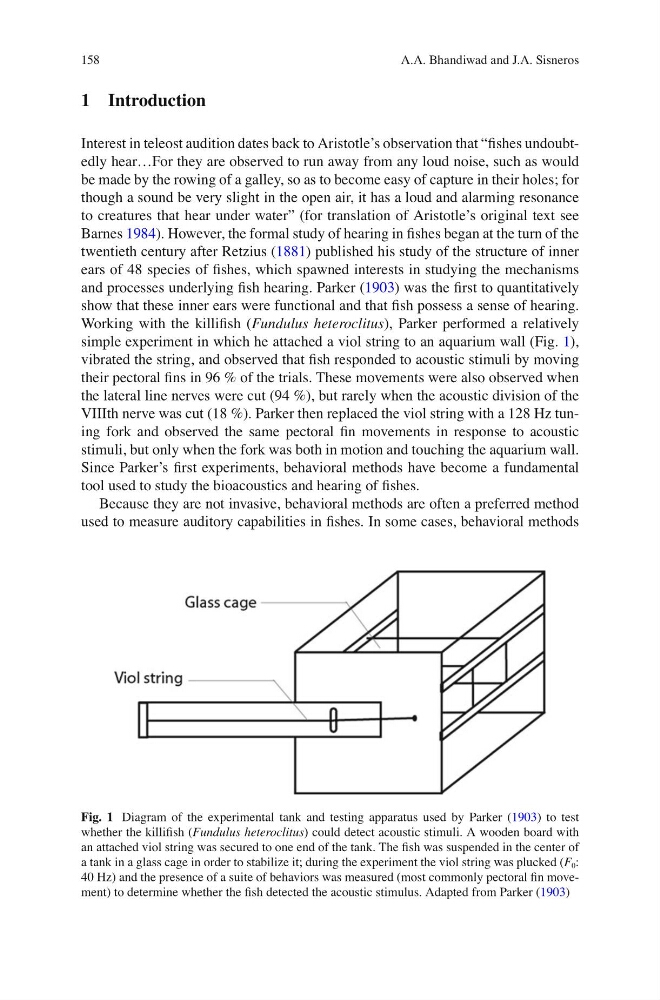
Working with the killifi sh ( Fundulus heteroclitus ), Parker performed a relatively
simple experiment in which he attached a viol string to an aquarium wall (Fig. 1 ),
vibrated the string, and observed that fi sh responded to acoustic stimuli by moving
their pectoral fi ns in 96 % of the trials. These movements were also observed when
the lateral line nerves were cut (94 %), but rarely when the acoustic division of the
VIIIth nerve was cut (18 %). Parker then replaced the viol string with a 128 Hz tuning fork and observed the same pectoral fi n movements in response to acoustic
stimuli, but only when the fork was both in motion and touching the aquarium wall.
Since Parker’s fi rst experiments, behavioral methods have become a fundamental
tool used to study the bioacoustics and hearing of fi shes.
Because they are not invasive, behavioral methods are often a preferred method
used to measure auditory capabilities in fi shes. In some cases, behavioral methods
Fig. 1 Diagram of the experimental tank and testing apparatus used by Parker ( 1903 ) to test
whether the killifi sh ( Fundulus heteroclitus ) could detect acoustic stimuli. A wooden board with
an attached viol string was secured to one end of the tank. The fi sh was suspended in the center of
a tank in a glass cage in order to stabilize it; during the experiment the viol string was plucked ( F 0 :
40 Hz) and the presence of a suite of behaviors was measured (most commonly pectoral fi n movement) to determine whether the fi sh detected the acoustic stimulus. Adapted from Parker ( 1903 )
A.A. Bhandiwad and J.A. Sisneros
1 Introduction
Interest in teleost audition dates back to Aristotle’s observation that “fi shes undoubtedly hear…For they are observed to run away from any loud noise, such as would
be made by the rowing of a galley, so as to become easy of capture in their holes; for
though a sound be very slight in the open air, it has a loud and alarming resonance
to creatures that hear under water” (for translation of Aristotle’s original text see
Barnes 1984 ). However, the formal study of hearing in fi shes began at the turn of the
twentieth century after Retzius ( 1881 ) published his study of the structure of inner
ears of 48 species of fi shes, which spawned interests in studying the mechanisms
and processes underlying fi sh hearing. Parker ( 1903 ) was the fi rst to quantitatively
show that these inner ears were functional and that fi sh possess a sense of hearing.
Working with the killifi sh ( Fundulus heteroclitus ), Parker performed a relatively
simple experiment in which he attached a viol string to an aquarium wall (Fig. 1 ),
vibrated the string, and observed that fi sh responded to acoustic stimuli by moving
their pectoral fi ns in 96 % of the trials. These movements were also observed when
the lateral line nerves were cut (94 %), but rarely when the acoustic division of the
VIIIth nerve was cut (18 %). Parker then replaced the viol string with a 128 Hz tuning fork and observed the same pectoral fi n movements in response to acoustic
stimuli, but only when the fork was both in motion and touching the aquarium wall.
Since Parker’s fi rst experiments, behavioral methods have become a fundamental
tool used to study the bioacoustics and hearing of fi shes.
Because they are not invasive, behavioral methods are often a preferred method
used to measure auditory capabilities in fi shes. In some cases, behavioral methods
Fig. 1 Diagram of the experimental tank and testing apparatus used by Parker ( 1903 ) to test
whether the killifi sh ( Fundulus heteroclitus ) could detect acoustic stimuli. A wooden board with
an attached viol string was secured to one end of the tank. The fi sh was suspended in the center of
a tank in a glass cage in order to stabilize it; during the experiment the viol string was plucked ( F 0 :
40 Hz) and the presence of a suite of behaviors was measured (most commonly pectoral fi n movement) to determine whether the fi sh detected the acoustic stimulus. Adapted from Parker ( 1903 )
A.A. Bhandiwad and J.A. Sisneros