

142
I r
r v r
,
,
,
t
p t
t
( )= ( ) ( )
(1)
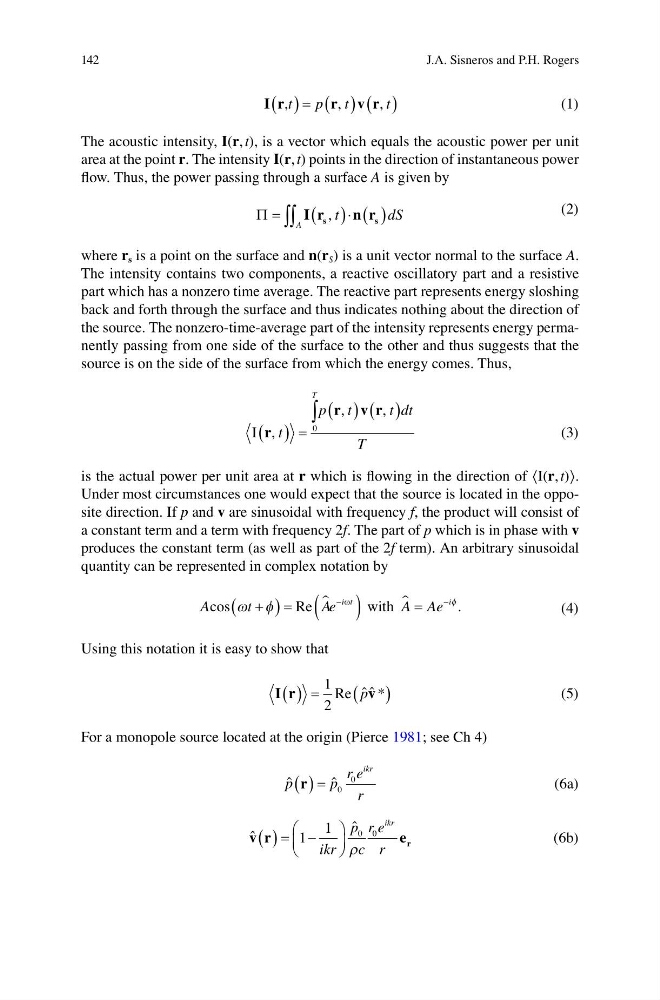
The acoustic intensity, I(r, t), is a vector which equals the acoustic power per unit
area at the point r. The intensity I(r, t) points in the direction of instantaneous power
flow. Thus, the power passing through a surface A is given by
P =
( )× ( )
òò I r n r
s
s
A
, t
d S
(2)
where r s is a point on the surface and n(r S ) is a unit vector normal to the surface A.
The intensity contains two components, a reactive oscillatory part and a resistive
part which has a nonzero time average. The reactive part represents energy sloshing
back and forth through the surface and thus indicates nothing about the direction of
the source. The nonzero-time-average part of the intensity represents energy permanently passing from one side of the surface to the other and thus suggests that the
source is on the side of the surface from which the energy comes. Thus,
I ,
,
,
r
r v r
t
p t
t dt
T
T
( ) =
( ) ( )
ò
0
(3)
is the actual power per unit area at r which is flowing in the direction of 〈I(r, t)〉.
Under most circumstances one would expect that the source is located in the opposite direction. If p and v are sinusoidal with frequency f, the product will consist of
a constant term and a term with frequency 2f. The part of p which is in phase with v
produces the constant term (as well as part of the 2f term). An arbitrary sinusoidal
quantity can be represented in complex notation by
A
t
e
A e
i t
i
cos
.
w
f
+
(
)= ( )
=
-
-
f Re
with
A
A
w
(4)
Using this notation it is easy to show that
I
v
r
( ) =
( )
1
2
Re ˆ ˆ *
p
(5)
For a monopole source located at the origin (Pierce 1981; see Ch 4)
ˆ
ˆ
p
p
r e
r
ikr
r
( ) = 0
0
(6a)
ˆ
ˆ
v r
e r
( ) = -
æ
è
ç
ö
ø
÷
1
1
0 0
ikr
p
c
r e
r
ikr
r
(6b)
J.A. Sisneros and P.H. Rogers
I r
r v r
,
,
,
t
p t
t
( )= ( ) ( )
(1)
The acoustic intensity, I(r, t), is a vector which equals the acoustic power per unit
area at the point r. The intensity I(r, t) points in the direction of instantaneous power
flow. Thus, the power passing through a surface A is given by
P =
( )× ( )
òò I r n r
s
s
A
, t
d S
(2)
where r s is a point on the surface and n(r S ) is a unit vector normal to the surface A.
The intensity contains two components, a reactive oscillatory part and a resistive
part which has a nonzero time average. The reactive part represents energy sloshing
back and forth through the surface and thus indicates nothing about the direction of
the source. The nonzero-time-average part of the intensity represents energy permanently passing from one side of the surface to the other and thus suggests that the
source is on the side of the surface from which the energy comes. Thus,
I ,
,
,
r
r v r
t
p t
t dt
T
T
( ) =
( ) ( )
ò
0
(3)
is the actual power per unit area at r which is flowing in the direction of 〈I(r, t)〉.
Under most circumstances one would expect that the source is located in the opposite direction. If p and v are sinusoidal with frequency f, the product will consist of
a constant term and a term with frequency 2f. The part of p which is in phase with v
produces the constant term (as well as part of the 2f term). An arbitrary sinusoidal
quantity can be represented in complex notation by
A
t
e
A e
i t
i
cos
.
w
f
+
(
)= ( )
=
-
-
f Re
with
A
A
w
(4)
Using this notation it is easy to show that
I
v
r
( ) =
( )
1
2
Re ˆ ˆ *
p
(5)
For a monopole source located at the origin (Pierce 1981; see Ch 4)
ˆ
ˆ
p
p
r e
r
ikr
r
( ) = 0
0
(6a)
ˆ
ˆ
v r
e r
( ) = -
æ
è
ç
ö
ø
÷
1
1
0 0
ikr
p
c
r e
r
ikr
r
(6b)
J.A. Sisneros and P.H. Rogers