

125
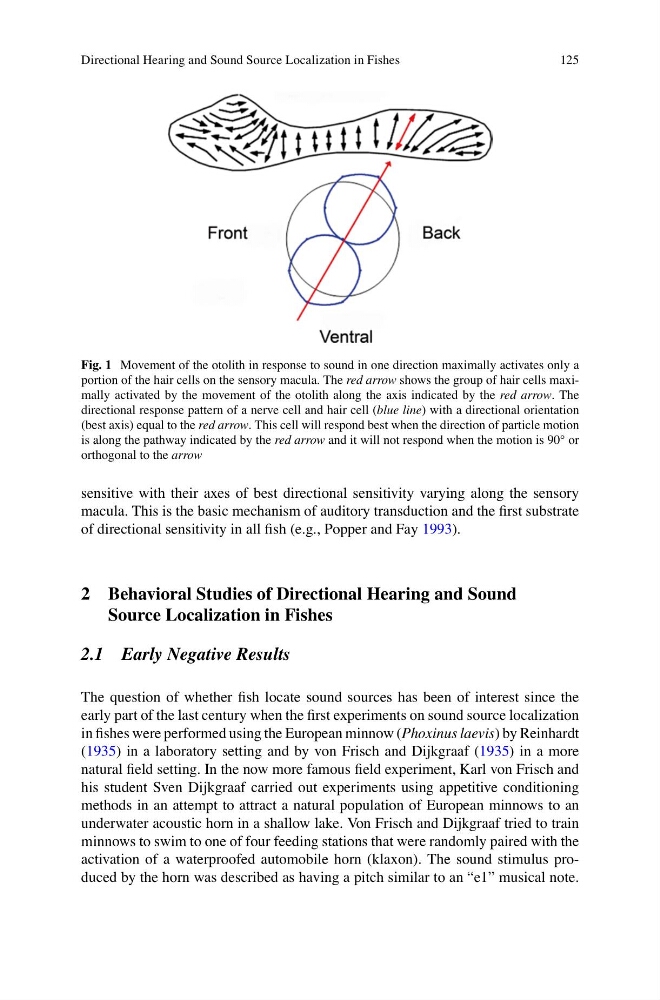
sensitive with their axes of best directional sensitivity varying along the sensory
macula. This is the basic mechanism of auditory transduction and the first substrate
of directional sensitivity in all fish (e.g., Popper and Fay 1993).
2 Behavioral Studies of Directional Hearing and Sound
Source Localization in Fishes
2.1 Early Negative Results
The question of whether fish locate sound sources has been of interest since the
early part of the last century when the first experiments on sound source localization
in fishes were performed using the European minnow (Phoxinus laevis) by Reinhardt
(1935) in a laboratory setting and by von Frisch and Dijkgraaf (1935) in a more
natural field setting. In the now more famous field experiment, Karl von Frisch and
his student Sven Dijkgraaf carried out experiments using appetitive conditioning
methods in an attempt to attract a natural population of European minnows to an
underwater acoustic horn in a shallow lake. Von Frisch and Dijkgraaf tried to train
minnows to swim to one of four feeding stations that were randomly paired with the
activation of a waterproofed automobile horn (klaxon). The sound stimulus produced by the horn was described as having a pitch similar to an “e1” musical note.
Fig. 1 Movement of the otolith in response to sound in one direction maximally activates only a
portion of the hair cells on the sensory macula. The red arrow shows the group of hair cells maximally activated by the movement of the otolith along the axis indicated by the red arrow. The
directional response pattern of a nerve cell and hair cell (blue line) with a directional orientation
(best axis) equal to the red arrow. This cell will respond best when the direction of particle motion
is along the pathway indicated by the red arrow and it will not respond when the motion is 90° or
orthogonal to the arrow
Directional Hearing and Sound Source Localization in Fishes
sensitive with their axes of best directional sensitivity varying along the sensory
macula. This is the basic mechanism of auditory transduction and the first substrate
of directional sensitivity in all fish (e.g., Popper and Fay 1993).
2 Behavioral Studies of Directional Hearing and Sound
Source Localization in Fishes
2.1 Early Negative Results
The question of whether fish locate sound sources has been of interest since the
early part of the last century when the first experiments on sound source localization
in fishes were performed using the European minnow (Phoxinus laevis) by Reinhardt
(1935) in a laboratory setting and by von Frisch and Dijkgraaf (1935) in a more
natural field setting. In the now more famous field experiment, Karl von Frisch and
his student Sven Dijkgraaf carried out experiments using appetitive conditioning
methods in an attempt to attract a natural population of European minnows to an
underwater acoustic horn in a shallow lake. Von Frisch and Dijkgraaf tried to train
minnows to swim to one of four feeding stations that were randomly paired with the
activation of a waterproofed automobile horn (klaxon). The sound stimulus produced by the horn was described as having a pitch similar to an “e1” musical note.
Fig. 1 Movement of the otolith in response to sound in one direction maximally activates only a
portion of the hair cells on the sensory macula. The red arrow shows the group of hair cells maximally activated by the movement of the otolith along the axis indicated by the red arrow. The
directional response pattern of a nerve cell and hair cell (blue line) with a directional orientation
(best axis) equal to the red arrow. This cell will respond best when the direction of particle motion
is along the pathway indicated by the red arrow and it will not respond when the motion is 90° or
orthogonal to the arrow
Directional Hearing and Sound Source Localization in Fishes