

104
This correspondence between cavity nesting and sound production is a similar pattern to darters, indicating another potential aspect of convergence.
Several goby species utilize distinct sound types during distinct spawning phases,
and in at least two sand goby species ( Knipowitschia punctatissima , K. panizzae ,)
the male, while silent during courtship outside of the nest, produces drumming
sounds exclusively while a female is in the nest (Lugli et al. 1997 ; Lugli and
Torricelli 1999 ). Padogobius bonelli courtship sounds are tonal ( f o ~ 100 Hz, duration ~ 500 ms), whereas spawning sounds are pulse trains or “complex” (Lugli et al.
1997 ) (Fig. 1e ). Similar sequence-specifi c sound types occur in P. canestrinii , where
courtship sounds emitted outside the nest are “thumps” consisting of single, short
pulses repeated within a burst of 10–20 pulses (Malavasi et al. 2009 ), whereas prespawning sounds emitted in the nest with the onset of spawning are long pulse trains
(>1 s duration in some cases) (Lugli and Torricelli 1999 ; Malavasi et al. 2009 ). A
similar thump-pulse train sequence was described for the closely related
Pomatoschistus pictus (Amorim and Neves 2007 ). Since the genera Padogobius and
Pomatoschistus are relatively distant clades (Huyse et al. 2004 ; Malavasi et al.
2008 ), the utilization of two distinct sound types for courtship and pre-spawning
function could represent convergent evolution.
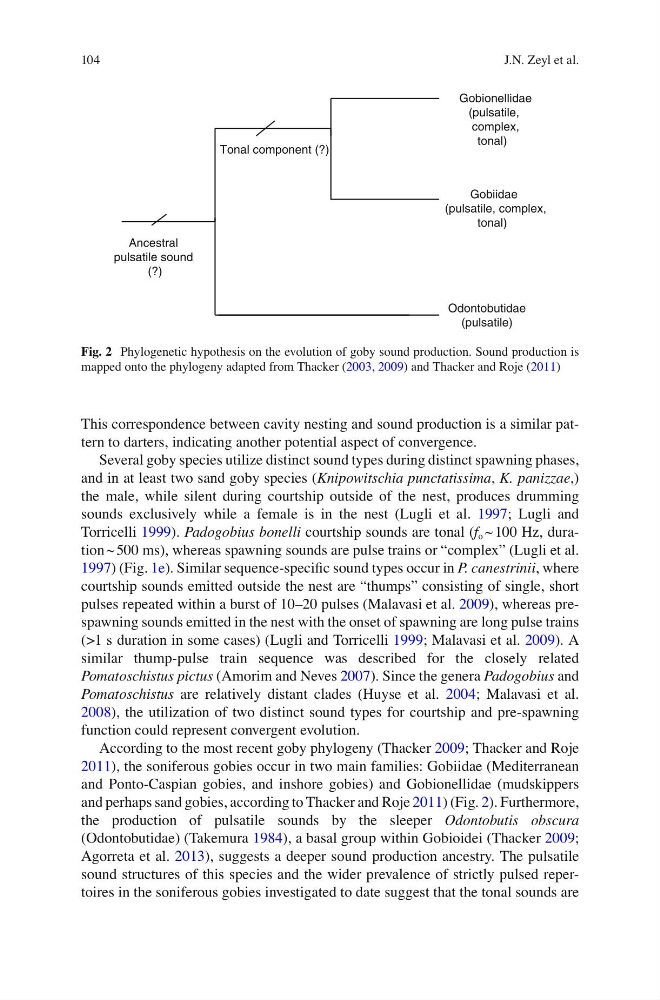
According to the most recent goby phylogeny (Thacker 2009 ; Thacker and Roje
2011 ), the soniferous gobies occur in two main families: Gobiidae (Mediterranean
and Ponto-Caspian gobies, and inshore gobies) and Gobionellidae (mudskippers
and perhaps sand gobies, according to Thacker and Roje 2011 ) (Fig. 2 ). Furthermore,
the production of pulsatile sounds by the sleeper Odontobutis obscura
(Odontobutidae) (Takemura 1984 ), a basal group within Gobioidei (Thacker 2009 ;
Agorreta et al. 2013 ), suggests a deeper sound production ancestry. The pulsatile
sound structures of this species and the wider prevalence of strictly pulsed repertoires in the soniferous gobies investigated to date suggest that the tonal sounds are
Odontobutidae
(pulsatile)
Gobiidae
(pulsatile, complex,
tonal)
Gobionellidae
(pulsatile,
complex,
tonal)
Tonal component (?)
Ancestral
pulsatile sound
(?)
Fig. 2 Phylogenetic hypothesis on the evolution of goby sound production. Sound production is
mapped onto the phylogeny adapted from Thacker ( 2003 , 2009 ) and Thacker and Roje ( 2011 )
J.N. Zeyl et al.
This correspondence between cavity nesting and sound production is a similar pattern to darters, indicating another potential aspect of convergence.
Several goby species utilize distinct sound types during distinct spawning phases,
and in at least two sand goby species ( Knipowitschia punctatissima , K. panizzae ,)
the male, while silent during courtship outside of the nest, produces drumming
sounds exclusively while a female is in the nest (Lugli et al. 1997 ; Lugli and
Torricelli 1999 ). Padogobius bonelli courtship sounds are tonal ( f o ~ 100 Hz, duration ~ 500 ms), whereas spawning sounds are pulse trains or “complex” (Lugli et al.
1997 ) (Fig. 1e ). Similar sequence-specifi c sound types occur in P. canestrinii , where
courtship sounds emitted outside the nest are “thumps” consisting of single, short
pulses repeated within a burst of 10–20 pulses (Malavasi et al. 2009 ), whereas prespawning sounds emitted in the nest with the onset of spawning are long pulse trains
(>1 s duration in some cases) (Lugli and Torricelli 1999 ; Malavasi et al. 2009 ). A
similar thump-pulse train sequence was described for the closely related
Pomatoschistus pictus (Amorim and Neves 2007 ). Since the genera Padogobius and
Pomatoschistus are relatively distant clades (Huyse et al. 2004 ; Malavasi et al.
2008 ), the utilization of two distinct sound types for courtship and pre-spawning
function could represent convergent evolution.
According to the most recent goby phylogeny (Thacker 2009 ; Thacker and Roje
2011 ), the soniferous gobies occur in two main families: Gobiidae (Mediterranean
and Ponto-Caspian gobies, and inshore gobies) and Gobionellidae (mudskippers
and perhaps sand gobies, according to Thacker and Roje 2011 ) (Fig. 2 ). Furthermore,
the production of pulsatile sounds by the sleeper Odontobutis obscura
(Odontobutidae) (Takemura 1984 ), a basal group within Gobioidei (Thacker 2009 ;
Agorreta et al. 2013 ), suggests a deeper sound production ancestry. The pulsatile
sound structures of this species and the wider prevalence of strictly pulsed repertoires in the soniferous gobies investigated to date suggest that the tonal sounds are
Odontobutidae
(pulsatile)
Gobiidae
(pulsatile, complex,
tonal)
Gobionellidae
(pulsatile,
complex,
tonal)
Tonal component (?)
Ancestral
pulsatile sound
(?)
Fig. 2 Phylogenetic hypothesis on the evolution of goby sound production. Sound production is
mapped onto the phylogeny adapted from Thacker ( 2003 , 2009 ) and Thacker and Roje ( 2011 )
J.N. Zeyl et al.