

60
planning/management agencies. The use of such frameworks, illustrated as models
to facilitate understanding and interpretation, is common throughout the whalewatching management literature (e.g. Duffus and Dearden 1990; IFAW 1995; Curtin
2003; Higham et al. 2009; New et al. 2015).
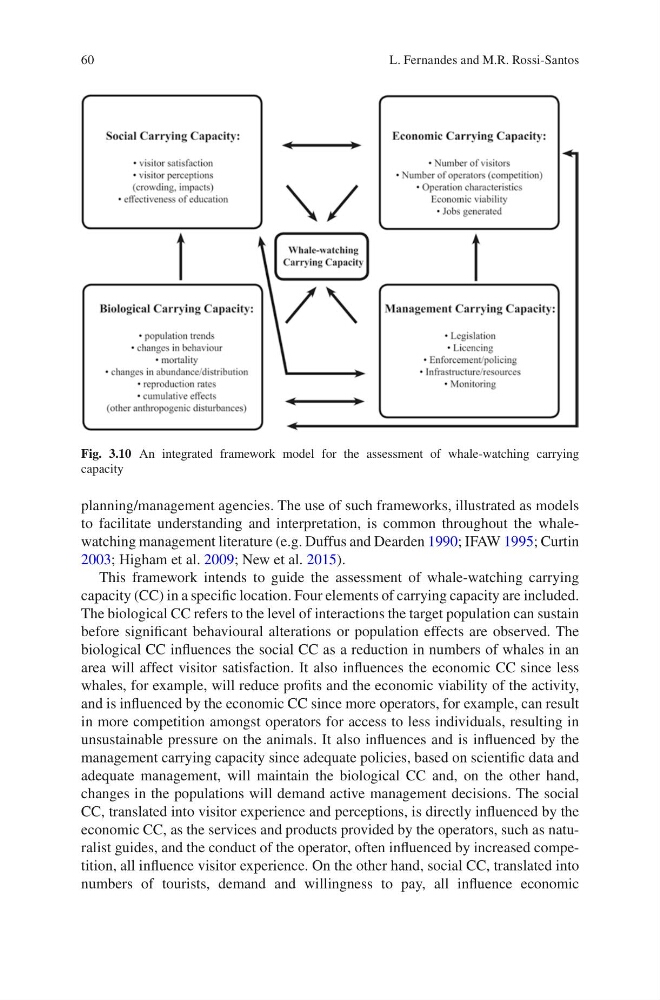
This framework intends to guide the assessment of whale-watching carrying
capacity (CC) in a specific location. Four elements of carrying capacity are included.
The biological CC refers to the level of interactions the target population can sustain
before significant behavioural alterations or population effects are observed. The
biological CC influences the social CC as a reduction in numbers of whales in an
area will affect visitor satisfaction. It also influences the economic CC since less
whales, for example, will reduce profits and the economic viability of the activity,
and is influenced by the economic CC since more operators, for example, can result
in more competition amongst operators for access to less individuals, resulting in
unsustainable pressure on the animals. It also influences and is influenced by the
management carrying capacity since adequate policies, based on scientific data and
adequate management, will maintain the biological CC and, on the other hand,
changes in the populations will demand active management decisions. The social
CC, translated into visitor experience and perceptions, is directly influenced by the
economic CC, as the services and products provided by the operators, such as naturalist guides, and the conduct of the operator, often influenced by increased competition, all influence visitor experience. On the other hand, social CC, translated into
numbers of tourists, demand and willingness to pay, all influence economic
Fig. 3.10 An integrated framework model for the assessment of whale-watching carrying
capacity
L. Fernandes and M.R. Rossi-Santos
planning/management agencies. The use of such frameworks, illustrated as models
to facilitate understanding and interpretation, is common throughout the whalewatching management literature (e.g. Duffus and Dearden 1990; IFAW 1995; Curtin
2003; Higham et al. 2009; New et al. 2015).
This framework intends to guide the assessment of whale-watching carrying
capacity (CC) in a specific location. Four elements of carrying capacity are included.
The biological CC refers to the level of interactions the target population can sustain
before significant behavioural alterations or population effects are observed. The
biological CC influences the social CC as a reduction in numbers of whales in an
area will affect visitor satisfaction. It also influences the economic CC since less
whales, for example, will reduce profits and the economic viability of the activity,
and is influenced by the economic CC since more operators, for example, can result
in more competition amongst operators for access to less individuals, resulting in
unsustainable pressure on the animals. It also influences and is influenced by the
management carrying capacity since adequate policies, based on scientific data and
adequate management, will maintain the biological CC and, on the other hand,
changes in the populations will demand active management decisions. The social
CC, translated into visitor experience and perceptions, is directly influenced by the
economic CC, as the services and products provided by the operators, such as naturalist guides, and the conduct of the operator, often influenced by increased competition, all influence visitor experience. On the other hand, social CC, translated into
numbers of tourists, demand and willingness to pay, all influence economic
Fig. 3.10 An integrated framework model for the assessment of whale-watching carrying
capacity
L. Fernandes and M.R. Rossi-Santos