

57
Similarly, whale-watching carrying capacity must be assessed with basis on a set
of variables related to the three spheres of sustainable management, namely the
impact on whales (Biological), on tourist experience (Social) and whale-watching
companies (Economic) (Chion et al. 2012), as well as management capacity.
3.5.1 Social Carrying Capacity – The Tourists
The social carrying capacity relates to visitor experience on whale-watching boats,
including the time spent observing whales, time spent alone with the whales and
satisfaction (Lime and Stankey 1971; Chion et al. 2012).
There are many studies that measured the satisfaction of whale-watching tourists
(e.g. Avila-Foucat et al. 2013; Filby et al. 2015; Sitar et al. 2015). Generally, tourists
prefer when whale-watching trips have educational elements (Bentz et al. 2016a),
licensed boat operators, and boat operators that follow whale-watching regulations
(Orams 2000) and are concerned about minimizing harm to whales (Kessler et al.
2014).
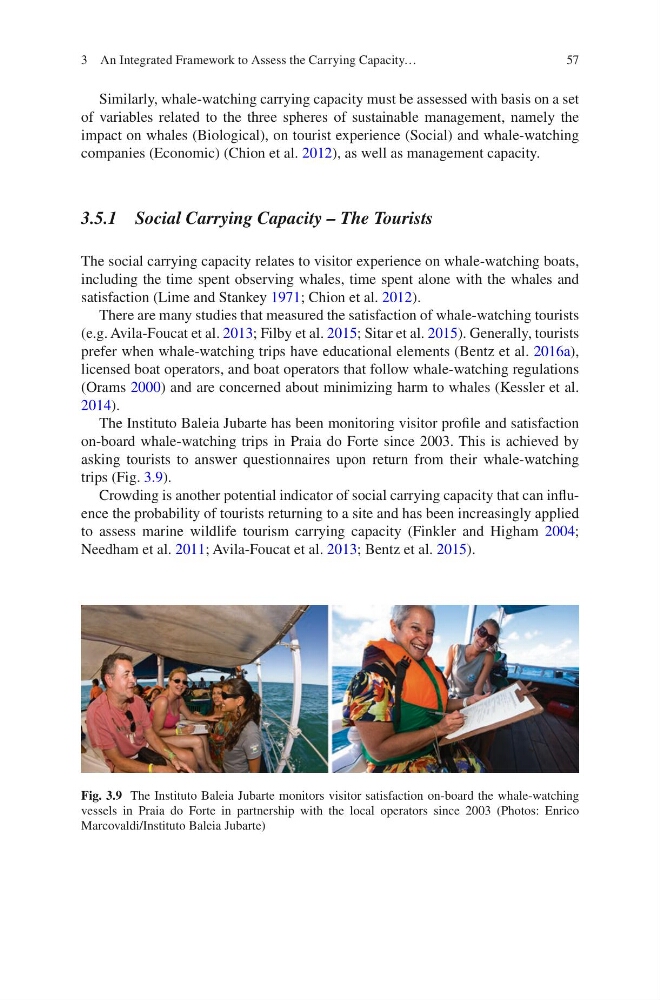
The Instituto Baleia Jubarte has been monitoring visitor profile and satisfaction
on-board whale-watching trips in Praia do Forte since 2003. This is achieved by
asking tourists to answer questionnaires upon return from their whale-watching
trips (Fig. 3.9).
Crowding is another potential indicator of social carrying capacity that can influence the probability of tourists returning to a site and has been increasingly applied
to assess marine wildlife tourism carrying capacity (Finkler and Higham 2004;
Needham et al. 2011; Avila-Foucat et al. 2013; Bentz et al. 2015).
Fig. 3.9 The Instituto Baleia Jubarte monitors visitor satisfaction on-board the whale-watching
vessels in Praia do Forte in partnership with the local operators since 2003 (Photos: Enrico
Marcovaldi/Instituto Baleia Jubarte)
3 An Integrated Framework to Assess the Carrying Capacity…
Similarly, whale-watching carrying capacity must be assessed with basis on a set
of variables related to the three spheres of sustainable management, namely the
impact on whales (Biological), on tourist experience (Social) and whale-watching
companies (Economic) (Chion et al. 2012), as well as management capacity.
3.5.1 Social Carrying Capacity – The Tourists
The social carrying capacity relates to visitor experience on whale-watching boats,
including the time spent observing whales, time spent alone with the whales and
satisfaction (Lime and Stankey 1971; Chion et al. 2012).
There are many studies that measured the satisfaction of whale-watching tourists
(e.g. Avila-Foucat et al. 2013; Filby et al. 2015; Sitar et al. 2015). Generally, tourists
prefer when whale-watching trips have educational elements (Bentz et al. 2016a),
licensed boat operators, and boat operators that follow whale-watching regulations
(Orams 2000) and are concerned about minimizing harm to whales (Kessler et al.
2014).
The Instituto Baleia Jubarte has been monitoring visitor profile and satisfaction
on-board whale-watching trips in Praia do Forte since 2003. This is achieved by
asking tourists to answer questionnaires upon return from their whale-watching
trips (Fig. 3.9).
Crowding is another potential indicator of social carrying capacity that can influence the probability of tourists returning to a site and has been increasingly applied
to assess marine wildlife tourism carrying capacity (Finkler and Higham 2004;
Needham et al. 2011; Avila-Foucat et al. 2013; Bentz et al. 2015).
Fig. 3.9 The Instituto Baleia Jubarte monitors visitor satisfaction on-board the whale-watching
vessels in Praia do Forte in partnership with the local operators since 2003 (Photos: Enrico
Marcovaldi/Instituto Baleia Jubarte)
3 An Integrated Framework to Assess the Carrying Capacity…