

458
(Hamilton et al. 2009). The software was designated to be server-based and is
accessible through the Internet. This allows data and images to be processed and
integrated from field stations, as well as provides a framework to allow public
assess. The database can also include photographs of skin lesions and general body
condition, allowing for health assessment studies.
A similar data management system was developed by Australian researchers, as
a need for a broader-based catalogue that provides for integration of data and linkages between projects (Australian Government 2009; Pirzl and Watson 2011). The
Australasian Right Whale Photo-identification Catalogue (ARWPIC) integrate
southern right whale photo-identification collections and related data of Australian
and New Zealand so that data are archived and accessible from one web-based
portal as a collaborative research and management initiative.
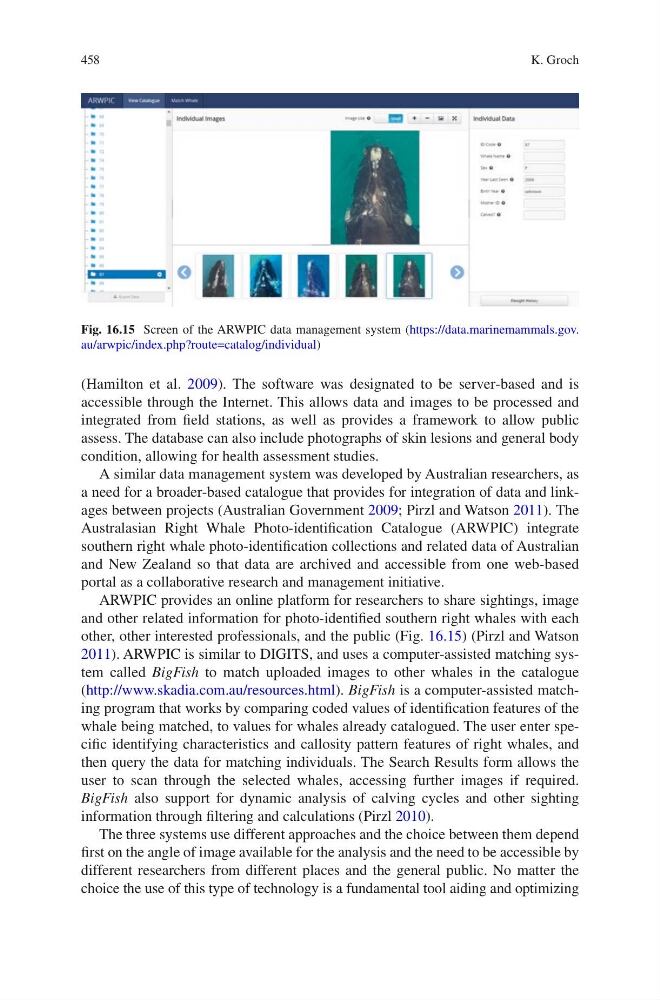
ARWPIC provides an online platform for researchers to share sightings, image
and other related information for photo-identified southern right whales with each
other, other interested professionals, and the public (Fig. 16.15) (Pirzl and Watson
2011). ARWPIC is similar to DIGITS, and uses a computer-assisted matching system called BigFish to match uploaded images to other whales in the catalogue
(http://www.skadia.com.au/resources.html). BigFish is a computer-assisted matching program that works by comparing coded values of identification features of the
whale being matched, to values for whales already catalogued. The user enter specific identifying characteristics and callosity pattern features of right whales, and
then query the data for matching individuals. The Search Results form allows the
user to scan through the selected whales, accessing further images if required.
BigFish also support for dynamic analysis of calving cycles and other sighting
information through filtering and calculations (Pirzl 2010).
The three systems use different approaches and the choice between them depend
first on the angle of image available for the analysis and the need to be accessible by
different researchers from different places and the general public. No matter the
choice the use of this type of technology is a fundamental tool aiding and optimizing
Fig. 16.15 Screen of the ARWPIC data management system (https://data.marinemammals.gov.
au/arwpic/index.php?route=catalog/individual)
K. Groch
(Hamilton et al. 2009). The software was designated to be server-based and is
accessible through the Internet. This allows data and images to be processed and
integrated from field stations, as well as provides a framework to allow public
assess. The database can also include photographs of skin lesions and general body
condition, allowing for health assessment studies.
A similar data management system was developed by Australian researchers, as
a need for a broader-based catalogue that provides for integration of data and linkages between projects (Australian Government 2009; Pirzl and Watson 2011). The
Australasian Right Whale Photo-identification Catalogue (ARWPIC) integrate
southern right whale photo-identification collections and related data of Australian
and New Zealand so that data are archived and accessible from one web-based
portal as a collaborative research and management initiative.
ARWPIC provides an online platform for researchers to share sightings, image
and other related information for photo-identified southern right whales with each
other, other interested professionals, and the public (Fig. 16.15) (Pirzl and Watson
2011). ARWPIC is similar to DIGITS, and uses a computer-assisted matching system called BigFish to match uploaded images to other whales in the catalogue
(http://www.skadia.com.au/resources.html). BigFish is a computer-assisted matching program that works by comparing coded values of identification features of the
whale being matched, to values for whales already catalogued. The user enter specific identifying characteristics and callosity pattern features of right whales, and
then query the data for matching individuals. The Search Results form allows the
user to scan through the selected whales, accessing further images if required.
BigFish also support for dynamic analysis of calving cycles and other sighting
information through filtering and calculations (Pirzl 2010).
The three systems use different approaches and the choice between them depend
first on the angle of image available for the analysis and the need to be accessible by
different researchers from different places and the general public. No matter the
choice the use of this type of technology is a fundamental tool aiding and optimizing
Fig. 16.15 Screen of the ARWPIC data management system (https://data.marinemammals.gov.
au/arwpic/index.php?route=catalog/individual)
K. Groch