

449
white individuals have been noted for several species of large and small cetaceans
(Fertl and Rosel 2009; Wells 2009), but southern right whales are the only species
where such individuals are relatively common (Schaeff et al. 1999). In southern
right whales, the partial albino individual body is mostly white with small black
spots as a calf, but darkens in the first years of life becoming brown or gray
(Fig. 16.8) (Payne et al. 1983; Best 1990; Schaeff et al. 1999). Individuals sexed
genetically were males but at least three individuals have been photographed with
calves in South Africa (Schaeff et al. 1999).
Right whales with natural markings as well as partial albino individuals have
been recorded in Argentina, South Africa, Australia and New Zealand (Patenaude
et al. 1998; Schaeff et al. 1999) as well as in Brazil (see below). North Atlantic right
whales (Eubalaena glacialis) do not exhibit any of the dorsal skin color markings,
only ventral markings (Schaeff and Hamilton 1999). North Pacific right whales
(Eubalaena japonica) present dorsal white marks (Rowntree et al. 1980).
Callosities have allowed to follow the lives of individual right whales documenting
basic features of the species’ life history, such as age-at-first-reproduction, calving
interval (e.g. Payne 1986; Whitehead et al. 1986; Best 1990; Rowntree et al. 2001)
and estimate demographic parameters of right whale populations worldwide (e.g.
Kraus et al. 1986; Caswell et al. 1999; Payne et al. 1990; Bannister 1990; Best et al.
2001; Cooke et al. 2001). From the individual recognition, it is possible to obtain
information on reproductive aspects, movements, habitat use, estimates of abundance
and population trends (Hammond 1986).
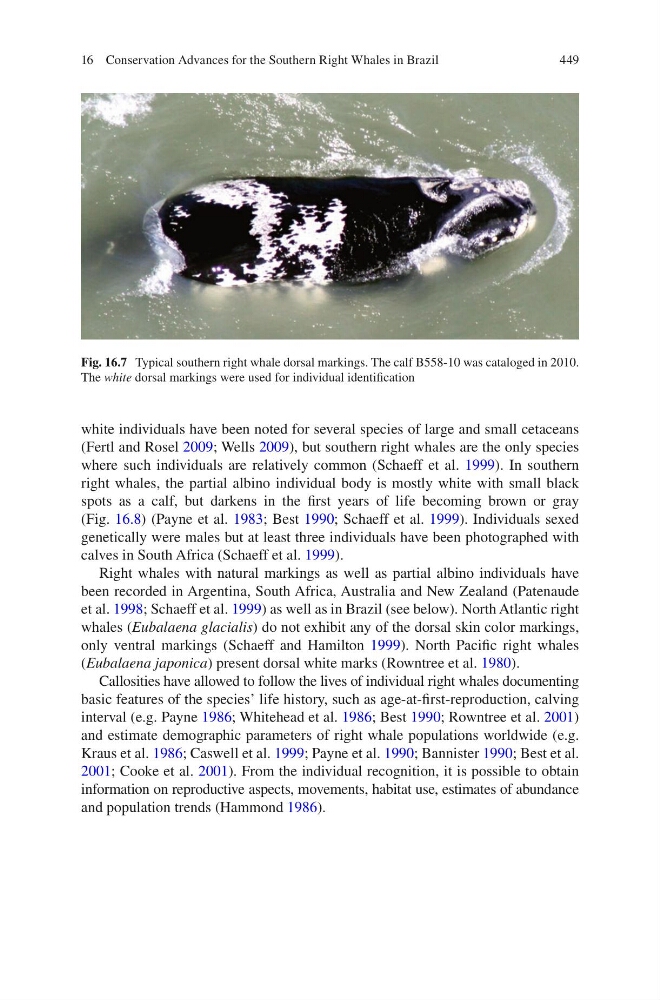
Fig. 16.7 Typical southern right whale dorsal markings. The calf B558-10 was cataloged in 2010.
The white dorsal markings were used for individual identification
16 Conservation Advances for the Southern Right Whales in Brazil
white individuals have been noted for several species of large and small cetaceans
(Fertl and Rosel 2009; Wells 2009), but southern right whales are the only species
where such individuals are relatively common (Schaeff et al. 1999). In southern
right whales, the partial albino individual body is mostly white with small black
spots as a calf, but darkens in the first years of life becoming brown or gray
(Fig. 16.8) (Payne et al. 1983; Best 1990; Schaeff et al. 1999). Individuals sexed
genetically were males but at least three individuals have been photographed with
calves in South Africa (Schaeff et al. 1999).
Right whales with natural markings as well as partial albino individuals have
been recorded in Argentina, South Africa, Australia and New Zealand (Patenaude
et al. 1998; Schaeff et al. 1999) as well as in Brazil (see below). North Atlantic right
whales (Eubalaena glacialis) do not exhibit any of the dorsal skin color markings,
only ventral markings (Schaeff and Hamilton 1999). North Pacific right whales
(Eubalaena japonica) present dorsal white marks (Rowntree et al. 1980).
Callosities have allowed to follow the lives of individual right whales documenting
basic features of the species’ life history, such as age-at-first-reproduction, calving
interval (e.g. Payne 1986; Whitehead et al. 1986; Best 1990; Rowntree et al. 2001)
and estimate demographic parameters of right whale populations worldwide (e.g.
Kraus et al. 1986; Caswell et al. 1999; Payne et al. 1990; Bannister 1990; Best et al.
2001; Cooke et al. 2001). From the individual recognition, it is possible to obtain
information on reproductive aspects, movements, habitat use, estimates of abundance
and population trends (Hammond 1986).
Fig. 16.7 Typical southern right whale dorsal markings. The calf B558-10 was cataloged in 2010.
The white dorsal markings were used for individual identification
16 Conservation Advances for the Southern Right Whales in Brazil