

424
Harmonics were registered in 2098, 73% of the measured notes, varying in number of 1–85 (mean = 10,4). Harmonic intervals ranged from 10,3 to 4309 Hz
(mean = 405).
15.3.5.2 The Humpback Whale Song Form
The song form, with descriptive information on the total number of notes, number
of different notes and number of themes was represented by some best quality
recording of each year for the Abrolhos Bank (Table 15.4) and for the North Coast
(Table 15.5). Additionally, the number of singer males that could be heard at the
background noise without confuse the main singer was also recorded.
The diversity in our recording systems evidenced that the humpback whale song
has a wider frequency range than previously commented, with some notes exceeding the frequency response in some occasions (Fig. 15.16).
Behavioral observations of 50 min, simultaneous to the song recording of FV_
ITA2006 sequential files, made at 34 m deep, indicated that the singer male stops
singing once blowing at the sea surface in short dive times (less than 30 s), when
silent moments were registered (Fig. 15.17).
15.3.5.3 Chorus Behavior
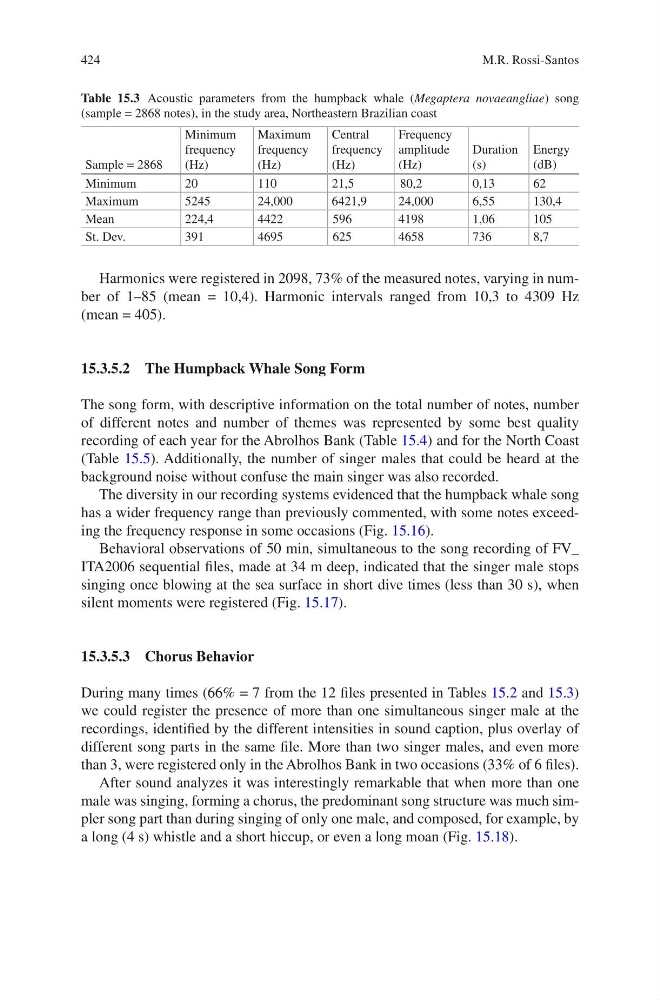
During many times (66% = 7 from the 12 files presented in Tables 15.2 and 15.3)
we could register the presence of more than one simultaneous singer male at the
recordings, identified by the different intensities in sound caption, plus overlay of
different song parts in the same file. More than two singer males, and even more
than 3, were registered only in the Abrolhos Bank in two occasions (33% of 6 files).
After sound analyzes it was interestingly remarkable that when more than one
male was singing, forming a chorus, the predominant song structure was much simpler song part than during singing of only one male, and composed, for example, by
a long (4 s) whistle and a short hiccup, or even a long moan (Fig. 15.18).
Table 15.3 Acoustic parameters from the humpback whale (Megaptera novaeangliae) song
(sample = 2868 notes), in the study area, Northeastern Brazilian coast
Sample = 2868
Minimum
frequency
(Hz)
Maximum
frequency
(Hz)
Central
frequency
(Hz)
Frequency
amplitude
(Hz)
Duration
(s)
Energy
(dB)
Minimum
20
110
21,5
80,2
0,13
62
Maximum
5245
24,000
6421,9
24,000
6,55
130,4
Mean
224,4
4422
596
4198
1,06
105
St. Dev.
391
4695
625
4658
736
8,7
M.R. Rossi-Santos
Harmonics were registered in 2098, 73% of the measured notes, varying in number of 1–85 (mean = 10,4). Harmonic intervals ranged from 10,3 to 4309 Hz
(mean = 405).
15.3.5.2 The Humpback Whale Song Form
The song form, with descriptive information on the total number of notes, number
of different notes and number of themes was represented by some best quality
recording of each year for the Abrolhos Bank (Table 15.4) and for the North Coast
(Table 15.5). Additionally, the number of singer males that could be heard at the
background noise without confuse the main singer was also recorded.
The diversity in our recording systems evidenced that the humpback whale song
has a wider frequency range than previously commented, with some notes exceeding the frequency response in some occasions (Fig. 15.16).
Behavioral observations of 50 min, simultaneous to the song recording of FV_
ITA2006 sequential files, made at 34 m deep, indicated that the singer male stops
singing once blowing at the sea surface in short dive times (less than 30 s), when
silent moments were registered (Fig. 15.17).
15.3.5.3 Chorus Behavior
During many times (66% = 7 from the 12 files presented in Tables 15.2 and 15.3)
we could register the presence of more than one simultaneous singer male at the
recordings, identified by the different intensities in sound caption, plus overlay of
different song parts in the same file. More than two singer males, and even more
than 3, were registered only in the Abrolhos Bank in two occasions (33% of 6 files).
After sound analyzes it was interestingly remarkable that when more than one
male was singing, forming a chorus, the predominant song structure was much simpler song part than during singing of only one male, and composed, for example, by
a long (4 s) whistle and a short hiccup, or even a long moan (Fig. 15.18).
Table 15.3 Acoustic parameters from the humpback whale (Megaptera novaeangliae) song
(sample = 2868 notes), in the study area, Northeastern Brazilian coast
Sample = 2868
Minimum
frequency
(Hz)
Maximum
frequency
(Hz)
Central
frequency
(Hz)
Frequency
amplitude
(Hz)
Duration
(s)
Energy
(dB)
Minimum
20
110
21,5
80,2
0,13
62
Maximum
5245
24,000
6421,9
24,000
6,55
130,4
Mean
224,4
4422
596
4198
1,06
105
St. Dev.
391
4695
625
4658
736
8,7
M.R. Rossi-Santos