

417
uncalibrated HTI – SSQ 96 hydrophone (sensitive to 20 kHz) that was connected to
a Sony TCD5-M cassette recorder, frequency response up to 17 kHz). From 2008 to
2010 we utilized a CR 54 hydrophone connected to a digital recorder (M-Audio
Microtrack Pro-II), increasing the frequency response up to 96 kHz.
Analyzes were first made both by listening and by visually comparing spectrograms, which are sound graphics with x-axis on time (seconds) and y-axis on frequency (Hertz). Spectrographic analyzes were performed using software RAVEN
3.1, selecting the following frequency parameters (Hertz), relative sound intensity
(dB re SNR – referenced to the Signal to Noise Ratio) and time (seconds): minimum,
maximum, central frequency, frequency amplitude, energy and duration. Whenever
found, the harmonics and their intervals were also measured, as well as the visual
contour shape from each note.
15.2.2.3 Sex Determination of Individuals
Genetic studies of humpback whales worldwide have shown that singing and escorting
are behavioral roles performed only by males and that a whale closely associated with
a calf is its mother, an adult female (eg. Palsboll et al. 1997; Darling and Berube 2001).
An ‘escort’ is defined as a whale that is associating with another adult whale
known to be female or with a mother-calf pair. When two or more males are engaged
in dispute behavior in the presence of a female, all are considered escorts (Herman
and Tavolga 1980), forming a competitive group (Fig. 15.10).
In this study, the sex of observed animals was assumed following the convictions
on these different behavioral roles of males and females. The term ‘calf’ refers to
calves of that year (Fig. 15.11). It was not possible to visually differentiate between
immature or sub-adult and adult whales, therefore the term ‘whale’ refers to all noncalf whales (Fig. 15.12).
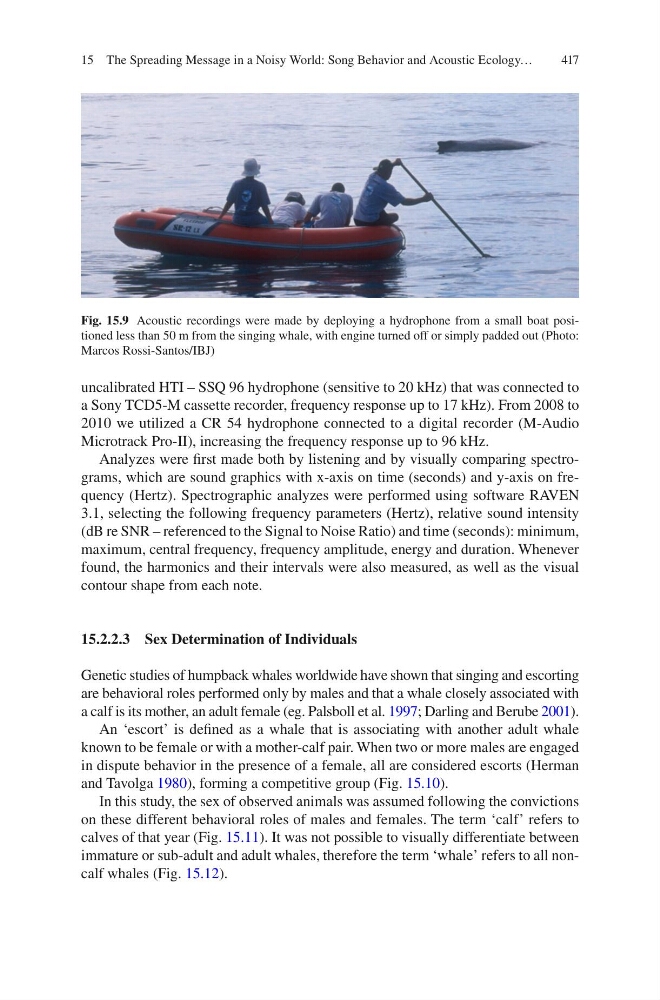
Fig. 15.9 Acoustic recordings were made by deploying a hydrophone from a small boat positioned less than 50 m from the singing whale, with engine turned off or simply padded out (Photo:
Marcos Rossi-Santos/IBJ)
15 The Spreading Message in a Noisy World: Song Behavior and Acoustic Ecology…
uncalibrated HTI – SSQ 96 hydrophone (sensitive to 20 kHz) that was connected to
a Sony TCD5-M cassette recorder, frequency response up to 17 kHz). From 2008 to
2010 we utilized a CR 54 hydrophone connected to a digital recorder (M-Audio
Microtrack Pro-II), increasing the frequency response up to 96 kHz.
Analyzes were first made both by listening and by visually comparing spectrograms, which are sound graphics with x-axis on time (seconds) and y-axis on frequency (Hertz). Spectrographic analyzes were performed using software RAVEN
3.1, selecting the following frequency parameters (Hertz), relative sound intensity
(dB re SNR – referenced to the Signal to Noise Ratio) and time (seconds): minimum,
maximum, central frequency, frequency amplitude, energy and duration. Whenever
found, the harmonics and their intervals were also measured, as well as the visual
contour shape from each note.
15.2.2.3 Sex Determination of Individuals
Genetic studies of humpback whales worldwide have shown that singing and escorting
are behavioral roles performed only by males and that a whale closely associated with
a calf is its mother, an adult female (eg. Palsboll et al. 1997; Darling and Berube 2001).
An ‘escort’ is defined as a whale that is associating with another adult whale
known to be female or with a mother-calf pair. When two or more males are engaged
in dispute behavior in the presence of a female, all are considered escorts (Herman
and Tavolga 1980), forming a competitive group (Fig. 15.10).
In this study, the sex of observed animals was assumed following the convictions
on these different behavioral roles of males and females. The term ‘calf’ refers to
calves of that year (Fig. 15.11). It was not possible to visually differentiate between
immature or sub-adult and adult whales, therefore the term ‘whale’ refers to all noncalf whales (Fig. 15.12).
Fig. 15.9 Acoustic recordings were made by deploying a hydrophone from a small boat positioned less than 50 m from the singing whale, with engine turned off or simply padded out (Photo:
Marcos Rossi-Santos/IBJ)
15 The Spreading Message in a Noisy World: Song Behavior and Acoustic Ecology…