

30
phin in the region, showing that the dolphins are able to select some species for
consumption (Louzada 2014).
One of the factors that strongly influences the fishing strategies is the presence of
calves in the group (Monteiro-Filho 1991, 2000). Calves require great attention of
parents, especially during the first months of life, when they are more vulnerable to
environmental adversities. Rautenberg and Monteiro-Filho (2008) described in detail
the key behaviors of parental care observed for the Guiana dolphin in the Cananéia
estuary. These authors identified one of the key behaviors, as already described for
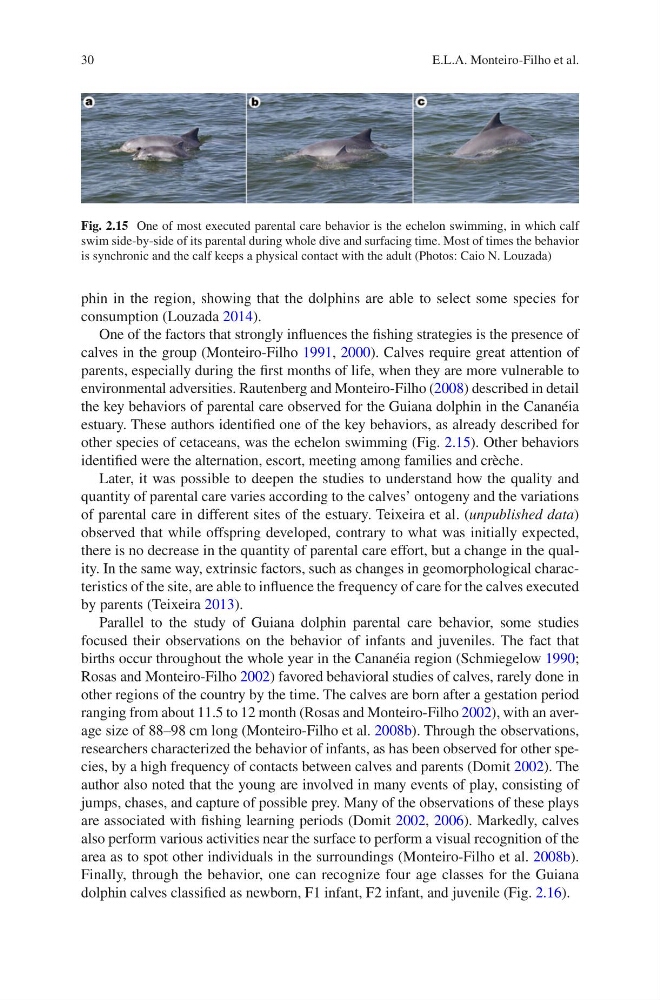
other species of cetaceans, was the echelon swimming (Fig. 2.15). Other behaviors
identified were the alternation, escort, meeting among families and crèche.
Later, it was possible to deepen the studies to understand how the quality and
quantity of parental care varies according to the calves’ ontogeny and the variations
of parental care in different sites of the estuary. Teixeira et al. (unpublished data)
observed that while offspring developed, contrary to what was initially expected,
there is no decrease in the quantity of parental care effort, but a change in the quality. In the same way, extrinsic factors, such as changes in geomorphological characteristics of the site, are able to influence the frequency of care for the calves executed
by parents (Teixeira 2013).
Parallel to the study of Guiana dolphin parental care behavior, some studies
focused their observations on the behavior of infants and juveniles. The fact that
births occur throughout the whole year in the Cananéia region (Schmiegelow 1990;
Rosas and Monteiro-Filho 2002) favored behavioral studies of calves, rarely done in
other regions of the country by the time. The calves are born after a gestation period
ranging from about 11.5 to 12 month (Rosas and Monteiro-Filho 2002), with an average size of 88–98 cm long (Monteiro-Filho et al. 2008b). Through the observations,
researchers characterized the behavior of infants, as has been observed for other species, by a high frequency of contacts between calves and parents (Domit 2002). The
author also noted that the young are involved in many events of play, consisting of
jumps, chases, and capture of possible prey. Many of the observations of these plays
are associated with fishing learning periods (Domit 2002, 2006). Markedly, calves
also perform various activities near the surface to perform a visual recognition of the
area as to spot other individuals in the surroundings (Monteiro- Filho et al. 2008b).
Finally, through the behavior, one can recognize four age classes for the Guiana
dolphin calves classified as newborn, F1 infant, F2 infant, and juvenile (Fig. 2.16).
Fig. 2.15 One of most executed parental care behavior is the echelon swimming, in which calf
swim side-by-side of its parental during whole dive and surfacing time. Most of times the behavior
is synchronic and the calf keeps a physical contact with the adult (Photos: Caio N. Louzada)
E.L.A. Monteiro-Filho et al.
phin in the region, showing that the dolphins are able to select some species for
consumption (Louzada 2014).
One of the factors that strongly influences the fishing strategies is the presence of
calves in the group (Monteiro-Filho 1991, 2000). Calves require great attention of
parents, especially during the first months of life, when they are more vulnerable to
environmental adversities. Rautenberg and Monteiro-Filho (2008) described in detail
the key behaviors of parental care observed for the Guiana dolphin in the Cananéia
estuary. These authors identified one of the key behaviors, as already described for
other species of cetaceans, was the echelon swimming (Fig. 2.15). Other behaviors
identified were the alternation, escort, meeting among families and crèche.
Later, it was possible to deepen the studies to understand how the quality and
quantity of parental care varies according to the calves’ ontogeny and the variations
of parental care in different sites of the estuary. Teixeira et al. (unpublished data)
observed that while offspring developed, contrary to what was initially expected,
there is no decrease in the quantity of parental care effort, but a change in the quality. In the same way, extrinsic factors, such as changes in geomorphological characteristics of the site, are able to influence the frequency of care for the calves executed
by parents (Teixeira 2013).
Parallel to the study of Guiana dolphin parental care behavior, some studies
focused their observations on the behavior of infants and juveniles. The fact that
births occur throughout the whole year in the Cananéia region (Schmiegelow 1990;
Rosas and Monteiro-Filho 2002) favored behavioral studies of calves, rarely done in
other regions of the country by the time. The calves are born after a gestation period
ranging from about 11.5 to 12 month (Rosas and Monteiro-Filho 2002), with an average size of 88–98 cm long (Monteiro-Filho et al. 2008b). Through the observations,
researchers characterized the behavior of infants, as has been observed for other species, by a high frequency of contacts between calves and parents (Domit 2002). The
author also noted that the young are involved in many events of play, consisting of
jumps, chases, and capture of possible prey. Many of the observations of these plays
are associated with fishing learning periods (Domit 2002, 2006). Markedly, calves
also perform various activities near the surface to perform a visual recognition of the
area as to spot other individuals in the surroundings (Monteiro- Filho et al. 2008b).
Finally, through the behavior, one can recognize four age classes for the Guiana
dolphin calves classified as newborn, F1 infant, F2 infant, and juvenile (Fig. 2.16).
Fig. 2.15 One of most executed parental care behavior is the echelon swimming, in which calf
swim side-by-side of its parental during whole dive and surfacing time. Most of times the behavior
is synchronic and the calf keeps a physical contact with the adult (Photos: Caio N. Louzada)
E.L.A. Monteiro-Filho et al.