

397
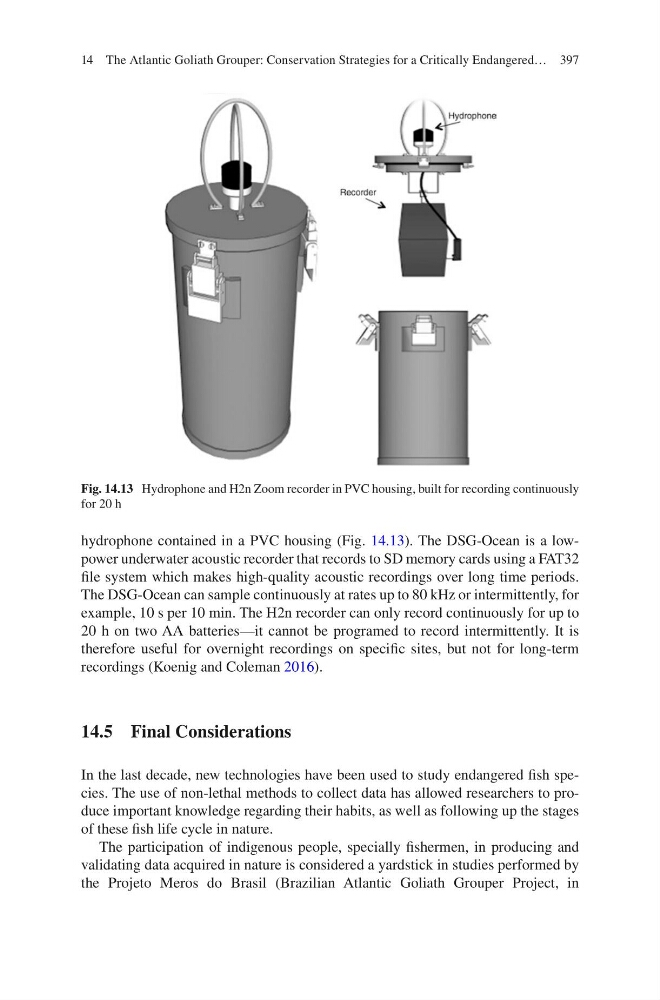
hydrophone contained in a PVC housing (Fig. 14.13). The DSG-Ocean is a lowpower underwater acoustic recorder that records to SD memory cards using a FAT32
file system which makes high-quality acoustic recordings over long time periods.
The DSG-Ocean can sample continuously at rates up to 80 kHz or intermittently, for
example, 10 s per 10 min. The H2n recorder can only record continuously for up to
20 h on two AA batteries—it cannot be programed to record intermittently. It is
therefore useful for overnight recordings on specific sites, but not for long-term
recordings (Koenig and Coleman 2016).
14.5 Final Considerations
In the last decade, new technologies have been used to study endangered fish species. The use of non-lethal methods to collect data has allowed researchers to produce important knowledge regarding their habits, as well as following up the stages
of these fish life cycle in nature.
The participation of indigenous people, specially fishermen, in producing and
validating data acquired in nature is considered a yardstick in studies performed by
the Projeto Meros do Brasil (Brazilian Atlantic Goliath Grouper Project, in
Fig. 14.13 Hydrophone and H2n Zoom recorder in PVC housing, built for recording continuously
for 20 h
14 The Atlantic Goliath Grouper: Conservation Strategies for a Critically Endangered…
hydrophone contained in a PVC housing (Fig. 14.13). The DSG-Ocean is a lowpower underwater acoustic recorder that records to SD memory cards using a FAT32
file system which makes high-quality acoustic recordings over long time periods.
The DSG-Ocean can sample continuously at rates up to 80 kHz or intermittently, for
example, 10 s per 10 min. The H2n recorder can only record continuously for up to
20 h on two AA batteries—it cannot be programed to record intermittently. It is
therefore useful for overnight recordings on specific sites, but not for long-term
recordings (Koenig and Coleman 2016).
14.5 Final Considerations
In the last decade, new technologies have been used to study endangered fish species. The use of non-lethal methods to collect data has allowed researchers to produce important knowledge regarding their habits, as well as following up the stages
of these fish life cycle in nature.
The participation of indigenous people, specially fishermen, in producing and
validating data acquired in nature is considered a yardstick in studies performed by
the Projeto Meros do Brasil (Brazilian Atlantic Goliath Grouper Project, in
Fig. 14.13 Hydrophone and H2n Zoom recorder in PVC housing, built for recording continuously
for 20 h
14 The Atlantic Goliath Grouper: Conservation Strategies for a Critically Endangered…