

378
Goliath Grouper of Brazil), in the southern coast of the country. Goliath Grouper
telemetry in Brazil starts with adults, aiming to monitor newly confirmed spawning
aggregations (Bueno et al. 2016). There are many challenges to work with a such
large and critically endangered species. The main one was to catch and handle these
animals. An important step was established with the cooperation partnership
between the Project and the Coleman & Koenig Lab at the Florida State University,
when researchers from Brazil got the opportunity to experience a full –scale methodology. Later, they brought the information regarding the methods to be adapted
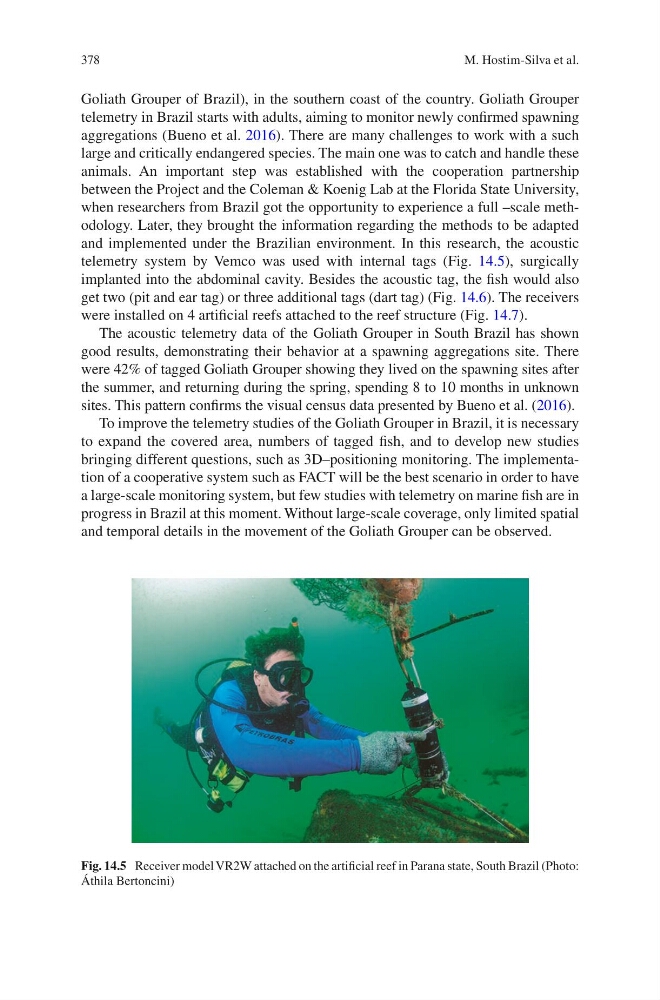
and implemented under the Brazilian environment. In this research, the acoustic
telemetry system by Vemco was used with internal tags (Fig. 14.5), surgically
implanted into the abdominal cavity. Besides the acoustic tag, the fish would also
get two (pit and ear tag) or three additional tags (dart tag) (Fig. 14.6). The receivers
were installed on 4 artificial reefs attached to the reef structure (Fig. 14.7).
The acoustic telemetry data of the Goliath Grouper in South Brazil has shown
good results, demonstrating their behavior at a spawning aggregations site. There
were 42% of tagged Goliath Grouper showing they lived on the spawning sites after
the summer, and returning during the spring, spending 8 to 10 months in unknown
sites. This pattern confirms the visual census data presented by Bueno et al. (2016).
To improve the telemetry studies of the Goliath Grouper in Brazil, it is necessary
to expand the covered area, numbers of tagged fish, and to develop new studies
bringing different questions, such as 3D–positioning monitoring. The implementation of a cooperative system such as FACT will be the best scenario in order to have
a large-scale monitoring system, but few studies with telemetry on marine fish are in
progress in Brazil at this moment. Without large-scale coverage, only limited spatial
and temporal details in the movement of the Goliath Grouper can be observed.
Fig. 14.5 Receiver model VR2W attached on the artificial reef in Parana state, South Brazil (Photo:
Áthila Bertoncini)
M. Hostim-Silva et al.
Goliath Grouper of Brazil), in the southern coast of the country. Goliath Grouper
telemetry in Brazil starts with adults, aiming to monitor newly confirmed spawning
aggregations (Bueno et al. 2016). There are many challenges to work with a such
large and critically endangered species. The main one was to catch and handle these
animals. An important step was established with the cooperation partnership
between the Project and the Coleman & Koenig Lab at the Florida State University,
when researchers from Brazil got the opportunity to experience a full –scale methodology. Later, they brought the information regarding the methods to be adapted
and implemented under the Brazilian environment. In this research, the acoustic
telemetry system by Vemco was used with internal tags (Fig. 14.5), surgically
implanted into the abdominal cavity. Besides the acoustic tag, the fish would also
get two (pit and ear tag) or three additional tags (dart tag) (Fig. 14.6). The receivers
were installed on 4 artificial reefs attached to the reef structure (Fig. 14.7).
The acoustic telemetry data of the Goliath Grouper in South Brazil has shown
good results, demonstrating their behavior at a spawning aggregations site. There
were 42% of tagged Goliath Grouper showing they lived on the spawning sites after
the summer, and returning during the spring, spending 8 to 10 months in unknown
sites. This pattern confirms the visual census data presented by Bueno et al. (2016).
To improve the telemetry studies of the Goliath Grouper in Brazil, it is necessary
to expand the covered area, numbers of tagged fish, and to develop new studies
bringing different questions, such as 3D–positioning monitoring. The implementation of a cooperative system such as FACT will be the best scenario in order to have
a large-scale monitoring system, but few studies with telemetry on marine fish are in
progress in Brazil at this moment. Without large-scale coverage, only limited spatial
and temporal details in the movement of the Goliath Grouper can be observed.
Fig. 14.5 Receiver model VR2W attached on the artificial reef in Parana state, South Brazil (Photo:
Áthila Bertoncini)
M. Hostim-Silva et al.