

374
Our databank of Photographic records came from the Participative Survey
Program of Projeto Meros do Brasil and from photo/video companies. Recognition
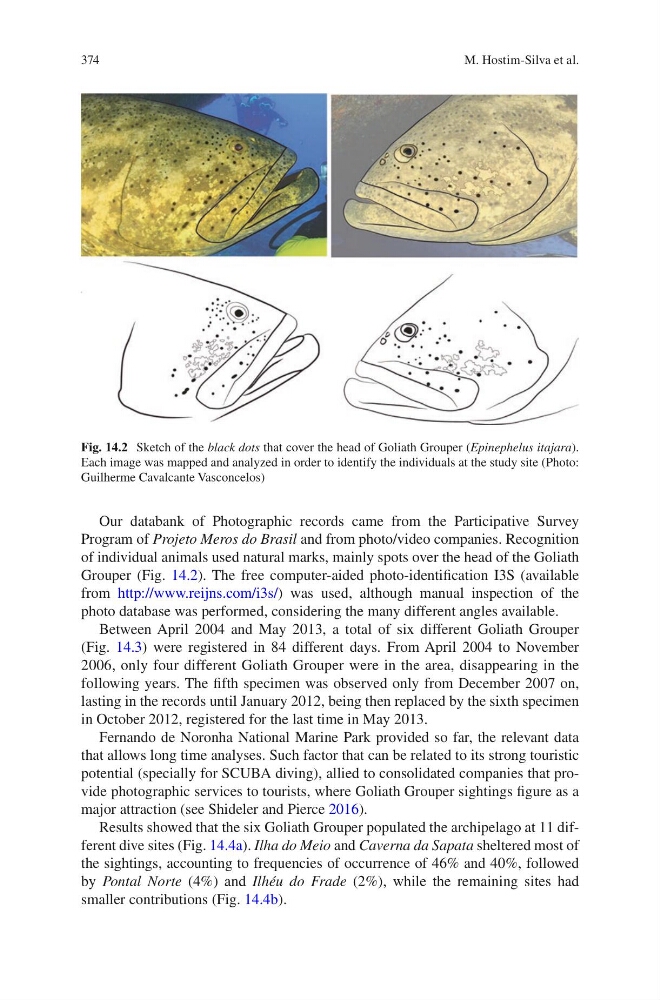
of individual animals used natural marks, mainly spots over the head of the Goliath
Grouper (Fig. 14.2). The free computer-aided photo-identification I3S (available
from http://www.reijns.com/i3s/) was used, although manual inspection of the
photo database was performed, considering the many different angles available.
Between April 2004 and May 2013, a total of six different Goliath Grouper
(Fig. 14.3) were registered in 84 different days. From April 2004 to November
2006, only four different Goliath Grouper were in the area, disappearing in the
following years. The fifth specimen was observed only from December 2007 on,
lasting in the records until January 2012, being then replaced by the sixth specimen
in October 2012, registered for the last time in May 2013.
Fernando de Noronha National Marine Park provided so far, the relevant data
that allows long time analyses. Such factor that can be related to its strong touristic
potential (specially for SCUBA diving), allied to consolidated companies that provide photographic services to tourists, where Goliath Grouper sightings figure as a
major attraction (see Shideler and Pierce 2016).
Results showed that the six Goliath Grouper populated the archipelago at 11 different dive sites (Fig. 14.4a). Ilha do Meio and Caverna da Sapata sheltered most of
the sightings, accounting to frequencies of occurrence of 46% and 40%, followed
by Pontal Norte (4%) and Ilhéu do Frade (2%), while the remaining sites had
smaller contributions (Fig. 14.4b).
Fig. 14.2 Sketch of the black dots that cover the head of Goliath Grouper (Epinephelus itajara).
Each image was mapped and analyzed in order to identify the individuals at the study site (Photo:
Guilherme Cavalcante Vasconcelos)
M. Hostim-Silva et al.
Our databank of Photographic records came from the Participative Survey
Program of Projeto Meros do Brasil and from photo/video companies. Recognition
of individual animals used natural marks, mainly spots over the head of the Goliath
Grouper (Fig. 14.2). The free computer-aided photo-identification I3S (available
from http://www.reijns.com/i3s/) was used, although manual inspection of the
photo database was performed, considering the many different angles available.
Between April 2004 and May 2013, a total of six different Goliath Grouper
(Fig. 14.3) were registered in 84 different days. From April 2004 to November
2006, only four different Goliath Grouper were in the area, disappearing in the
following years. The fifth specimen was observed only from December 2007 on,
lasting in the records until January 2012, being then replaced by the sixth specimen
in October 2012, registered for the last time in May 2013.
Fernando de Noronha National Marine Park provided so far, the relevant data
that allows long time analyses. Such factor that can be related to its strong touristic
potential (specially for SCUBA diving), allied to consolidated companies that provide photographic services to tourists, where Goliath Grouper sightings figure as a
major attraction (see Shideler and Pierce 2016).
Results showed that the six Goliath Grouper populated the archipelago at 11 different dive sites (Fig. 14.4a). Ilha do Meio and Caverna da Sapata sheltered most of
the sightings, accounting to frequencies of occurrence of 46% and 40%, followed
by Pontal Norte (4%) and Ilhéu do Frade (2%), while the remaining sites had
smaller contributions (Fig. 14.4b).
Fig. 14.2 Sketch of the black dots that cover the head of Goliath Grouper (Epinephelus itajara).
Each image was mapped and analyzed in order to identify the individuals at the study site (Photo:
Guilherme Cavalcante Vasconcelos)
M. Hostim-Silva et al.