

372
Brazil: Subsidies for Environmental Licensing of Oil and Gas Exploration and
Production”).
This initiative, resulted from a Federal environmental damage compensation fee,
and combined many institutions and researchers through the country, aiming to map
spawning aggregation areas of reef fishes along the Brazilian coast.
The Goliath Grouper was one of the main targeted species in this study. At first,
the existing data was compiled from fisheries landings monitoring programs, and at
the same time, specialized fishermen were interviewed, to investigate the existence
of areas and periods when spawning aggregations occurred in order to complement
the data and to define the reproductive season of the species.
In this context, the researchers of the Projeto Meros do Brasil were assigned to
investigate of two areas: one in the South of Brazil (the coast of the Brazilian State
of Santa Catarina) (Bertoncini et al. 2012), and another in the East-Northeast
(Northern shore of the Brazilian State of Espírito Santo to the Southern shore of the
State of Bahia). The area located between Bahia and Espírito Santo, included one of
the main reef areas of the Brazilian coast, characterized by the elevated biological
importance, considered as a priority for conservation (Mazzei et al. 2016). This
coastal zone is known as an area of artisanal fishermen, who perform subsistence
fishing or small-scale fishing.
However, the location, as well as the characterization of the Goliath Grouper
spawning aggregations is not a simple task, and requires a large sample effort
through different seasons and areas yet to be explored. As a result from this study,
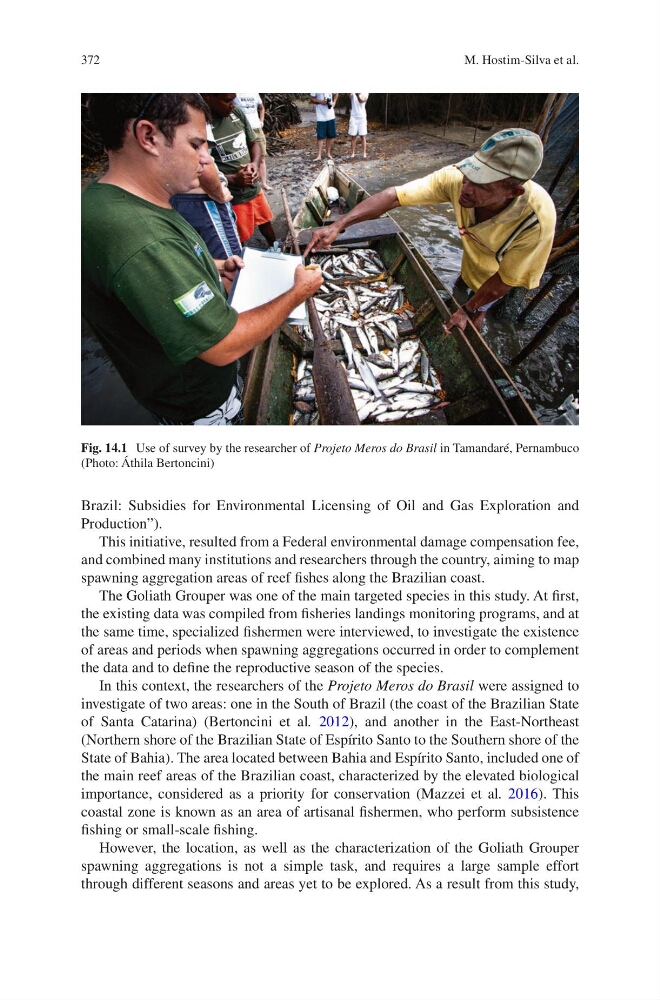
Fig. 14.1 Use of survey by the researcher of Projeto Meros do Brasil in Tamandaré, Pernambuco
(Photo: Áthila Bertoncini)
M. Hostim-Silva et al.
Brazil: Subsidies for Environmental Licensing of Oil and Gas Exploration and
Production”).
This initiative, resulted from a Federal environmental damage compensation fee,
and combined many institutions and researchers through the country, aiming to map
spawning aggregation areas of reef fishes along the Brazilian coast.
The Goliath Grouper was one of the main targeted species in this study. At first,
the existing data was compiled from fisheries landings monitoring programs, and at
the same time, specialized fishermen were interviewed, to investigate the existence
of areas and periods when spawning aggregations occurred in order to complement
the data and to define the reproductive season of the species.
In this context, the researchers of the Projeto Meros do Brasil were assigned to
investigate of two areas: one in the South of Brazil (the coast of the Brazilian State
of Santa Catarina) (Bertoncini et al. 2012), and another in the East-Northeast
(Northern shore of the Brazilian State of Espírito Santo to the Southern shore of the
State of Bahia). The area located between Bahia and Espírito Santo, included one of
the main reef areas of the Brazilian coast, characterized by the elevated biological
importance, considered as a priority for conservation (Mazzei et al. 2016). This
coastal zone is known as an area of artisanal fishermen, who perform subsistence
fishing or small-scale fishing.
However, the location, as well as the characterization of the Goliath Grouper
spawning aggregations is not a simple task, and requires a large sample effort
through different seasons and areas yet to be explored. As a result from this study,
Fig. 14.1 Use of survey by the researcher of Projeto Meros do Brasil in Tamandaré, Pernambuco
(Photo: Áthila Bertoncini)
M. Hostim-Silva et al.