

27
frigatebird (Fregata magnificens, Mathews, 1914), terns (Sterna hirundinacea,
Lesson, 1831), gulls (Larus dominicanus, Lichenstein, 1983), and cormorants
(Phalacrocorax brasilianus, Gmelin 1789; Fig. 2.13).
One notable feature of the Guiana dolphin behavior in Cananéia estuary is the
interaction with the artisanal fishing traps, regionally called cerco-fixo (for more
information on the operation of the cerco-fixo see Dias 1990; Oliveira and Hanazaki
2011). The dolphins use the fishing apparatus to aid in hunting strategies (MonteiroFilho 1995; Louzada 2013; Fig. 2.14). In this positive interaction between local
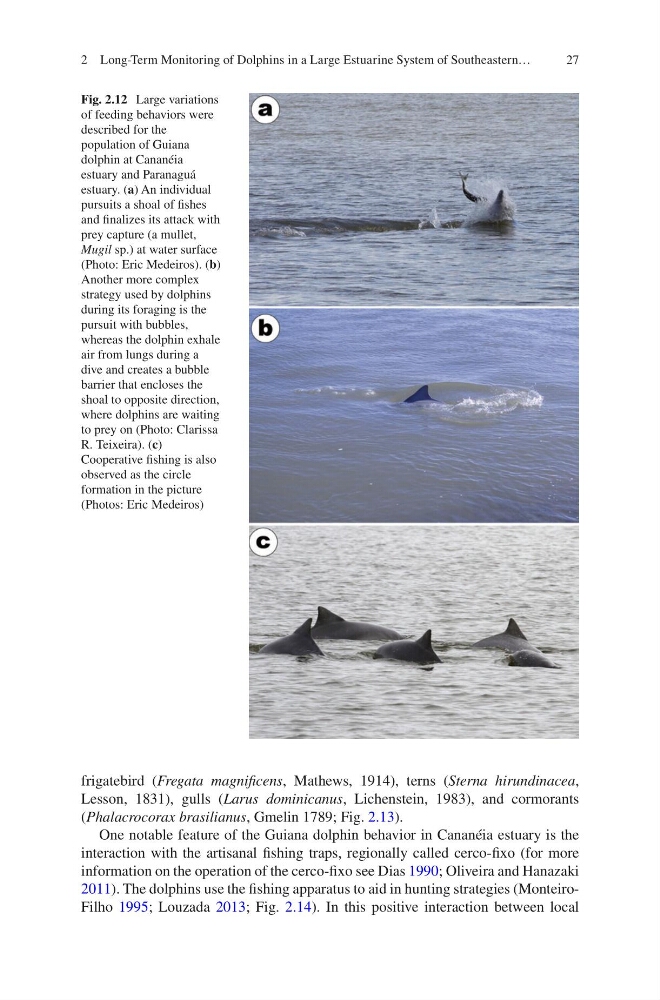
Fig. 2.12 Large variations
of feeding behaviors were
described for the
population of Guiana
dolphin at Cananéia
estuary and Paranaguá
estuary. (a) An individual
pursuits a shoal of fishes
and finalizes its attack with
prey capture (a mullet,
Mugil sp.) at water surface
(Photo: Eric Medeiros). (b)
Another more complex
strategy used by dolphins
during its foraging is the
pursuit with bubbles,
whereas the dolphin exhale
air from lungs during a
dive and creates a bubble
barrier that encloses the
shoal to opposite direction,
where dolphins are waiting
to prey on (Photo: Clarissa
R. Teixeira). (c)
Cooperative fishing is also
observed as the circle
formation in the picture
(Photos: Eric Medeiros)
2 Long-Term Monitoring of Dolphins in a Large Estuarine System of Southeastern…
frigatebird (Fregata magnificens, Mathews, 1914), terns (Sterna hirundinacea,
Lesson, 1831), gulls (Larus dominicanus, Lichenstein, 1983), and cormorants
(Phalacrocorax brasilianus, Gmelin 1789; Fig. 2.13).
One notable feature of the Guiana dolphin behavior in Cananéia estuary is the
interaction with the artisanal fishing traps, regionally called cerco-fixo (for more
information on the operation of the cerco-fixo see Dias 1990; Oliveira and Hanazaki
2011). The dolphins use the fishing apparatus to aid in hunting strategies (MonteiroFilho 1995; Louzada 2013; Fig. 2.14). In this positive interaction between local
Fig. 2.12 Large variations
of feeding behaviors were
described for the
population of Guiana
dolphin at Cananéia
estuary and Paranaguá
estuary. (a) An individual
pursuits a shoal of fishes
and finalizes its attack with
prey capture (a mullet,
Mugil sp.) at water surface
(Photo: Eric Medeiros). (b)
Another more complex
strategy used by dolphins
during its foraging is the
pursuit with bubbles,
whereas the dolphin exhale
air from lungs during a
dive and creates a bubble
barrier that encloses the
shoal to opposite direction,
where dolphins are waiting
to prey on (Photo: Clarissa
R. Teixeira). (c)
Cooperative fishing is also
observed as the circle
formation in the picture
(Photos: Eric Medeiros)
2 Long-Term Monitoring of Dolphins in a Large Estuarine System of Southeastern…