

353
Studies reported that tourism boats at a speed of 5 knots in shallow waters have
the potential to reduce the communication of dolphins in 26% at a distance of up to
50 m (Jensen et al. 2009). By increasing the speed to 10 knots, cavitation noise may
rise by up to 10 dB re 1 μPa @ 1 m (Gervaise et al. 2012), also increasing considerably the frequency and the distance at which noise is propagated (Jensen et al.
2009). For comparison, speeds of 2.5 knots have been described as suitable for areas
of high concentration of cetaceans, as it showed no masking factor in odontocetes
species analyzed (Jensen et al. 2008).
Erbe (2002) estimated the intensity of noises emitted by whale watching tourism
boats at 145–169 dB re 1 μPa @ 1 m and Hildebrand et al. (2006) described noises
intensities from 110–145 dB re 1 μPa @ 1 m, with frequencies from 6 to 75 kHz.
Values that are probably enough to mask the signals emitted by the S. guianensis.
Carrera et al. (2008) reported that in the presence of tourism boats in Pipa beach,
the Guiana dolphin reduced foraging activity, with avoidance of the area also
reported, especially for younger animals, considered by some authors as protective
behaviors (eg Santos-Jr et al. 2006).
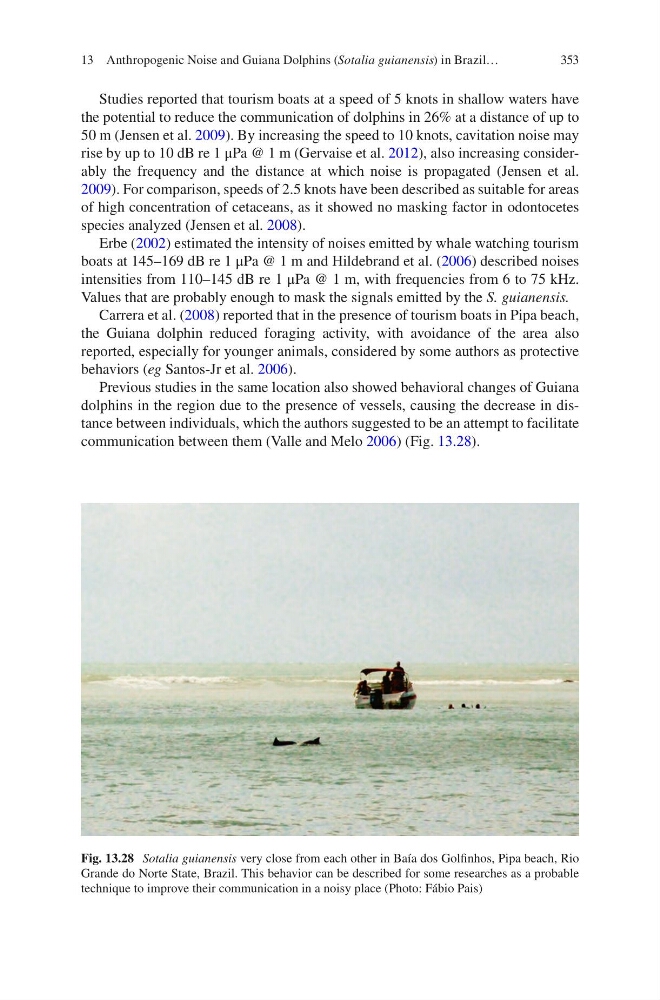
Previous studies in the same location also showed behavioral changes of Guiana
dolphins in the region due to the presence of vessels, causing the decrease in distance between individuals, which the authors suggested to be an attempt to facilitate
communication between them (Valle and Melo 2006) (Fig. 13.28).
Fig. 13.28 Sotalia guianensis very close from each other in Baía dos Golfinhos, Pipa beach, Rio
Grande do Norte State, Brazil. This behavior can be described for some researches as a probable
technique to improve their communication in a noisy place (Photo: Fábio Pais)
13 Anthropogenic Noise and Guiana Dolphins (Sotalia guianensis) in Brazil…
Studies reported that tourism boats at a speed of 5 knots in shallow waters have
the potential to reduce the communication of dolphins in 26% at a distance of up to
50 m (Jensen et al. 2009). By increasing the speed to 10 knots, cavitation noise may
rise by up to 10 dB re 1 μPa @ 1 m (Gervaise et al. 2012), also increasing considerably the frequency and the distance at which noise is propagated (Jensen et al.
2009). For comparison, speeds of 2.5 knots have been described as suitable for areas
of high concentration of cetaceans, as it showed no masking factor in odontocetes
species analyzed (Jensen et al. 2008).
Erbe (2002) estimated the intensity of noises emitted by whale watching tourism
boats at 145–169 dB re 1 μPa @ 1 m and Hildebrand et al. (2006) described noises
intensities from 110–145 dB re 1 μPa @ 1 m, with frequencies from 6 to 75 kHz.
Values that are probably enough to mask the signals emitted by the S. guianensis.
Carrera et al. (2008) reported that in the presence of tourism boats in Pipa beach,
the Guiana dolphin reduced foraging activity, with avoidance of the area also
reported, especially for younger animals, considered by some authors as protective
behaviors (eg Santos-Jr et al. 2006).
Previous studies in the same location also showed behavioral changes of Guiana
dolphins in the region due to the presence of vessels, causing the decrease in distance between individuals, which the authors suggested to be an attempt to facilitate
communication between them (Valle and Melo 2006) (Fig. 13.28).
Fig. 13.28 Sotalia guianensis very close from each other in Baía dos Golfinhos, Pipa beach, Rio
Grande do Norte State, Brazil. This behavior can be described for some researches as a probable
technique to improve their communication in a noisy place (Photo: Fábio Pais)
13 Anthropogenic Noise and Guiana Dolphins (Sotalia guianensis) in Brazil…