

336
The latest data on frequency range of whistles of S. guianensis throughout its
distribution in the South Atlantic Ocean (in various locations along the Brazilian
coast, Costa Rica and Venezuela) is summarized in the table below (Table 13.1).
The low values at maximum frequency in Caravelas estuary (Bahia State) and
Venezuela are explained by the authors possibly due to the equipment used for recording having frequency response up to 24 kHz. The best hearing sensitivity range of this
species is described between 64 and 105 kHz (Sauerland and Dehnhardt 1998).
During fishing activities there are evidences on emission of complex compositions and intercalating types of sounds described above resulting in possible phrases
(Fig. 13.12), as occurrence was observed in the presence of lone dolphin (MonteiroFilho and Monteiro 2001).
There is evidence of individual whistles of Guiana dolphin, equivalent to an
“acoustic signature”, since specific types of whistles would be produced by each
animal and can be used for individual identification (Figueiredo and Simão 2009;
Lima and Le Pendu 2014).
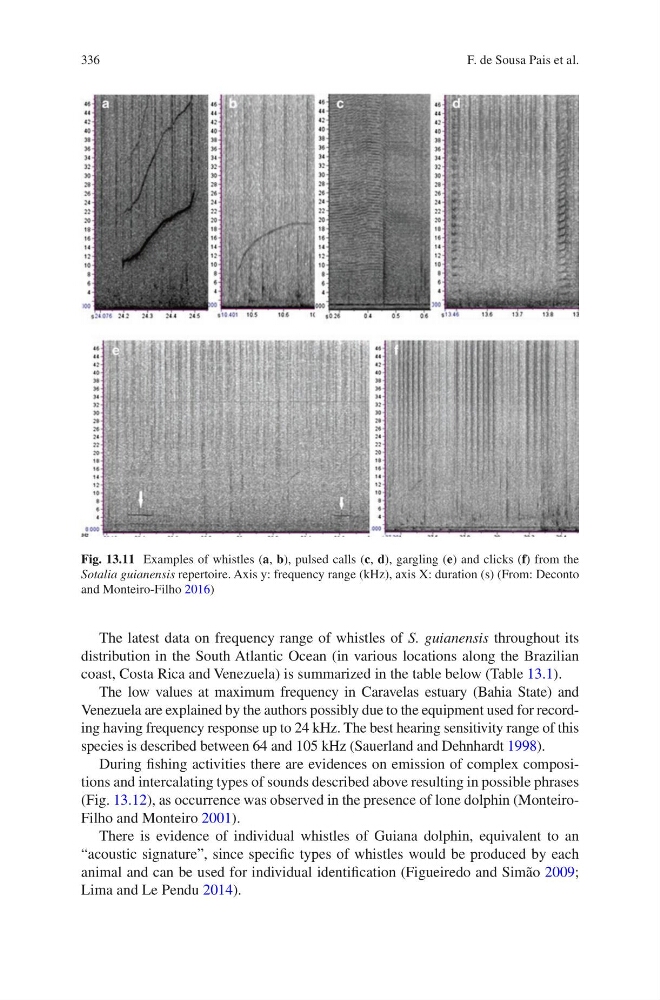
Fig. 13.11 Examples of whistles (a, b), pulsed calls (c, d), gargling (e) and clicks (f) from the
Sotalia guianensis repertoire. Axis y: frequency range (kHz), axis X: duration (s) (From: Deconto
and Monteiro-Filho 2016)
F. de Sousa Pais et al.
The latest data on frequency range of whistles of S. guianensis throughout its
distribution in the South Atlantic Ocean (in various locations along the Brazilian
coast, Costa Rica and Venezuela) is summarized in the table below (Table 13.1).
The low values at maximum frequency in Caravelas estuary (Bahia State) and
Venezuela are explained by the authors possibly due to the equipment used for recording having frequency response up to 24 kHz. The best hearing sensitivity range of this
species is described between 64 and 105 kHz (Sauerland and Dehnhardt 1998).
During fishing activities there are evidences on emission of complex compositions and intercalating types of sounds described above resulting in possible phrases
(Fig. 13.12), as occurrence was observed in the presence of lone dolphin (MonteiroFilho and Monteiro 2001).
There is evidence of individual whistles of Guiana dolphin, equivalent to an
“acoustic signature”, since specific types of whistles would be produced by each
animal and can be used for individual identification (Figueiredo and Simão 2009;
Lima and Le Pendu 2014).
Fig. 13.11 Examples of whistles (a, b), pulsed calls (c, d), gargling (e) and clicks (f) from the
Sotalia guianensis repertoire. Axis y: frequency range (kHz), axis X: duration (s) (From: Deconto
and Monteiro-Filho 2016)
F. de Sousa Pais et al.