

20
collections [Projeto Mamirauá (State of Amazonas), Museu Nacional (State of Rio
de Janeiro), Museu de Zoologia da USP (State of São Paulo), Museu de História
Natural da UNICAMP (State of São Paulo), Laboratório de Mamíferos Aquáticos
da UFSC (State of Santa Catarina)] besides the collection from Instituto de Pesquisas
Cananéia (IPeC), responsible for the “Projeto Boto-Cinza”. Besides the discussion
about the group systematics, the study points out to some other aspects. Specific
adaptive characteristics in skulls were linked to the difference in the environment as
well as different needs for each species. The authors discuss about differences in
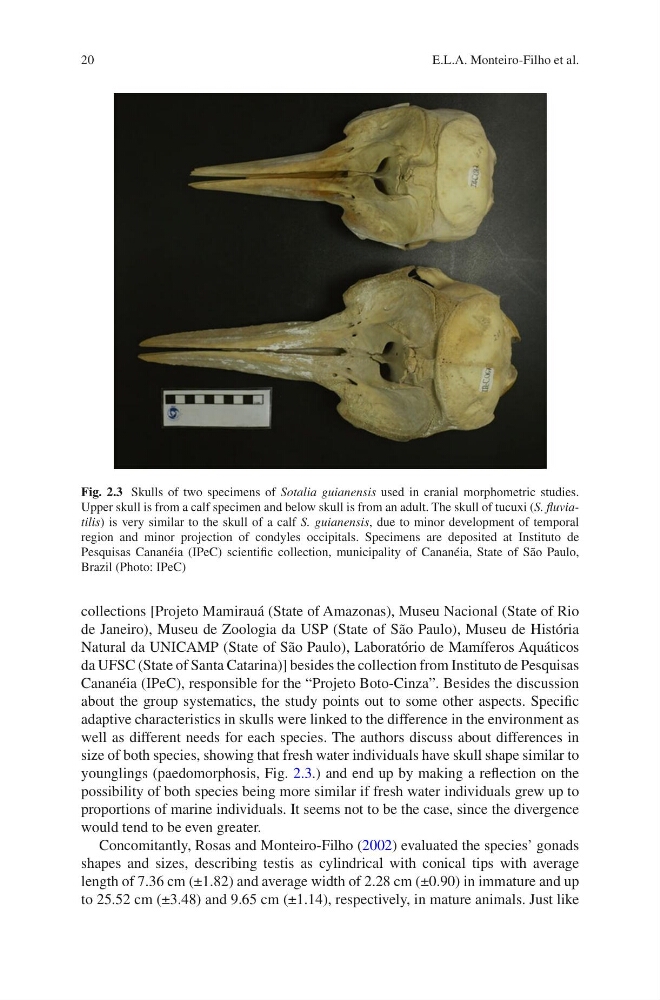
size of both species, showing that fresh water individuals have skull shape similar to
younglings (paedomorphosis, Fig. 2.3.) and end up by making a reflection on the
possibility of both species being more similar if fresh water individuals grew up to
proportions of marine individuals. It seems not to be the case, since the divergence
would tend to be even greater.
Concomitantly, Rosas and Monteiro-Filho (2002) evaluated the species’ gonads
shapes and sizes, describing testis as cylindrical with conical tips with average
length of 7.36 cm (±1.82) and average width of 2.28 cm (±0.90) in immature and up
to 25.52 cm (±3.48) and 9.65 cm (±1.14), respectively, in mature animals. Just like
Fig. 2.3 Skulls of two specimens of Sotalia guianensis used in cranial morphometric studies.
Upper skull is from a calf specimen and below skull is from an adult. The skull of tucuxi (S. fluviatilis) is very similar to the skull of a calf S. guianensis, due to minor development of temporal
region and minor projection of condyles occipitals. Specimens are deposited at Instituto de
Pesquisas Cananéia (IPeC) scientific collection, municipality of Cananéia, State of São Paulo,
Brazil (Photo: IPeC)
E.L.A. Monteiro-Filho et al.
collections [Projeto Mamirauá (State of Amazonas), Museu Nacional (State of Rio
de Janeiro), Museu de Zoologia da USP (State of São Paulo), Museu de História
Natural da UNICAMP (State of São Paulo), Laboratório de Mamíferos Aquáticos
da UFSC (State of Santa Catarina)] besides the collection from Instituto de Pesquisas
Cananéia (IPeC), responsible for the “Projeto Boto-Cinza”. Besides the discussion
about the group systematics, the study points out to some other aspects. Specific
adaptive characteristics in skulls were linked to the difference in the environment as
well as different needs for each species. The authors discuss about differences in
size of both species, showing that fresh water individuals have skull shape similar to
younglings (paedomorphosis, Fig. 2.3.) and end up by making a reflection on the
possibility of both species being more similar if fresh water individuals grew up to
proportions of marine individuals. It seems not to be the case, since the divergence
would tend to be even greater.
Concomitantly, Rosas and Monteiro-Filho (2002) evaluated the species’ gonads
shapes and sizes, describing testis as cylindrical with conical tips with average
length of 7.36 cm (±1.82) and average width of 2.28 cm (±0.90) in immature and up
to 25.52 cm (±3.48) and 9.65 cm (±1.14), respectively, in mature animals. Just like
Fig. 2.3 Skulls of two specimens of Sotalia guianensis used in cranial morphometric studies.
Upper skull is from a calf specimen and below skull is from an adult. The skull of tucuxi (S. fluviatilis) is very similar to the skull of a calf S. guianensis, due to minor development of temporal
region and minor projection of condyles occipitals. Specimens are deposited at Instituto de
Pesquisas Cananéia (IPeC) scientific collection, municipality of Cananéia, State of São Paulo,
Brazil (Photo: IPeC)
E.L.A. Monteiro-Filho et al.