

279
skull shape from animals from Brazil and those from Caribbean and Florida, indicating an urgent reassessment of species taxonomy.
In Colombia, Satizábal et al. (2012) tested the Male-biased dispersal (MBD)
hypothesis in the country’s rivers (Sinú, northern Magdalena, San Jorge, Ciénaga de
Paredes, Meta and Orinoco). D-loop analyses indicated high levels of structuring
between Sinú, San Jorge and Magdalena rivers, as also between Northern Magdalena
and Ciénaga de Paredes. Some evidence of structuring between the Orinoco and
Meta rivers was also observed, despite the small number of samples. Microsatellite
data suggested no structure. These results indicate male-biased gene flow dispersal
in manatees that inhabit Colombia rivers.
In Brazil, Luna et al. (2012) reported three haplotypes (M01, M03 and M04) for
the species, with only one (M01) recorded in animals from Ceará to Alagoas. The
authors indicated that rehabilitated calves from the states north of Ceará should not
be released in current release areas (Paraíba and Alagoas) due to risk of genetic
swamping. However, according to Santos et al. (2016), this is not a plausible explanation to restrict release sites in Brazil, since M04 differs from M01 by just one
mutation that can happen spontaneously in one generation.
Also in Brazil, in the east coast of Ceará and northwestern Rio Grande do Norte,
where a high frequency of newborn live calves strand in the country (Meirelles
2008; Parente et al. 2004; Silva 2010), Silva (2015) studied genetic structuring and
kinship between stranded manatees. There was no population structuring between
CE and RN. The majority of animals in which it was possible to define kinship had
some level of genetic kinship (34.4% of total). This is an indication of a small manatee population in the studied region.
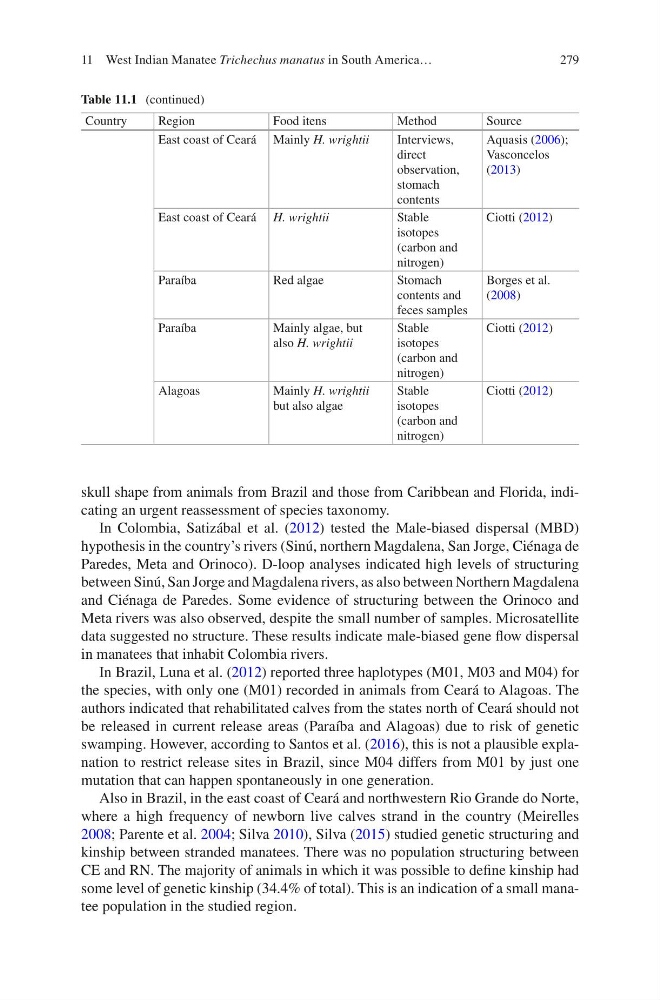
Table 11.1 (continued)
Country
Region
Food itens
Method
Source
East coast of Ceará Mainly H. wrightii
Interviews,
direct
observation,
stomach
contents
Aquasis (2006);
Vasconcelos
(2013)
East coast of Ceará H. wrightii
Stable
isotopes
(carbon and
nitrogen)
Ciotti (2012)
Paraíba
Red algae
Stomach
contents and
feces samples
Borges et al.
(2008)
Paraíba
Mainly algae, but
also H. wrightii
Stable
isotopes
(carbon and
nitrogen)
Ciotti (2012)
Alagoas
Mainly H. wrightii
but also algae
Stable
isotopes
(carbon and
nitrogen)
Ciotti (2012)
11 West Indian Manatee Trichechus manatus in South America…
skull shape from animals from Brazil and those from Caribbean and Florida, indicating an urgent reassessment of species taxonomy.
In Colombia, Satizábal et al. (2012) tested the Male-biased dispersal (MBD)
hypothesis in the country’s rivers (Sinú, northern Magdalena, San Jorge, Ciénaga de
Paredes, Meta and Orinoco). D-loop analyses indicated high levels of structuring
between Sinú, San Jorge and Magdalena rivers, as also between Northern Magdalena
and Ciénaga de Paredes. Some evidence of structuring between the Orinoco and
Meta rivers was also observed, despite the small number of samples. Microsatellite
data suggested no structure. These results indicate male-biased gene flow dispersal
in manatees that inhabit Colombia rivers.
In Brazil, Luna et al. (2012) reported three haplotypes (M01, M03 and M04) for
the species, with only one (M01) recorded in animals from Ceará to Alagoas. The
authors indicated that rehabilitated calves from the states north of Ceará should not
be released in current release areas (Paraíba and Alagoas) due to risk of genetic
swamping. However, according to Santos et al. (2016), this is not a plausible explanation to restrict release sites in Brazil, since M04 differs from M01 by just one
mutation that can happen spontaneously in one generation.
Also in Brazil, in the east coast of Ceará and northwestern Rio Grande do Norte,
where a high frequency of newborn live calves strand in the country (Meirelles
2008; Parente et al. 2004; Silva 2010), Silva (2015) studied genetic structuring and
kinship between stranded manatees. There was no population structuring between
CE and RN. The majority of animals in which it was possible to define kinship had
some level of genetic kinship (34.4% of total). This is an indication of a small manatee population in the studied region.
Table 11.1 (continued)
Country
Region
Food itens
Method
Source
East coast of Ceará Mainly H. wrightii
Interviews,
direct
observation,
stomach
contents
Aquasis (2006);
Vasconcelos
(2013)
East coast of Ceará H. wrightii
Stable
isotopes
(carbon and
nitrogen)
Ciotti (2012)
Paraíba
Red algae
Stomach
contents and
feces samples
Borges et al.
(2008)
Paraíba
Mainly algae, but
also H. wrightii
Stable
isotopes
(carbon and
nitrogen)
Ciotti (2012)
Alagoas
Mainly H. wrightii
but also algae
Stable
isotopes
(carbon and
nitrogen)
Ciotti (2012)
11 West Indian Manatee Trichechus manatus in South America…