

268
There is no recent effort to identify the species distribution in Guyana and almost
every report is related to the use of species to control aquatic vegetation. It seems
the species is still used in the country to control the aquatic vegetation in water bodies. The Botanical Gardens still maintains manatees in the waterways, and although
some articles (eg, Converse et al. 1994) indicated that the population that inhabits
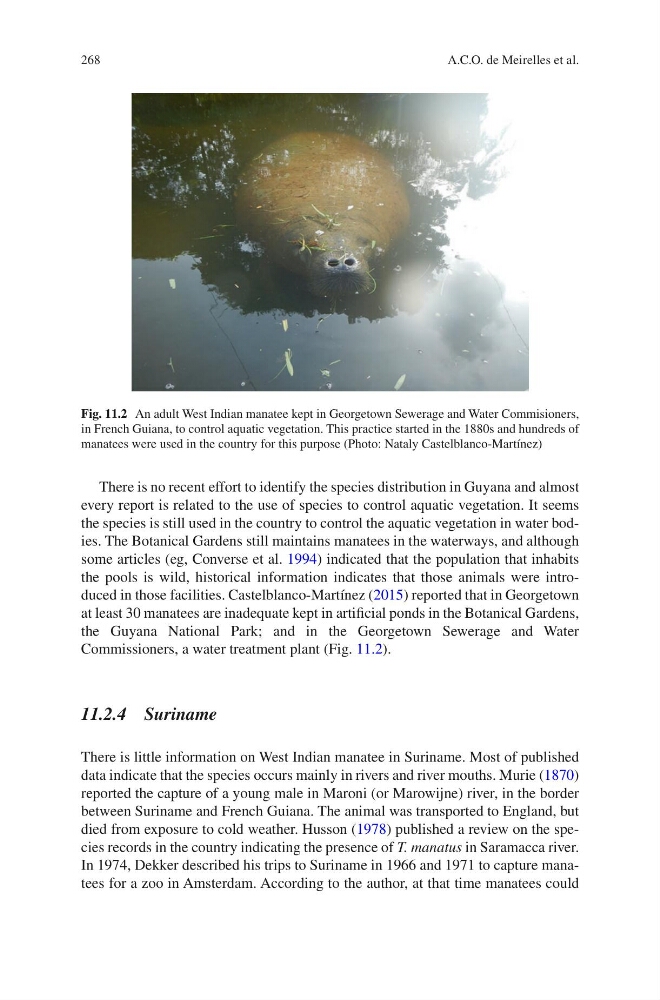
the pools is wild, historical information indicates that those animals were introduced in those facilities. Castelblanco-Martínez (2015) reported that in Georgetown
at least 30 manatees are inadequate kept in artificial ponds in the Botanical Gardens,
the Guyana National Park; and in the Georgetown Sewerage and Water
Commissioners, a water treatment plant (Fig. 11.2).
11.2.4 Suriname
There is little information on West Indian manatee in Suriname. Most of published
data indicate that the species occurs mainly in rivers and river mouths. Murie (1870)
reported the capture of a young male in Maroni (or Marowijne) river, in the border
between Suriname and French Guiana. The animal was transported to England, but
died from exposure to cold weather. Husson (1978) published a review on the species records in the country indicating the presence of T. manatus in Saramacca river.
In 1974, Dekker described his trips to Suriname in 1966 and 1971 to capture manatees for a zoo in Amsterdam. According to the author, at that time manatees could
Fig. 11.2 An adult West Indian manatee kept in Georgetown Sewerage and Water Commisioners,
in French Guiana, to control aquatic vegetation. This practice started in the 1880s and hundreds of
manatees were used in the country for this purpose (Photo: Nataly Castelblanco-Martínez)
A.C.O. de Meirelles et al.
There is no recent effort to identify the species distribution in Guyana and almost
every report is related to the use of species to control aquatic vegetation. It seems
the species is still used in the country to control the aquatic vegetation in water bodies. The Botanical Gardens still maintains manatees in the waterways, and although
some articles (eg, Converse et al. 1994) indicated that the population that inhabits
the pools is wild, historical information indicates that those animals were introduced in those facilities. Castelblanco-Martínez (2015) reported that in Georgetown
at least 30 manatees are inadequate kept in artificial ponds in the Botanical Gardens,
the Guyana National Park; and in the Georgetown Sewerage and Water
Commissioners, a water treatment plant (Fig. 11.2).
11.2.4 Suriname
There is little information on West Indian manatee in Suriname. Most of published
data indicate that the species occurs mainly in rivers and river mouths. Murie (1870)
reported the capture of a young male in Maroni (or Marowijne) river, in the border
between Suriname and French Guiana. The animal was transported to England, but
died from exposure to cold weather. Husson (1978) published a review on the species records in the country indicating the presence of T. manatus in Saramacca river.
In 1974, Dekker described his trips to Suriname in 1966 and 1971 to capture manatees for a zoo in Amsterdam. According to the author, at that time manatees could
Fig. 11.2 An adult West Indian manatee kept in Georgetown Sewerage and Water Commisioners,
in French Guiana, to control aquatic vegetation. This practice started in the 1880s and hundreds of
manatees were used in the country for this purpose (Photo: Nataly Castelblanco-Martínez)
A.C.O. de Meirelles et al.