

265
America, this tool is already being used in some countries, with encouraging results
(eg, Colombia, Arévalo-González et al. 2014; Arévalo-González and CastelblancoMartínez 2015; Brazil, Choi-Lima et al. 2014; FMA 2015).
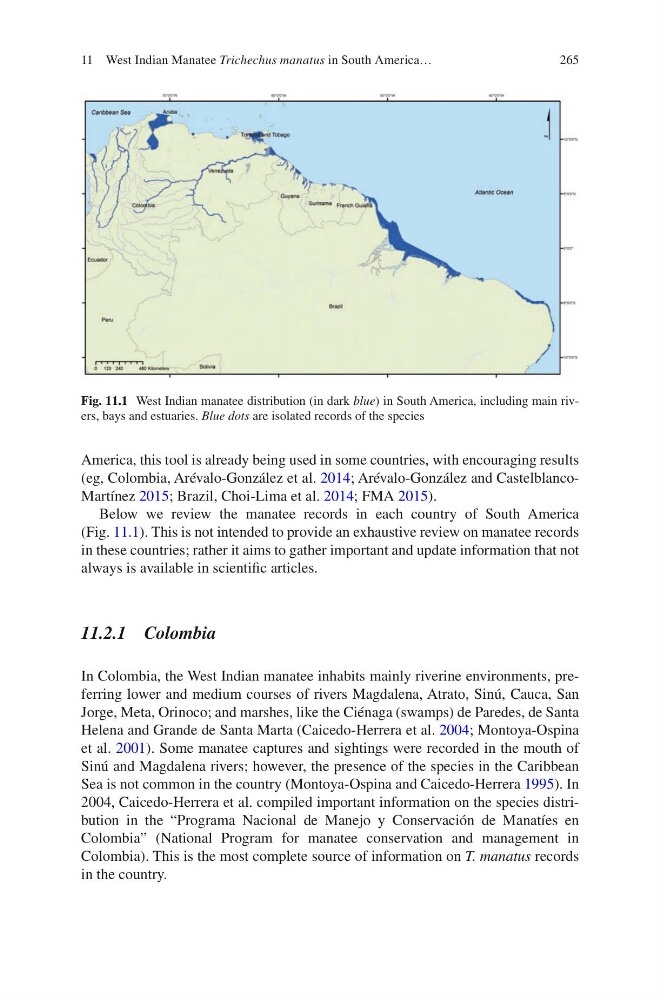
Below we review the manatee records in each country of South America
(Fig. 11.1). This is not intended to provide an exhaustive review on manatee records
in these countries; rather it aims to gather important and update information that not
always is available in scientific articles.
11.2.1 Colombia
In Colombia, the West Indian manatee inhabits mainly riverine environments, preferring lower and medium courses of rivers Magdalena, Atrato, Sinú, Cauca, San
Jorge, Meta, Orinoco; and marshes, like the Ciénaga (swamps) de Paredes, de Santa
Helena and Grande de Santa Marta (Caicedo-Herrera et al. 2004; Montoya-Ospina
et al. 2001). Some manatee captures and sightings were recorded in the mouth of
Sinú and Magdalena rivers; however, the presence of the species in the Caribbean
Sea is not common in the country (Montoya-Ospina and Caicedo-Herrera 1995). In
2004, Caicedo-Herrera et al. compiled important information on the species distribution in the “Programa Nacional de Manejo y Conservación de Manatíes en
Colombia” (National Program for manatee conservation and management in
Colombia). This is the most complete source of information on T. manatus records
in the country.
Fig. 11.1 West Indian manatee distribution (in dark blue) in South America, including main rivers, bays and estuaries. Blue dots are isolated records of the species
11 West Indian Manatee Trichechus manatus in South America…
America, this tool is already being used in some countries, with encouraging results
(eg, Colombia, Arévalo-González et al. 2014; Arévalo-González and CastelblancoMartínez 2015; Brazil, Choi-Lima et al. 2014; FMA 2015).
Below we review the manatee records in each country of South America
(Fig. 11.1). This is not intended to provide an exhaustive review on manatee records
in these countries; rather it aims to gather important and update information that not
always is available in scientific articles.
11.2.1 Colombia
In Colombia, the West Indian manatee inhabits mainly riverine environments, preferring lower and medium courses of rivers Magdalena, Atrato, Sinú, Cauca, San
Jorge, Meta, Orinoco; and marshes, like the Ciénaga (swamps) de Paredes, de Santa
Helena and Grande de Santa Marta (Caicedo-Herrera et al. 2004; Montoya-Ospina
et al. 2001). Some manatee captures and sightings were recorded in the mouth of
Sinú and Magdalena rivers; however, the presence of the species in the Caribbean
Sea is not common in the country (Montoya-Ospina and Caicedo-Herrera 1995). In
2004, Caicedo-Herrera et al. compiled important information on the species distribution in the “Programa Nacional de Manejo y Conservación de Manatíes en
Colombia” (National Program for manatee conservation and management in
Colombia). This is the most complete source of information on T. manatus records
in the country.
Fig. 11.1 West Indian manatee distribution (in dark blue) in South America, including main rivers, bays and estuaries. Blue dots are isolated records of the species
11 West Indian Manatee Trichechus manatus in South America…