

223
Furthermore, the values of marine primary producers vary depending on a number
of factors including the photosynthetic route, taxonomic differences in isotopic
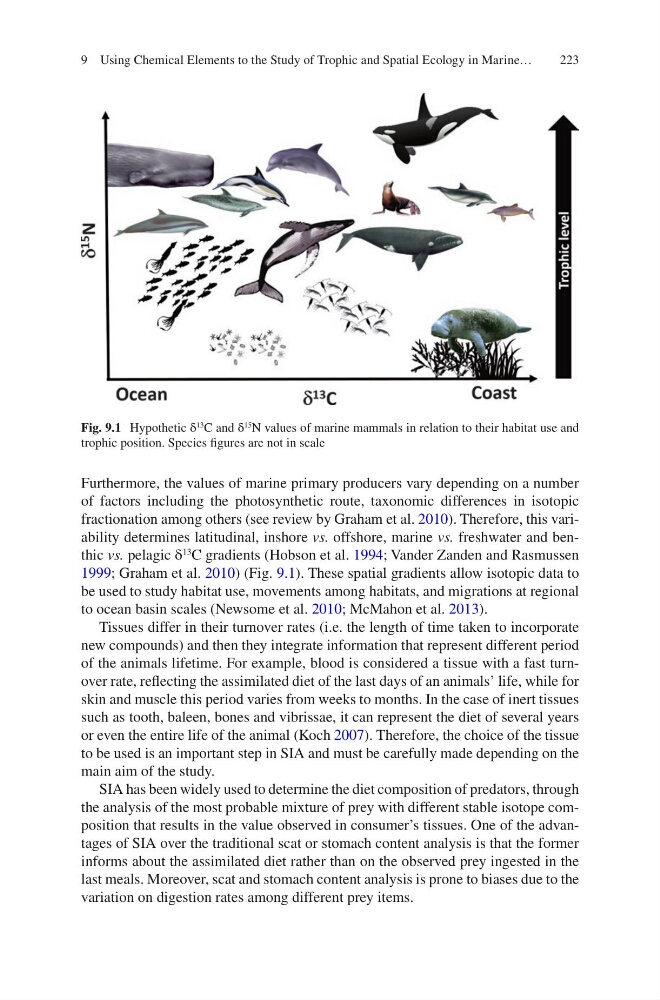
fractionation among others (see review by Graham et al. 2010). Therefore, this variability determines latitudinal, inshore vs. offshore, marine vs. freshwater and benthic vs. pelagic δ
13
C gradients (Hobson et al. 1994; Vander Zanden and Rasmussen
1999; Graham et al. 2010) (Fig. 9.1). These spatial gradients allow isotopic data to
be used to study habitat use, movements among habitats, and migrations at regional
to ocean basin scales (Newsome et al. 2010; McMahon et al. 2013).
Tissues differ in their turnover rates (i.e. the length of time taken to incorporate
new compounds) and then they integrate information that represent different period
of the animals lifetime. For example, blood is considered a tissue with a fast turnover rate, reflecting the assimilated diet of the last days of an animals’ life, while for
skin and muscle this period varies from weeks to months. In the case of inert tissues
such as tooth, baleen, bones and vibrissae, it can represent the diet of several years
or even the entire life of the animal (Koch 2007). Therefore, the choice of the tissue
to be used is an important step in SIA and must be carefully made depending on the
main aim of the study.
SIA has been widely used to determine the diet composition of predators, through
the analysis of the most probable mixture of prey with different stable isotope composition that results in the value observed in consumer’s tissues. One of the advantages of SIA over the traditional scat or stomach content analysis is that the former
informs about the assimilated diet rather than on the observed prey ingested in the
last meals. Moreover, scat and stomach content analysis is prone to biases due to the
variation on digestion rates among different prey items.
Fig. 9.1 Hypothetic δ
13 C and δ
15
N values of marine mammals in relation to their habitat use and
trophic position. Species figures are not in scale
9 Using Chemical Elements to the Study of Trophic and Spatial Ecology in Marine…
Furthermore, the values of marine primary producers vary depending on a number
of factors including the photosynthetic route, taxonomic differences in isotopic
fractionation among others (see review by Graham et al. 2010). Therefore, this variability determines latitudinal, inshore vs. offshore, marine vs. freshwater and benthic vs. pelagic δ
13
C gradients (Hobson et al. 1994; Vander Zanden and Rasmussen
1999; Graham et al. 2010) (Fig. 9.1). These spatial gradients allow isotopic data to
be used to study habitat use, movements among habitats, and migrations at regional
to ocean basin scales (Newsome et al. 2010; McMahon et al. 2013).
Tissues differ in their turnover rates (i.e. the length of time taken to incorporate
new compounds) and then they integrate information that represent different period
of the animals lifetime. For example, blood is considered a tissue with a fast turnover rate, reflecting the assimilated diet of the last days of an animals’ life, while for
skin and muscle this period varies from weeks to months. In the case of inert tissues
such as tooth, baleen, bones and vibrissae, it can represent the diet of several years
or even the entire life of the animal (Koch 2007). Therefore, the choice of the tissue
to be used is an important step in SIA and must be carefully made depending on the
main aim of the study.
SIA has been widely used to determine the diet composition of predators, through
the analysis of the most probable mixture of prey with different stable isotope composition that results in the value observed in consumer’s tissues. One of the advantages of SIA over the traditional scat or stomach content analysis is that the former
informs about the assimilated diet rather than on the observed prey ingested in the
last meals. Moreover, scat and stomach content analysis is prone to biases due to the
variation on digestion rates among different prey items.
Fig. 9.1 Hypothetic δ
13 C and δ
15
N values of marine mammals in relation to their habitat use and
trophic position. Species figures are not in scale
9 Using Chemical Elements to the Study of Trophic and Spatial Ecology in Marine…