

205
but in the south limit of the study area, next to Barra Grande (14° 53′S; 38° 15′W).
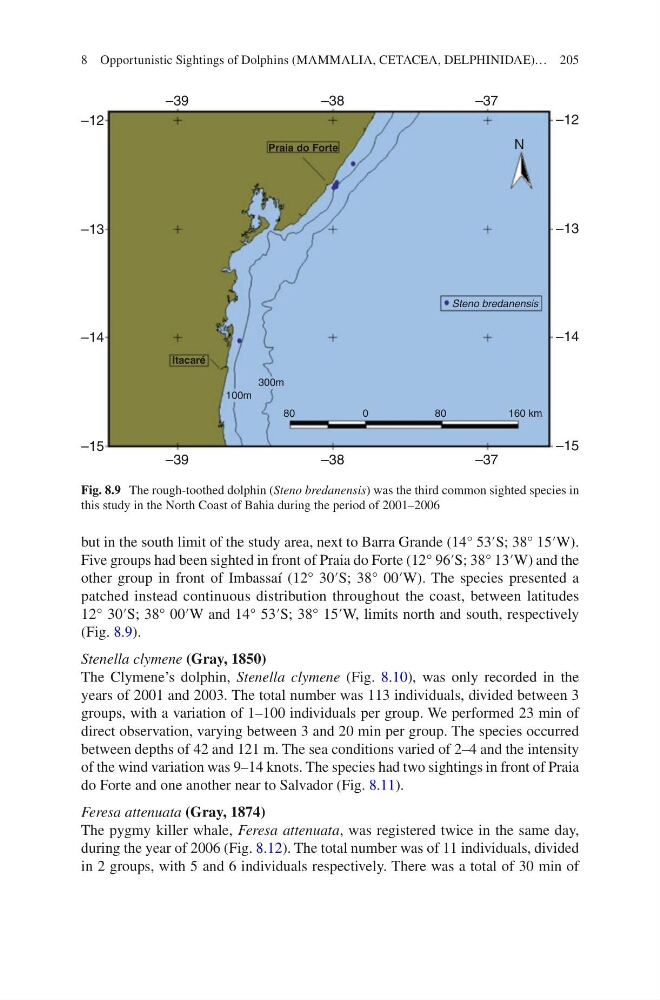
Five groups had been sighted in front of Praia do Forte (12° 96′S; 38° 13′W) and the
other group in front of Imbassaí (12° 30′S; 38° 00′W). The species presented a
patched instead continuous distribution throughout the coast, between latitudes
12° 30′S; 38° 00′W and 14° 53′S; 38° 15′W, limits north and south, respectively
(Fig. 8.9).
Stenella clymene (Gray, 1850)
The Clymene’s dolphin, Stenella clymene (Fig. 8.10), was only recorded in the
years of 2001 and 2003. The total number was 113 individuals, divided between 3
groups, with a variation of 1–100 individuals per group. We performed 23 min of
direct observation, varying between 3 and 20 min per group. The species occurred
between depths of 42 and 121 m. The sea conditions varied of 2–4 and the intensity
of the wind variation was 9–14 knots. The species had two sightings in front of Praia
do Forte and one another near to Salvador (Fig. 8.11).
Feresa attenuata (Gray, 1874)
The pygmy killer whale, Feresa attenuata, was registered twice in the same day,
during the year of 2006 (Fig. 8.12). The total number was of 11 individuals, divided
in 2 groups, with 5 and 6 individuals respectively. There was a total of 30 min of
–12
–13
–14
–15
–12
–13
–14
–15
–39
–38
–37
–39
–38
–37
N
80
80
160 km
0
100m
300m
Praia do Forte
Itacaré
Steno bredanensis
Fig. 8.9 The rough-toothed dolphin (Steno bredanensis) was the third common sighted species in
this study in the North Coast of Bahia during the period of 2001–2006
8 Opportunistic Sightings of Dolphins (MAMMALIA, CETACEA, DELPHINIDAE)…
but in the south limit of the study area, next to Barra Grande (14° 53′S; 38° 15′W).
Five groups had been sighted in front of Praia do Forte (12° 96′S; 38° 13′W) and the
other group in front of Imbassaí (12° 30′S; 38° 00′W). The species presented a
patched instead continuous distribution throughout the coast, between latitudes
12° 30′S; 38° 00′W and 14° 53′S; 38° 15′W, limits north and south, respectively
(Fig. 8.9).
Stenella clymene (Gray, 1850)
The Clymene’s dolphin, Stenella clymene (Fig. 8.10), was only recorded in the
years of 2001 and 2003. The total number was 113 individuals, divided between 3
groups, with a variation of 1–100 individuals per group. We performed 23 min of
direct observation, varying between 3 and 20 min per group. The species occurred
between depths of 42 and 121 m. The sea conditions varied of 2–4 and the intensity
of the wind variation was 9–14 knots. The species had two sightings in front of Praia
do Forte and one another near to Salvador (Fig. 8.11).
Feresa attenuata (Gray, 1874)
The pygmy killer whale, Feresa attenuata, was registered twice in the same day,
during the year of 2006 (Fig. 8.12). The total number was of 11 individuals, divided
in 2 groups, with 5 and 6 individuals respectively. There was a total of 30 min of
–12
–13
–14
–15
–12
–13
–14
–15
–39
–38
–37
–39
–38
–37
N
80
80
160 km
0
100m
300m
Praia do Forte
Itacaré
Steno bredanensis
Fig. 8.9 The rough-toothed dolphin (Steno bredanensis) was the third common sighted species in
this study in the North Coast of Bahia during the period of 2001–2006
8 Opportunistic Sightings of Dolphins (MAMMALIA, CETACEA, DELPHINIDAE)…